Grain-free Baked tiramisu
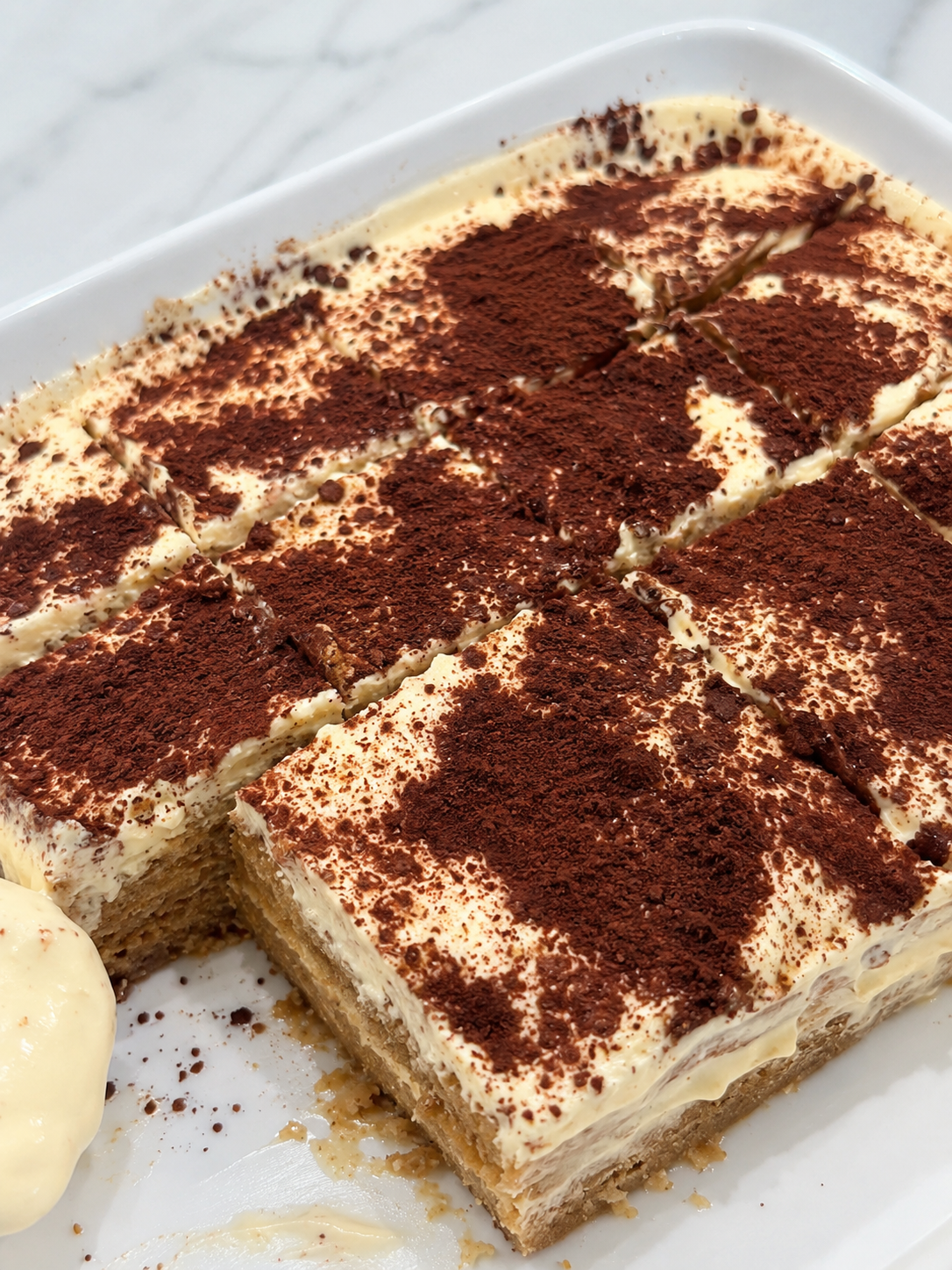
Almond-arrowroot sponge cake, mascarpone-egg cream filling, traditional Italian architecture — baked in 8 mason jars or layered in a 9×13 pan
The grain-free version of traditional Italian tiramisu — an actual baked sponge cake (almond flour + arrowroot + whipped eggs + coconut sugar), the classic mascarpone-and-egg-yolk filling, soaked with cold-brewed espresso, and dusted with raw cacao. This is the structurally closest grain-free version to authentic tiramisu — the technique and architecture are preserved, with refined wheat and refined sugar swapped for almond flour, arrowroot, and coconut sugar.
Yield: 8 individual mason jars (8 oz each) OR one 9×13 pan (12–16 squares)
Active: 45 min · Total: 1 hr 30 min + overnight refrigeration ·
A note from the kitchen
This is what tiramisu becomes when you remove the refined wheat and refined sugar but keep everything else that makes tiramisu actually tiramisu — the baked sponge, the cooked egg-yolk-mascarpone cream, the cold-brew espresso soak, the cacao dusting on top. For a no-baked version, see the accompanying raw Tiramisu version recipe.
Ingredients
For the sponge cake (savoiardi-style):
4 large pasture-raised eggs, separated
5 tbsp coconut sugar, divided (2 tbsp for whites, 3 tbsp for yolks)
⅔ cup arrowroot powder
⅓ cup blanched almond flour
⅛ tsp sea salt
⅛ tsp baking soda
2 tbsp grass-fed butter, melted (or unrefined coconut oil)
1 tsp pure vanilla extract
For the mascarpone-coffee cream filling:
8 large pasture-raised egg yolks
6 tbsp coconut sugar (or 4 tbsp pure maple syrup for a less granular finish)
16 oz grass-fed mascarpone, softened to room temperature
1½ cups raw heavy cream from grass-fed cows (or minimally-pasteurized grass-fed)
2 tsp pure vanilla extract
Pinch sea salt
For the espresso soak:
½ cup cold-brewed coffee (or 1 oz strong brewed espresso diluted with 3 oz filtered water, cooled)
1 tbsp pure maple syrup (optional — for a slightly sweetened soak)
For finishing:
2 tbsp raw cacao powder, for dusting (essential — the structural visual signature)
Optional: 2 tbsp shaved 70%+ dark chocolate
Optional: whole coffee beans for decorative garnish
Method
Make the sponge cake
Preheat the oven to 350°F.
Separate the eggs carefully. Place the whites in a medium clean, dry bowl (any yolk residue prevents the whites from whipping properly). Place the yolks in a larger bowl.
Whip the egg whites. Using a stand mixer or hand mixer, beat the whites on medium speed until foamy. Add 2 tbsp of the coconut sugar and continue whipping until shiny soft peaks form (about 2–3 minutes). Set aside.
Whip the egg yolks. To the bowl of yolks, add the remaining 3 tbsp coconut sugar. Beat on medium-high speed 3–4 minutes until pale yellow, thick, and ribbon-like when lifted with the whisk. Beat in the melted butter and vanilla until smooth.
Combine the dry ingredients. In a small bowl, whisk together the arrowroot powder, almond flour, sea salt, and baking soda.
Fold dry into yolks. Add the dry ingredients to the yolk mixture and stir gently but thoroughly. The mixture will be very thick and sticky — this is correct.
Fold in the egg whites. Add about ⅓ of the whipped whites to the yolk mixture first to lighten it (this makes folding easier). Then gently fold in the remaining whites in two batches, using a silicone spatula and a careful folding motion. Don't deflate the whites — you want the airy structure to hold.
Bake.
For mason jars: Fill each 8-oz jar about ¼ full with batter (ungreased; the sponge releases naturally). Place jars on a baking sheet and bake 20–25 minutes until golden brown and a toothpick comes out clean.
For a 9×13 pan: Line the pan with parchment paper. Spread the batter evenly. Bake 18–22 minutes until golden brown and a toothpick comes out clean.
Cool completely. Cool the sponge in the pan (or jars) for at least 30 minutes before assembling. Warm sponge will melt the cream layer.
Make the mascarpone-coffee cream filling
Option to temper or leave raw. Traditional Italian tiramisu uses raw egg yolks. For the tempered method, follow the next two steps. For the traditional Italian raw-yolk method, skip ahead to "Whip the cream" and add the yolks directly to the mascarpone mixture at the end. Both produce excellent results — the tempered version is slightly thicker; the raw version is silkier.
Set up a double boiler. Bring 1 inch of water to a gentle simmer in a small saucepan. Place a heatproof bowl on top (make sure the bottom doesn't touch the water). In the heatproof bowl, whisk together the 8 egg yolks and 3 tbsp of the coconut sugar (or 2 tbsp of the maple syrup) constantly over the gently simmering water. Continue whisking 4–5 minutes until the yolks reach 160°F (use a thermometer to verify) and become pale, thick, and ribbon-like. Don't stop whisking — the goal is gentle heating, not scrambling.
Cool the yolks. Remove the bowl from the heat. Whisk for another minute to cool slightly. (Optional: place the bowl in a sink with cool water for faster cooling.)
Whip the cream. In a separate bowl, beat the raw heavy cream with the remaining 3 tbsp coconut sugar (or 2 tbsp maple syrup) and vanilla on medium-high speed until soft peaks form (about 3–4 minutes). Don't overwhip — you want soft peaks, not stiff.
Combine with mascarpone. Gently fold the softened mascarpone into the whipped cream until just combined. The mixture should be smooth and slightly thick. Don't use a stand mixer for this step — overmixing will break the mascarpone fat.
Fold in the cooled egg yolks. Add the cooled tempered yolks to the mascarpone-cream mixture and gently fold to combine. The cream should be silky, glossy, and pourable but firm enough to hold its shape.
Assemble
Prepare the espresso soak. In a small bowl, combine the cold-brewed coffee and optional maple syrup.
Soak the sponge.
For mason jars: Drizzle 1–2 tbsp of espresso soak over the cooled sponge in each jar. Use a toothpick to poke small holes if it's not absorbing easily.
For the 9×13 pan: Cut the cooled sponge crosswise into two thin layers using a long serrated knife. Brush each layer generously with espresso soak.
Layer the cream.
For mason jars: Spoon the mascarpone-coffee cream on top of the soaked sponge, filling to just below the jar rim.
For the 9×13 pan: Place the first sponge layer (espresso-soaked) in the bottom of a clean pan. Spread ½ of the cream evenly over it. Top with the second sponge layer (espresso-soaked). Spread the remaining cream evenly over the top.
Dust with cacao. Using a fine-mesh strainer, dust the top of each jar (or the entire pan) generously with raw cacao powder. Important: Apply the dusting before refrigeration — it will absorb moisture overnight and settle beautifully into the cream.
Refrigerate overnight. Cover with lids (mason jars) or plastic wrap (pan). Refrigerate at least 6 hours, ideally overnight (12–18 hours). The flavor improves significantly overnight as the espresso soaks deeper and the layers integrate.
Garnish and serve
Just before serving, optionally top with shaved dark chocolate or a whole coffee bean. The mason jars are served as is; the 9×13 pan is sliced into 12–16 squares with a sharp knife (wiped clean between cuts).
Variations
Coconut sugar–free version (with maple syrup): Substitute all the coconut sugar with pure maple syrup at a 2:3 ratio (2 tbsp maple = 3 tbsp coconut sugar). The texture will be slightly more tender; flavor will be less granular and slightly more caramel-forward. Beautiful for those who prefer maple over coconut sugar.
Dairy-free version: Replace the mascarpone with full-fat coconut cream (1 can, refrigerated overnight, thick portion scooped). Replace the raw heavy cream with whipped chilled coconut cream. The result is a slightly more tropical-leaning tiramisu with all the same structural integrity. (Note: the resulting cream sets softer than the dairy version.)
Cocoa-chocolate version: Add 2 tbsp raw cacao powder to the sponge cake batter (folded in with the dry ingredients). Also dust generously with cacao between layers, not just on top. Beautiful for a deeper chocolate-coffee profile.
Hazelnut variation: Substitute the almond flour with hazelnut flour (or use a 50/50 mix). Top the finished tiramisu with toasted chopped hazelnuts. Classic Italian gianduja-meets-tiramisu profile.
Spiced winter variation (autumn-winter): Add 1 tsp Ceylon cinnamon and ¼ tsp ground cardamom to the sponge cake batter. Add a pinch of cinnamon to the espresso soak. Beautiful for cold-weather entertaining.
Espresso intensified version: Increase the espresso soak to ¾ cup. Add 1 tsp instant espresso powder to the mascarpone cream filling. For readers who want a stronger coffee profile.
Cake format (9×13 layered): Make a sheet sponge instead of mason jars. Cut crosswise into two thin layers, soak each, and stack with cream between for a more traditional layered tiramisu cake. Slice into 12–16 squares.
Mini ramekin format: Bake the sponge in 4-oz ramekins or small bowls. Layer cream on top within each ramekin. Beautiful for dinner-party plated dessert.
Sourcing
Pasture-raised eggs:
"Pasture-raised," not "free-range" or "cage-free."
Deep orange yolks — the visual indicator that the hens foraged on real pasture.
From a local farmer at the farmers' market when possible.
Recently laid (within 2 weeks).
For raw-yolk tiramisu specifically, source from a farm you know personally where the chickens are healthy and the eggs are very fresh.
Grass-fed mascarpone:
Real Italian mascarpone is structurally just thickened fresh cream — about 75% fat, with the unctuous texture that defines Italian dessert tradition.
From cows on pasture year-round when possible. Italian mascarpone DOP-quality from small Lombardy producers is the gold standard when available.
The shortest possible ingredient list — ideally just cream and citric acid (used to thicken). Avoid mascarpone with gums, stabilizers, "natural flavors," or modified starches.
Full-fat (never low-fat or reduced-fat versions — they won't set properly).
Should be smooth, ivory-white, and slightly sweet-smelling (never sour or tangy — that's cream cheese, not mascarpone).
From a specialty Italian grocer, cheesemonger, or small local creamery when possible.
Bring to room temperature 30 minutes before mixing for best texture.
Raw heavy cream:
From cows on pasture year-round when legally available. State-by-state legal availability varies; check realmilk.com.
If unavailable, minimally-pasteurized full-fat heavy cream from grass-fed cows.
The shortest possible ingredient list — ideally just cream.
Avoid ultra-pasteurized cream entirely (which has had its raw enzymes and Wulzen factor destroyed).
Deep cream-yellow color is the visual indicator of grass-fed source dairy.
Grass-fed butter:
From cows on pasture year-round when possible.
Cultured butter (fermented before churning) for the deepest flavor.
Deep yellow color — the visual indicator of grass-fed dairy.
Organic when available.
Blanched almond flour:
Finely-ground blanched (skins removed) — not almond meal, which is coarser and contains the skins.
100% almonds as the only ingredient.
Organic when possible.
Recently milled — almond flour goes rancid quickly. Should smell sweet and faintly nutty, never musty.
Stored in the refrigerator or freezer once opened.
Arrowroot powder:
100% arrowroot — the only ingredient on the label should be "arrowroot powder."
Organic when possible.
Single-source from Caribbean/South American arrowroot producers when available.
Stored cool in a sealed glass container.
Coconut sugar:
100% coconut sugar — the only ingredient should be coconut sugar (from coconut palm sap).
Organic when possible.
Single-origin when available.
Avoid coconut sugar blended with cane sugar or other sweeteners.
Pure maple syrup (alternative sweetener):
Grade A Dark Robust (formerly called "Grade B") for deeper, more caramelized flavor.
From small-batch producers in Vermont, New Hampshire, Maine, Quebec, or Ontario.
100% maple — the only ingredient should be maple.
In a glass bottle.
Pure vanilla extract:
100% vanilla extract from real vanilla beans (Madagascar, Tahitian, or Mexican).
The ingredient list should be: vanilla beans, alcohol, water. Nothing else.
Avoid "imitation vanilla" or "vanilla flavoring" — typically synthetic vanillin from wood pulp.
Cold-brewed coffee / espresso:
100% pure ground coffee — no sweeteners, no additives.
Single-origin from a small specialty roaster when possible (significantly more flavor depth than commodity supermarket coffee).
Organic, mold-tested when possible (some coffee carries ochratoxin levels worth being aware of).
For cold-brewed coffee: brew at 1:8 ratio (coffee to filtered water) for 12–18 hours at room temperature, then strain. Or use 1 oz strong espresso diluted with 3 oz filtered water.
Raw cacao powder:
Raw or low-temperature processed (under 115°F) — preserves the antioxidants, polyphenols, and minerals that conventional cocoa powder loses through heat processing.
100% cacao — the only ingredient should be cacao.
Organic, fair-trade, single-origin when possible.
Stored cool in a sealed glass container.
Dark chocolate (for variations and shaved garnish):
70%+ cacao.
Single-origin or fair-trade.
Ingredient list should be: cacao mass, cacao butter, sugar (preferably coconut sugar). The shorter the list, the better.
Avoid chocolate with soy lecithin, dairy emulsifiers, or "natural flavors."
Sea salt:
Baja Gold mineral sea salt (third-party tested at 29.5–31.5% sodium, harvested from the Sea of Cortez, solar-dried) or any equivalent unrefined mineral-rich sea salt for the recipe.
Fleur de sel for finishing if desired.
Storage
Refrigerator: Up to 5 days in mason jars with lids, or sealed in a glass container. The flavor genuinely improves over the first 2–3 days as the espresso soaks deeper and the cream integrates with the sponge.
Freezer: Up to 1 month. Mason jars freeze beautifully; the 9×13 pan can be sliced into individual squares, wrapped in parchment, and frozen. Thaw overnight in the refrigerator before serving.
Best eaten: Day 2 or day 3 after assembly — when the flavors have integrated. Day 1 is good; day 2-3 is when this tiramisu reaches its peak.
For batch cooking: A beautiful Sunday-afternoon project that produces a week of dessert. The 8 mason jars are perfect for individual portioning; pull one from the fridge each day.
For gifting: A set of 4 mason jars makes a beautiful real-food gift, tied with twine and labeled by date. Or wrap the 9×13 pan whole in cellophane with a serving spoon for a dinner-party host gift.
Nourishment Notes
This baked grain-free tiramisu walks the architecture of authentic Italian tiramisu forward — substituting refined wheat with almond flour and arrowroot (the only grain-free flour pair that produces a true sponge-like texture), and replacing refined white sugar with coconut sugar (or pure maple syrup). Every other structural element of traditional Italian tiramisu is preserved: the separated-egg sponge technique, the cooked egg-yolk-mascarpone cream, the cold-brew espresso soak, the raw cacao dusting.
Pasture-raised eggs are the structural foundation of both the sponge and the cream. The yolks deliver complete protein, fat-soluble vitamins A, D, E, and K2, choline, lecithin (which acts as the structural emulsifier in the cream filling), and the deep orange color that distinguishes real pasture-raised eggs from confined-feedlot eggs. The whites whipped to soft peaks create the airy structure of the sponge cake — a technique that has anchored Italian baking for centuries. Twelve eggs total (4 for sponge + 8 yolks for cream) means a single serving delivers meaningful complete protein alongside the indulgence — closer to a substantial brunch dish than a pure dessert.
Grass-fed mascarpone delivers calcium, fat-soluble vitamins A, D, and K2, and the live bacterial cultures of fresh dairy. Real mascarpone is just thickened fresh cream — about 75% fat — produced by acidifying cream with citric acid and straining. The unctuous texture that defines Italian dessert tradition comes from this fat content; low-fat mascarpone is structurally incapable of producing the silky cream filling that defines tiramisu. Raw, grass-fed heavy cream carries additional fat-soluble vitamins, butyrate, and the Wulzen factor — the anti-stiffness compound destroyed by pasteurization, present only in raw dairy from cows grazed on real pasture.
Almond flour brings vitamin E, magnesium, and monounsaturated fats with cake-like structural integrity, but without grains or refined flour. Blanched almond flour (skins removed) is the structural choice — almond meal would produce a coarser, oilier sponge. Arrowroot powder is the binding element that gives the sponge cake its airy, springy texture — derived from the rhizomes of the Maranta arundinacea plant, used for centuries as a digestion-supportive starch. Together, almond flour + arrowroot produce the structurally closest grain-free approximation of a traditional savoiardi sponge.
Coconut sugar contributes a slightly lower glycemic response than refined cane sugar (about 35-45 GI vs. 60-65 for white sugar), inulin (a prebiotic fiber that supports gut bacteria), and a subtle caramel-malty flavor profile that aligns beautifully with coffee and cacao. Pure maple syrup (in the maple-sweetened variation) contributes manganese and zinc with an even gentler glycemic curve than coconut sugar, plus the slow-burning complexity of real Vermont/Quebec sugaring tradition.
Coffee and espresso deliver chlorogenic acids and a gentle thermogenic stimulant lift alongside meaningful polyphenols. The caffeine content is real (about 60mg per shot of espresso) — circadian timing matters. Eaten in the afternoon with the Italian tradition, the espresso content is genuinely modest and rarely interferes with sleep. Eaten after dinner, particularly for caffeine-sensitive individuals, the same dose can disrupt sleep architecture.
Raw cacao powder in the dusting brings flavanols, theobromine, magnesium, and iron — compounds with documented effects on circulation, focus, and mood. Theobromine produces a slow, sustained cardiovascular opening that feels different from caffeine's sharper edge. The combination of theobromine and caffeine has been studied for cognitive performance, mood elevation, and metabolic support. Raw cacao carries one of the highest antioxidant loads measured in any common food.
Pairs Well With
For the afternoon: A small espresso, a strong pour-over coffee, or a cup of black tea. The caffeine pairing is structural and traditional — Italian tiramisu has always been an afternoon dessert paired with coffee, not an after-dinner sweet. The combination of coffee's caffeine, cacao's theobromine, and the substantial fat content makes a small jar deeply satisfying and gently energizing — exactly the “pick me up” the original Italian name promises.
For an Italian-inspired dinner: Serve a small portion at the end of a Mediterranean dinner — alongside fresh berries (in summer), poached pears (in autumn), or sliced citrus (in winter). The bright fruit cuts the richness of the mascarpone cream beautifully.
For dinner parties and retreats: The mason jar format is genuinely the most elegant for a dinner party — individual portions, no slicing required, beautiful in clear glass. Each jar can be served with a small spoon, garnished with a whole coffee bean and a final dusting of cacao right before serving.
For brunch: This tiramisu reads beautifully on a brunch table — the substantial protein from 12 eggs makes it more breakfast-substantial than a typical dessert. Serve alongside fresh fruit, espresso, and a small cheese board for a Sunday brunch.
For circadian alignment: Best eaten midday or early afternoon — the espresso load metabolizes most cleanly during daylight hours.
Why This Dessert
Real Italian tiramisu doesn't need refined wheat or refined sugar. Real tiramisu comes from real pasture-raised eggs (separated, whipped, tempered), real grass-fed mascarpone (with the rich fat content that defines Italian dessert tradition), real raw heavy cream (with the live enzymes and fat-soluble vitamins of grass-fed pasture dairy), real cold-brewed coffee (from beans that were properly roasted), and real raw cacao (with its full polyphenol load intact). The technique stays exactly true to the Veneto tradition — the only thing that changes is the refined wheat (now almond flour + arrowroot) and the refined sugar (now coconut sugar or maple syrup). Make this once and you'll understand why traditional Italian dessert architecture, rebuilt with real ingredients, can deliver the same indulgence as the conventional version while feeding the body real nutrition.
— Anna aka Food Marshall