Raw Tiramisu
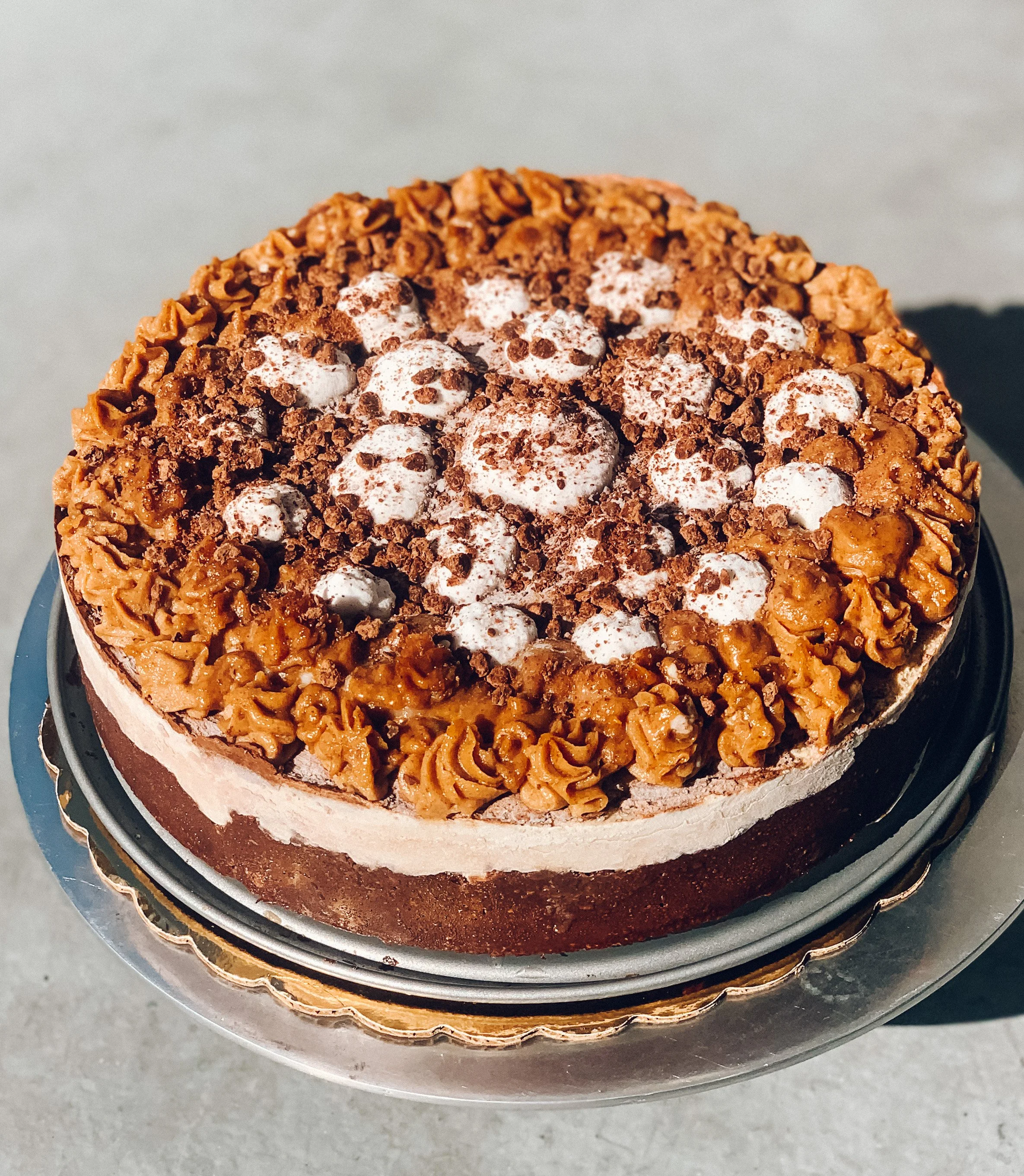
Layered cake with cashew cream, espresso & cacao — with format adaptations for 8×8 slice bars and individual mason jars
A remake of the Italian classic — espresso-walnut "ladyfingers," vanilla cashew cream, coffee cream, dusted with raw cacao powder. No dairy, no refined sugar, no grain. The architecture stays exactly true to traditional tiramisu — the palate still reads “tiramisu” — but every ingredient has been rebuilt from whole foods.
Yield: One 8-inch round cake (10–12 slices) OR one 8×8 pan of slice bars (12–16 squares) OR 6–8 individual mason jars
Active: 45 min · Total: 6 hr (with freezer set times)
A note from the kitchen
Traditional Italian tiramisu — literally “pick me up” in Italian — emerged in the Veneto region in the 1960s, built on Marsala-soaked ladyfingers, mascarpone cheese, raw eggs, espresso, and cocoa powder. The name acknowledges what the dish was designed to do: combine sugar, fat, caffeine, and chocolate in a layered architecture engineered to lift the spirit and the body.
This raw version still embodies the “pick me up,” without having a “pick me down” right after from a potential sugar crash. It is built on real wholesome ingredients and the flavor identification still works because the layered cookies-and-cream-and-coffee architecture is what the palate recognizes as tiramisu.
A few notes worth mentioning before you begin making the recipe:
The same recipe produces three distinct presentations:
8-inch round springform cake — celebration-ready, restaurant-elegant, photogenic
8×8 pan of slice bars — portable, party-friendly, 12–16 squares for retreat dessert tables
Individual mason jars or small glasses — the Italian al cucchiaio tradition, perfect for dinner parties and dinner-for-two
The base recipe makes the slice-bar quantities and 8-inch cake. For mason jars, use the slice-bar quantities and portion across 6–8 jars.
Cashew soaking is non-negotiable. Cashews must soak in cold filtered water for at least 4 hours (ideally overnight) before blending. Soaking neutralizes phytic acid, softens the seed for proper blending, and is the difference between silky restaurant-quality filling and gritty homemade-quality filling. A high-speed blender (Vitamix, Blendtec, or equivalent) is the structural tool — anything less leaves residual cashew texture.
The cacao powder dusting is the visual signature. Don't skip the final dusting of raw cacao powder. This is the structural visual element that tells the eye and palate "tiramisu" before the first bite. The dusting goes on right before serving, never earlier (it absorbs moisture from the cream layer and loses its powdery elegance).
Ingredients
For the espresso-walnut base:
1½ cups raw walnuts (or substitute almonds, or use a mix)
1 cup raw almonds
7–8 medjool dates, pitted (soaked 10 min in warm water if firm)
2 tbsp unrefined coconut oil, melted
2 tsp instant espresso powder (or 1 shot brewed espresso, cooled)
1 tbsp raw cacao powder
Pinch sea salt (Baja Gold or equivalent)
For the cacao-espresso "ladyfinger" layer (the structural sponge-replacement):
1½ cups blanched almond flour
7 medjool dates, pitted
2 tbsp mesquite powder (optional but recommended — see sourcing)
2 tsp instant espresso powder (or a few drops of pure coffee extract)
1 tbsp raw cacao powder
1–2 tbsp filtered water as needed
Pinch sea salt
For the vanilla cashew cream:
1½ cups raw cashews, soaked at least 4 hours and drained
½ cup full-fat coconut cream (the thick portion of a chilled can)
⅓ cup pure maple syrup
¼ cup unrefined coconut oil, melted
1 tsp pure vanilla bean powder (or seeds of 1 fresh vanilla bean)
Pinch sea salt
2–3 tbsp filtered water as needed for blending
OR
Vanilla mascarpone (traditional dairy version):
2 cups grass-fed mascarpone, softened to room temperature
½ cup raw heavy cream from grass-fed cows
⅓ cup pure maple syrup
1 tsp pure vanilla bean powder (or seeds of 1 fresh vanilla bean)
Pinch sea salt
Note: No coconut oil needed in the mascarpone version — the dairy fat is structurally sufficient. The mascarpone version sets softer than the cashew version (closer to traditional Italian tiramisu texture).
For the coffee cream (the mocha layer):
1½ cups raw cashews, soaked at least 4 hours and drained
¼ cup cold-brewed coffee (or a few drops pure coffee extract + ¼ cup unsweetened homemade almond milk)
¼ cup unrefined coconut oil, melted
¼ cup full-fat coconut cream
⅓ cup pure maple syrup
1 tsp pure vanilla bean powder
½ tsp maca powder (optional — see sourcing)
Pinch sea salt
For finishing:
2 tbsp raw cacao powder, for dusting (essential — the structural visual signature)
Optional: 2 tbsp raw cacao nibs, for crunch
Optional: 1 tbsp coconut sugar (process briefly with cacao nibs for a crumble)
Optional: whole coffee beans, for decorative top
Optional: 2 tbsp shaved dark chocolate (70%+ cacao)
Method
Prep the pan. Line an 8-inch springform pan with parchment (for the cake), an 8×8-inch baking pan with parchment leaving overhang on two sides (for slice bars), or set out 6–8 individual mason jars or small glasses.
Make the espresso-walnut base. In a food processor, pulse the walnuts and almonds until they break down into a coarse meal with some texture remaining. Add the dates, melted coconut oil, espresso powder, cacao powder, and sea salt. Process 1–2 minutes until a sticky, cohesive dough forms.
Press the base. Press the dough firmly and evenly into the bottom of the pan (or 2–3 tbsp into the bottom of each mason jar), packing tightly with the back of a measuring cup. Freeze 20 minutes.
Make the vanilla cream layer (cashew or mascarpone version).
For the cashew version: In a high-speed blender, combine the drained cashews, coconut cream, maple syrup, melted coconut oil, vanilla, and sea salt. Blend on high 2–3 minutes until completely silky-smooth and glossy. Add filtered water 1 tbsp at a time as needed for blending. Stop and scrape down the sides as needed.
For the mascarpone version: In a large bowl with a stand mixer or hand mixer, beat the softened mascarpone, raw heavy cream, maple syrup, vanilla, and sea salt on medium speed until completely smooth, light, and fluffy (about 3–4 minutes). Avoid using a high-speed blender — overmixing will break the dairy fat structure.
Pour ½ of the vanilla cream over the chilled base. Smooth the top with an offset spatula. Reserve the remaining vanilla cream at room temperature. Freeze the pan 30 minutes.
Make the cacao-espresso "ladyfinger" layer. In a food processor, combine the almond flour, dates, mesquite powder, espresso powder, cacao powder, and sea salt. Process to a soft, slightly sticky dough; add filtered water 1 tbsp at a time only if needed. The ladyfinger layer should be moldable but still firm — it functions as the espresso-soaked sponge in the original.
Crumble the ladyfinger dough across the firm vanilla cream layer, pressing gently. Don't compress it too firmly — you want visible ladyfinger texture rather than a tightly packed sheet. (For mason jars: distribute crumbled ladyfinger across all jars, gently pressing.)
Pour the remaining vanilla cream over the ladyfinger layer. Smooth the top. Freeze 30 minutes.
Make the coffee cream. In a high-speed blender, combine the drained cashews, cold-brewed coffee, melted coconut oil, coconut cream, maple syrup, vanilla, optional maca powder, and sea salt. Blend on high 2–3 minutes until completely silky-smooth and glossy.
Pour the coffee cream over the firm vanilla layer. Smooth the top.
Final set. Cover with plastic wrap or a fitted lid. Freeze at least 6 hours, ideally overnight, for the cleanest slicing.
Garnish and serve. Just before serving:
Lift the slab from the pan using the parchment overhang (slice bars) or release the springform (cake).
Dust the top generously with raw cacao powder using a fine-mesh strainer. This is the structural visual signature — don't skip it.
Add optional cacao nib crumble (process nibs briefly with coconut sugar for an extra-textured topping), shaved dark chocolate, and whole coffee beans.
For slice bars: cut into 12–16 squares with a hot dry knife (run under hot water and dry between cuts).
For the cake: slice into 10-12 wedges using the same hot-knife technique.
For mason jars: dust each jar with cacao before serving.
Allow 5–10 minutes thawing at room temperature for the cleanest cut and best texture.
Variations
Espresso-only version (no coffee cream): Skip the coffee cream layer entirely. Make a double batch of vanilla cashew cream. Layer: base → ½ vanilla cream → ladyfinger crumble → ½ vanilla cream → freeze → dust with cacao + a heavier dose of espresso powder mixed with cacao for a more concentrated espresso flavor on top. Beautiful for those who want the texture without the second cream layer.
Pumpkin spice variation (autumn-winter in temperate climates): Add 1 tsp ground Ceylon cinnamon, ½ tsp ground ginger, ¼ tsp ground cardamom, pinch of clove to the cacao-espresso ladyfinger layer. Beautiful seasonal twist that aligns with cold-weather warming spices.
Hazelnut variation: Substitute the walnuts in the base with hazelnuts (or use a mix). Hazelnut + coffee + cacao is a classic Italian flavor combination (think Nutella, gianduja). Toast the hazelnuts at 300°F for 10 minutes first for deeper flavor.
Cardamom-rosewater variation: Add ½ tsp ground cardamom and ½ tsp pure rosewater to the vanilla cashew cream. Beautiful Middle Eastern-Italian fusion — surprisingly complementary with the espresso and cacao.
Chocolate-layer variation: Between the espresso ladyfinger layer and the coffee cream, add a thin "hard chocolate" layer: melt ½ cup chopped dark chocolate (70%+ cacao) + 2 tbsp coconut oil + 1 tbsp maple syrup. Pour a thin layer (about ⅛-inch) over the firm cream. Freeze 5 minutes until set. Continue with the coffee cream layer. Adds a satisfying snap when bitten through.
Tahini variation (nut-free): Substitute the cashews in both cream layers with 3 cups soaked sunflower seeds. Substitute the walnut/almond base with 1½ cups tahini + 1½ cups coconut flakes + the same dates and binders. The result will be slightly more savory-sweet but structurally similar.
Springform mini-cake versions: Use a 4-inch springform pan or four small ramekins for individual mini cakes. Reduce all filling quantities by ½. Beautiful for restaurant-style plated dessert.
Coconut butter cream variation (nut-free option for cream layers): Substitute the cashews in both cream layers with a coconut-butter-based cream. For each cream layer, replace the cashews with: 1½ cups coconut butter (melted) + ½ cup coconut oil (melted) + ⅓ cup full-fat coconut cream. Maintain the espresso for the coffee layer; maintain the vanilla for the vanilla layer. The texture is denser and more truffle-like than the cashew version — closer to a chocolate-truffle filling than a mousse. Beautiful for those avoiding nuts entirely.
Sourcing
Raw walnuts:
Sprouted/soaked-and-dehydrated whenever possible — significantly easier to digest than raw, with reduced phytic acid.
100% walnuts as the only ingredient — no oils, sweeteners, or "natural flavors."
Stored cool and dry in a glass container; walnuts go rancid faster than most nuts (high omega-3 content), so use within 3 months of purchase.
Avoid bulk-bin walnuts that have sat exposed for long periods.
Raw almonds and cashews:
Truly raw, not steam-treated. (Important note: U.S.-grown almonds are required by law to be steam-pasteurized; "raw" almonds from California are not actually raw. For truly raw almonds, look for Spanish, Italian, or Mediterranean-sourced almonds.)
Sprouted/soaked-and-dehydrated when possible.
Organic when possible.
Cashews should be cream-colored, never gray (sign of age or steam treatment).
Stored cool and dry in glass containers.
Medjool dates:
Soft, plump, fresh dates with the natural caramel-amber color (not dried out or wrinkled).
Pitted (or pit them yourself — fresh-pitted dates are softer).
Local farmers' market or specialty grocer for the freshest options.
Organic and unsulfured.
Avoid bulk dates that have been pasteurized (lose enzyme activity and sweetness depth).
Blanched almond flour:
Finely-ground blanched (skins removed) — not almond meal, which is coarser and contains the skins.
100% almonds as the only ingredient.
Organic when possible.
Recently milled — almond flour goes rancid quickly. Should smell sweet and faintly nutty, never musty.
Stored in the refrigerator or freezer once opened.
Mesquite powder (optional regional ingredient):
Mesquite is an ancient Sonoran Desert food, used by the Tohono O'odham peoples for centuries. Carries a natural caramel-malty flavor that pairs beautifully with coffee and chocolate, and supports blood sugar moderation through its high fiber content.
100% mesquite powder — no fillers, no sweeteners.
Stone-ground when possible.
For readers outside the Southwest U.S. or Mexico, this is a regional ingredient and may be hard to find — substitute with 2 additional pitted dates if unavailable.
Maca powder (optional regional ingredient):
Maca is the Peruvian Andean root vegetable used for centuries — adaptogenic, traditionally supportive for energy and stamina. Carries subtle caramel-earthy notes.
For readers in tropical/subtropical climates with access to South American imports, maca is widely available. In temperate climates and regions distant from Andean trade routes, maca is an occasional/specialty ingredient.
Look for traditionally gelatinized maca (easier on digestion than raw maca).
Stone-ground, single-origin, third-party tested for purity.
100% maca — no fillers, no sweeteners.
This is genuinely optional — the recipe is structurally complete without it.
Coconut cream:
Full-fat (never light or low-fat). The thick portion of a chilled can is what you want — refrigerate the can overnight, then scoop the thick layer off the top.
Organic and unsweetened.
Single-ingredient when possible (just coconut), guar-gum-free.
Heritage coconut varieties (Aceitera, Tagnanan, Macapuno) for deeper coconut flavor when available.
Unrefined coconut oil:
100% coconut oil, cold-pressed, unrefined, virgin.
White when solid, clear when liquid.
Smells distinctly coconutty.
Organic and single-source.
In a glass jar.
Pure maple syrup:
Grade A Dark Robust (formerly called "Grade B") for deeper, more caramelized flavor.
From small-batch producers in Vermont, New Hampshire, Maine, Quebec, or Ontario.
100% maple — the only ingredient should be maple.
In a glass bottle.
Espresso powder and cold-brewed coffee:
100% pure ground coffee — no sweeteners, no additives.
Single-origin from a small specialty roaster when possible (significantly more flavor depth than commodity supermarket coffee).
Organic, mold-tested when possible (some coffee carries ochratoxin levels worth being aware of).
For cold-brewed coffee: brew at 1:8 ratio (coffee to filtered water) for 12–18 hours at room temperature, then strain. Or use 1 oz strong espresso diluted with 3 oz filtered water.
Pure coffee extract (from a small-batch full-spectrum extract producer) works as a substitute when you want concentrated flavor without additional liquid.
Pure vanilla bean powder:
100% ground vanilla beans — no fillers, no sweeteners.
Single-origin (Madagascar Bourbon for the classic profile; Tahitian or Mexican for variations).
Whole vanilla beans (split lengthwise, seeds scraped out with a knife) work even better when available.
Raw cacao powder:
Raw or low-temperature processed (under 115°F) — preserves the antioxidants, polyphenols, and minerals that conventional cocoa powder loses through heat processing.
100% cacao — the only ingredient should be cacao.
Organic, fair-trade, single-origin when possible.
Stored cool in a sealed glass container.
Raw cacao nibs:
Raw or low-temperature processed.
100% cacao — no sweeteners.
Organic, fair-trade, single-origin when possible.
Coconut sugar (optional):
100% coconut sugar — the only ingredient should be coconut sugar (from coconut palm sap).
Organic when possible.
Single-origin when available.
Avoid coconut sugar blended with cane sugar or other sweeteners.
Dark chocolate (for variations and shaved garnish):
70%+ cacao.
Single-origin or fair-trade.
Ingredient list should be: cacao mass, cacao butter, sugar (preferably coconut sugar). The shorter the list, the better.
Avoid chocolate with soy lecithin, dairy emulsifiers, or "natural flavors."
Grass-fed mascarpone (for the traditional dairy version):
Real Italian mascarpone is structurally just thickened fresh cream — about 75% fat, with the unctuous texture that defines Italian dessert tradition.
From cows on pasture year-round when possible. Italian mascarpone DOP-quality from small Lombardy producers is the gold standard when available.
The shortest possible ingredient list — ideally just cream and citric acid (used to thicken). Avoid mascarpone with gums, stabilizers, "natural flavors," or modified starches.
Full-fat (never low-fat or reduced-fat versions — they won't set properly).
Should be smooth, ivory-white, and slightly sweet-smelling (never sour or tangy — that's cream cheese, not mascarpone).
From a specialty Italian grocer, cheesemonger, or small local creamery when possible.
Bring to room temperature 30 minutes before mixing for best texture.
Avoid mass-produced supermarket mascarpone in plastic tubs with extended shelf-life packaging.
Raw heavy cream (for the mascarpone version):
From cows on pasture year-round when legally available. State-by-state legal availability varies; check realmilk.com.
If unavailable, minimally-pasteurized full-fat heavy cream from grass-fed cows.
The shortest possible ingredient list — ideally just cream.
Avoid ultra-pasteurized cream entirely (which has had its raw enzymes and Wulzen factor destroyed).
Deep cream-yellow color is the visual indicator of grass-fed source dairy.
Sea salt:
Baja Gold mineral sea salt (third-party tested at 29.5–31.5% sodium, harvested from the Sea of Cortez, solar-dried) or any equivalent unrefined mineral-rich sea salt for the recipe.
Fleur de sel for finishing if desired — hand-harvested by skimming the delicate top layer of French salt pans.
Storage
Freezer: Up to 1 month, sealed in a glass container or covered with plastic wrap. The freezer is genuinely the natural home for this dessert — the layers hold their integrity best frozen.
Refrigerator: Up to 5 days, sealed in a glass container. The texture softens significantly in the refrigerator and reads more like a traditional Italian tiramisu (less firm, more pudding-like).
Best eaten: Slightly thawed — pull from the freezer 5–10 minutes before serving for the cleanest slice and the best texture. The cashew cream layers should be firm but yielding under a fork, not rock-hard.
For batch cooking: This is a beautiful Sunday-afternoon project that produces a full week of dessert. Make once, slice into individual portions, wrap in parchment, store in the freezer. Pull out one slice at a time as needed.
For gifting: An 8-inch springform cake or a 6-jar set of individual tiramisu makes a beautiful gift for friends, hostess offerings, or postpartum new mothers. Wrap in cellophane, tie with twine, and label by date.
Pairs Well With
For the afternoon: A small espresso, a strong pour-over coffee, or a cup of black tea. The caffeine pairing is structural and traditional — Italian tiramisu has always been an afternoon dessert paired with coffee, not an after-dinner sweet on its own.
For an Italian-inspired dinner: Serve a small slice at the end of a Mediterranean dinner — alongside fresh berries (in summer), poached pears (in autumn), or sliced citrus (in winter). The bright fruit cuts the richness of the cashew cream beautifully.
For dinner parties and retreats: The mason jar format is genuinely the most elegant for a dinner party — individual portions, no slicing required, beautiful in clear glass. Garnish each jar with a whole coffee bean and a small dusting of cacao right before serving.
For circadian alignment: This dessert is best eaten midday or in the early afternoon — the espresso load is meaningful and metabolizes most cleanly during daylight hours. Eating tiramisu late in the evening pushes the body's natural cooling and melatonin curve back; the caffeine can linger in circulation 6–8 hours.
Nourishment Notes
These cream-and-cacao-and-coffee desserts share an architecture that delivers genuine functional ingredients in a format that reads as effortless and pleasure-forward. The nourishment isn't an afterthought built around a "treat" structure — it's woven directly into the architecture itself.
Walnuts in the espresso-walnut base deliver omega-3 ALA (one of the few plant-based sources of long-chain fatty acid precursors), polyphenols, vitamin E, and copper. Walnut-and-coffee is one of the more harmonious pairings in the dessert tradition — the bitter notes complement each other, and the walnut's natural slight tannins echo the coffee's. Walnuts also carry meaningful magnesium and the specific anti-inflammatory polyphenols (urolithins, ellagic acid precursors) that have been studied for cardiovascular and cognitive support.
Cashews in the cream layers provide the silken, dairy-free body of both cream layers — and contribute zinc, copper, magnesium, and tryptophan (the amino acid precursor to serotonin and melatonin). Cashews are technically seeds, not nuts, with significantly lower oxalate content than most tree nuts and one of the highest plant sources of magnesium. Soaking is non-negotiable for both digestibility and texture — soaked cashews blend silky-smooth and have meaningfully reduced phytic acid.
Medjool dates contribute potassium, magnesium, and slow sugars softened by their fiber matrix — and serve as the binder that holds the date-and-nut crust together without flour. The fiber content moderates the natural sugar absorption substantially; dates produce a much steadier glycemic response than refined sugar despite their sweetness.
Coconut oil and coconut cream throughout provide medium-chain triglycerides (particularly lauric acid) for stable, slow-burning energy that the body converts directly to ketones. Coconut butter (in the nut-free cream variation) carries the full fiber and fat profile of the whole coconut — denser and more truffle-like than the cashew-based cream. Lauric acid specifically has documented antimicrobial properties and is one of the few medium-chain triglycerides that's structurally similar to compounds in breast milk.
Almond flour in the cacao-espresso ladyfinger layer brings vitamin E, magnesium, and monounsaturated fats with the cake-like structural integrity that the original Italian sponge delivers — but without grains, refined flour, or gluten. Blanched almond flour is the structural choice here; almond meal (with skins) would produce a coarser, oilier ladyfinger.
Coffee and espresso deliver chlorogenic acids and a gentle thermogenic stimulant lift alongside meaningful polyphenols. Espresso specifically — when made from quality whole beans — is among the most polyphenol-dense beverages you can drink. The caffeine content is real (about 60mg per shot), so circadian timing matters: eaten in the afternoon, the espresso content of these desserts is genuinely modest and rarely interferes with sleep. Eaten after dinner, particularly for caffeine-sensitive individuals, the same dose can disrupt sleep architecture. This is essentially the same logic that has Italians traditionally eating tiramisu in the afternoon with an espresso, not in the evening after dinner.
Raw cacao powder in the dusting and ladyfinger layers contributes flavanols, theobromine, magnesium, and iron — compounds with documented effects on circulation, focus, and mood. Raw cacao is dramatically different from Dutch-processed cocoa (which destroys the flavonoid content through alkalization); look for "raw cacao" specifically. Theobromine produces a slow, sustained cardiovascular opening that feels different from caffeine's sharper edge — and the combination of theobromine and caffeine has been studied for cognitive performance, mood elevation, and metabolic support. Raw cacao carries one of the highest antioxidant loads measured in any common food.
Mesquite powder (optional in the ladyfinger layer) is an ancient Sonoran Desert food, used by the Tohono O'odham peoples for centuries. Carries a natural caramel-malty flavor that pairs beautifully with coffee and chocolate, and supports blood sugar moderation through its high fiber content.
Maca powder (optional in the coffee cream) is the Peruvian Andean root vegetable used for centuries — adaptogenic, traditionally supportive for energy and stamina. In small quantities (½ tsp), it adds subtle complexity to the flavor while reinforcing the dessert's "lift me up" structural function.
Raw mascarpone and raw heavy cream (in the traditional dairy version) deliver calcium, vitamin K2, fat-soluble vitamins A and D, and the live bacterial cultures of fresh dairy. Raw, grass-fed cream specifically carries the Wulzen factor — an anti-stiffness compound destroyed by pasteurization, present only in raw dairy from cows grazed on real pasture. The dairy version anchors the dessert in its Italian tradition while honoring the same real-food principles.
Pure maple syrup contributes manganese and zinc with a meaningfully gentler glycemic curve than refined sugar — and the fiber-and-fat matrix of the surrounding ingredients slows sugar absorption substantially.
The freezer-set construction preserves the heat-sensitive enzymes and polyphenols in the raw cacao, vanilla, and maple syrup — which is one of the architectural advantages of the raw approach. Conventional baked tiramisu doesn't have this issue (its components are cooked separately), but the freezer-set version captures all the nutritional benefits of the raw approach without sacrificing any of the textural pleasure.
As a circadian and seasonal food, this is afternoon eating at its best. The combination of the coffee's caffeine, the cacao's theobromine, and the substantial fat content makes a small slice deeply satisfying and gently energizing — exactly the “pick me up” the original Italian name promises.
Why This Dessert
Make this once and you'll understand why healthy dessert-making can deliver the same indulgence as the conventional version while feeding the body real nutrition.
— Anna aka Food Marshall