Grilled Swordfish with Carrot-Ginger Purée, Sautéed Peppers, and Citrus Reduction
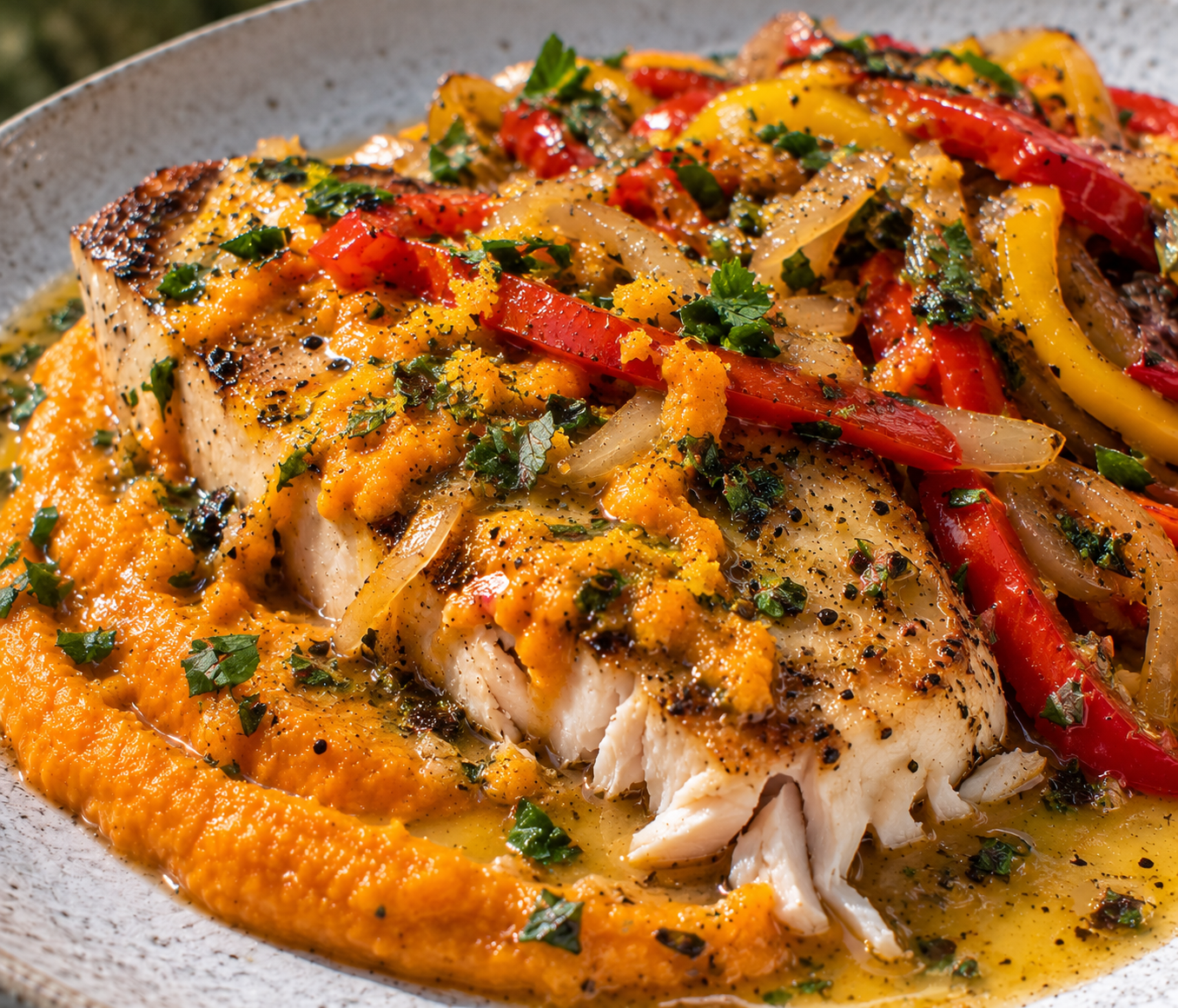
Meaty grilled swordfish over a silky carrot-ginger purée, with sweet sautéed peppers and a bright, glossy citrus reduction.
Yield: Serves 2 · Active: 35 min · Total: 45 min · Best in North America from late spring into early fall, during the Atlantic swordfish season · Best eaten: midday or early evening
Ingredients
Swordfish
2 wild-caught swordfish steaks (6–8 oz each, about 1 inch thick)
1 tbsp extra virgin olive oil
Baja Gold sea salt and freshly cracked black pepper
Optional: a pinch of smoked paprika
Carrot-ginger purée
1 lb carrots, peeled and chopped
1 tbsp grass-fed butter (or extra virgin olive oil)
1 small shallot, sliced
1 tsp freshly grated ginger (or 1 stalk lemongrass, bruised, for a subtler flavor)
½ cup chicken bone broth
Optional: 2 tbsp raw heavy cream or full-fat coconut milk, for silkiness
Baja Gold sea salt, to taste
A small squeeze of orange or lemon juice
Sautéed vegetables
1 red bell pepper, thinly sliced
1 small red or yellow onion, thinly sliced
Optional: 1 zucchini or yellow squash, sliced
1 tbsp extra virgin olive oil
Baja Gold sea salt, black pepper, and a pinch of red pepper flakes
Citrus reduction
½ cup fresh orange juice
¼ cup fresh lemon juice
2 tbsp dry white wine (or 1 tbsp raw apple cider vinegar plus 1 tbsp water, for alcohol-free)
1 tbsp raw honey
1 tbsp grass-fed butter
Pinch of Baja Gold sea salt
Garnish: microgreens, red pepper flakes, lemon zest, and flaky sea salt
Swaps: Wild halibut, striped bass, or salmon all work in place of the swordfish; adjust the cooking time to the thickness. In winter, use blood oranges in the reduction, for a stunning red-orange color. For dairy-free, use coconut milk in the purée and skip the butter in the reduction (it will be a little less glossy, but still bright).
Method
1. Make the carrot purée.
Cook the carrots in a pot of boiling salted water for 12–15 minutes, until very tender, then drain.
Meanwhile, sauté the shallot in the butter over medium heat for 2–3 minutes, then add the ginger (or lemongrass) for 1 minute, until fragrant.
Add the carrots and broth, then transfer everything to a blender (remove the lemongrass, if using), and add the cream (if using).
Blend until completely smooth and silky. Season with salt and a squeeze of citrus, and keep it warm.
Restaurant trick: press the purée through a fine-mesh sieve, for an ultra-smooth texture.
2. Make the citrus reduction.
Simmer the orange juice, lemon juice, wine, and honey in a small saucepan over medium heat for 8–10 minutes, until reduced by about half and slightly syrupy.
Whisk in the butter and a pinch of salt. It should taste bright, not too sweet.
3. Sauté the vegetables.
Heat the olive oil in a skillet over medium-high heat, and cook the onion 5 minutes, until lightly caramelized.
Add the pepper (and zucchini, if using), and cook 4–5 minutes more, until tender but still vibrant. Season with salt, pepper, and chili flakes.
4. Grill the swordfish.
Pat the swordfish dry, and rub it with olive oil, salt, pepper, and smoked paprika (if using).
Heat a grill or grill pan to medium-high, and cook the swordfish 4–5 minutes per side, until it has grill marks and is just cooked through (about 130–135°F in the center, for a moist texture). Don't overcook it; swordfish dries out quickly.
5. Plate like a restaurant.
Spoon the purée onto each plate, and swoosh it into a smooth arc with the back of the spoon.
Set the swordfish on top, and pile the peppers and onions beside it.
Drizzle the citrus reduction around the plate in a loose ring, and finish with microgreens, chili flakes, lemon zest, and flaky salt.
For an even more restaurant-style plate: add blistered cherry tomatoes or charred asparagus, baste the fish with brown butter, or use blood oranges in the reduction.
Storage
Leftovers don't hold up especially well, since swordfish dries out and the purée separates slightly. The purée keeps refrigerated up to 3 days (reheat it with a splash of broth), and the citrus reduction keeps up to 1 week (warm it gently, and whisk in a little butter). For 4, double the recipe. For 6 or more, grilling and plating everything at once gets tricky, so consider oven-roasted halibut or salmon instead.
A note on honey: The honey in the reduction is simmered, so it's no longer raw. Honey shouldn't be given to babies under 12 months.
Nourishment Notes
Swordfish is a large, meaty predatory fish, so it's rich in nutrients, and it also carries more mercury than smaller fish. It brings EPA and DHA omega-3s, selenium, vitamin D, B12, and plenty of protein. U.S. North Atlantic swordfish is the most sustainable choice, but swordfish's mercury depends mostly on its size and age, not where it's caught. The FDA advises that pregnant or breastfeeding women and young children avoid it (wild salmon, sardines, mackerel, and anchovies are better choices for them), and that other adults enjoy it occasionally. Swordfish is also rich in selenium, which binds to mercury in the body and helps reduce its effects. DHA concentrates in the retina, brain, and cell membranes, where it supports vision and brain health.
Carrots are rich in alpha- and beta-carotene, which your body converts to vitamin A as needed, for vision, immunity, and healthy skin. Cooking carrots and eating them with fat makes those carotenoids much easier to absorb, which is why the butter and cream in the purée are more than just flavor. Ginger brings gingerols and shogaols, well studied for their anti-inflammatory effects, and traditionally used to warm digestion. It also lifts the carrots' natural sweetness.
The citrus reduction brings vitamin C, which helps your body absorb the iron from the vegetables, along with a bright acidity that balances the rich fish and purée. The honey and butter round out the acid with sweetness and richness. The red peppers add capsanthin, beta-carotene, and more vitamin C, and the onions and shallot bring quercetin and sulfur compounds.
As a circadian and seasonal food, this is midday or early-evening eating, when your digestion is at its strongest. Late spring into early fall is its natural season, when Atlantic swordfish is in season and peppers and zucchini are at their peak. It's the dish for an anniversary, a reunion, or any night that calls for a celebration, without complicated technique: forty-five minutes, three pans, and a plate that feels like dinner on the coast.
For your cycle: The swordfish's omega-3s, vitamin D, and selenium support a healthy cycle, and the carrots' beta-carotene supports healthy skin and hormones. It's lovely in the follicular and ovulatory phases.
Sourcing
Swordfish — wild-caught U.S. North Atlantic swordfish (MSC certified), harpoon- or buoy-caught if possible, from a trusted fishmonger
Halibut, striped bass, or salmon (if swapping) — wild-caught, from a trusted fishmonger
Carrots, shallots, ginger, red peppers, onions, zucchini, and microgreens — organic, from a farmers' market
Oranges and lemons — organic, especially since you're using the zest
Bone broth — homemade (see my Broths 101)
Cream or coconut milk (optional) — raw or organic, grass-fed cream; organic, full-fat coconut milk with no guar gum
Dry white wine (optional) — organic, with low added sulfites
Raw honey — organic, local, and unfiltered
Grass-fed butter — organic, cultured butter from 100% grass-fed cows
Smoked paprika and red pepper flakes — organic and non-irradiated
Extra virgin olive oil — organic, single-estate, harvest-dated, in dark glass
Salt — Baja Gold sea salt; Maldon for finishing
— Anna aka Food Marshall