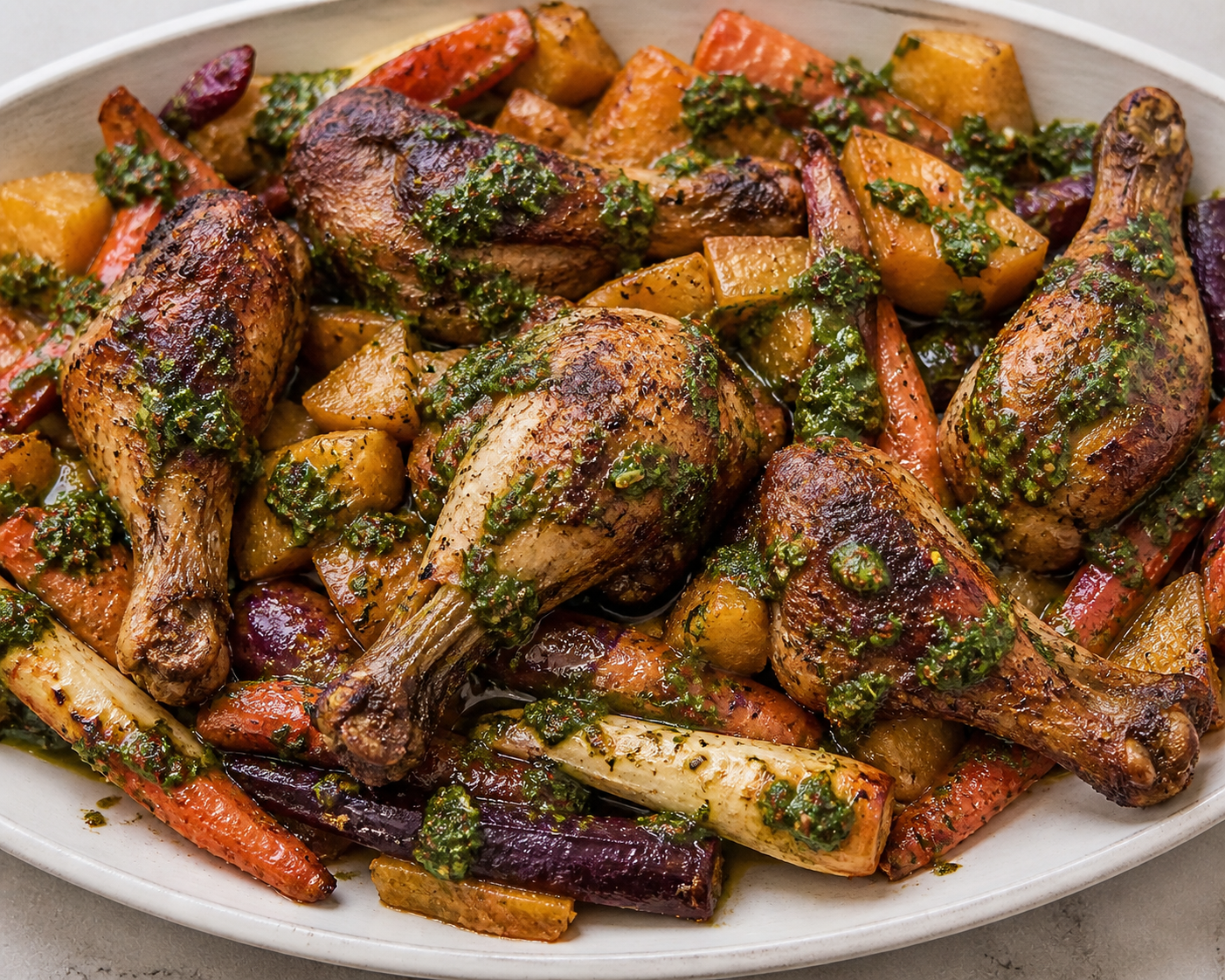
Moroccan-Spiced Roast Chicken with Caramelized Root Vegetables, Chermoula, and Green Yogurt
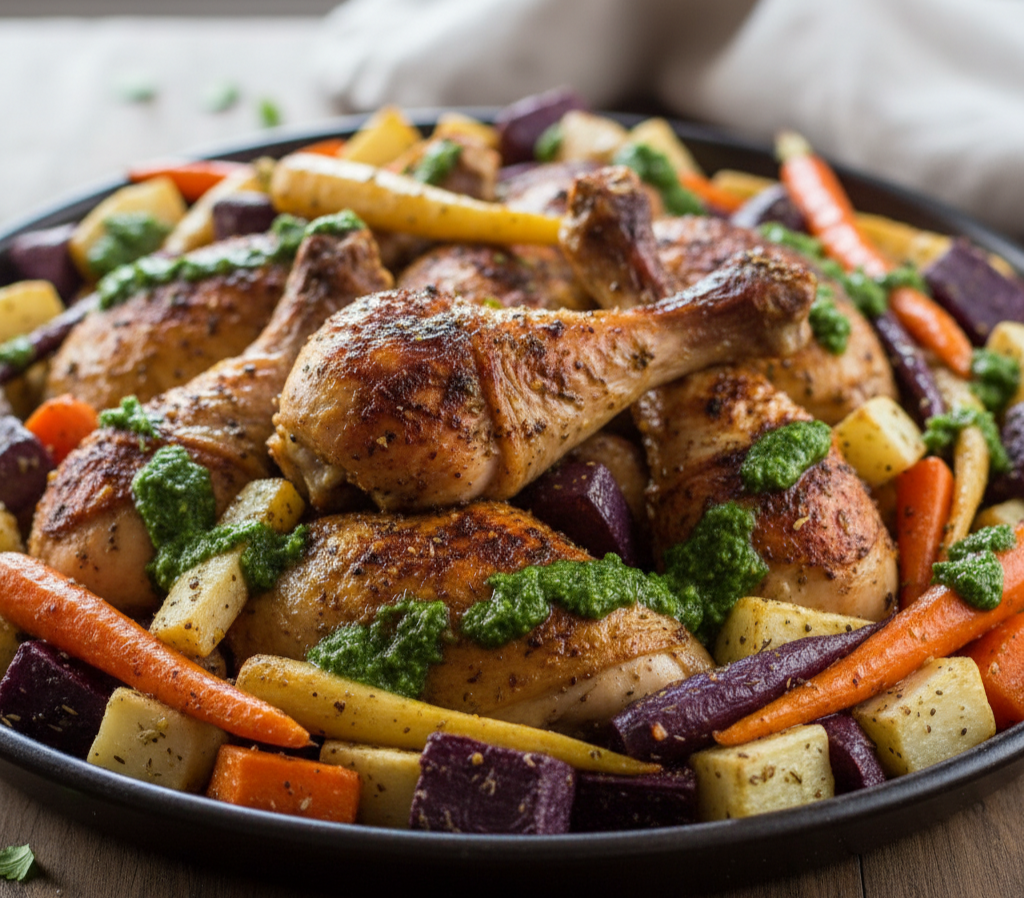
Moroccan-Spiced Roast Chicken with Caramelized Root Vegetables, Chermoula, and Green Yogurt
Spice-rubbed pasture-raised chicken legs over carrots, parsnips, and rutabaga, with two sauces — bright olive-oil chermoula and creamy chermoula-yogurt
Season: Autumn · early Winter · Cuisine: Moroccan · Tunisian · North African · Yield: Serves 4 (generous, with leftovers) · Active: 30 min · Total: 1 hr 30 min · Best eaten: early evening
This is the autumn dinner that smells like North Africa from three rooms away — pasture-raised chicken legs rubbed with a ras-el-hanout-style spice blend, roasted over caramelizing carrots, parsnips, sweet potato, and rutabaga, then finished with two sauces. The chermoula is the classic green herb sauce of Maghrebi cookery (cilantro, parsley, mint, lemon, garlic, olive oil); the green yogurt sauce is its creamier sibling — the same flavor profile folded into strained Greek yogurt with a spoonful of tahini for nutty depth. Together they turn what could be a simple roast into something genuinely irresistible — the kind of dinner where guests reach for both sauces and end up eating the leftover roots straight off the platter with bread.
Ingredients
Spice blend (ras el hanout style)
2 tbsp sea salt
1 tbsp ground Ceylon cinnamon
1 tbsp ground coriander
2 tsp ground turmeric
2 tsp ground cumin
2 tsp ground cardamom
1 tsp freshly ground black pepper
This makes about 6 tablespoons of spice mix — enough for two batches of this recipe. Store the leftover in a sealed glass jar away from light; it keeps 3 months at full potency, 6 months overall.
Chicken and vegetables
6 whole pasture-raised chicken legs (drumstick and thigh attached, 6–8 oz each) — see sourcing notes for soy-free, corn-free options. Bone-in, skin-on thighs or a mixed cut (legs, thighs, wings) work too; avoid boneless skinless cuts here, the skin is structural to the dish
3 tbsp extra virgin olive oil, divided (or grass-fed ghee, melted, for a richer flavor)
2 garlic cloves, grated or minced
1 medium red onion, cut into 8 wedges
6 cups diced root vegetables in 1-inch pieces — a mix of carrots, parsnips, rutabaga, and sweet potato (or substitute beets, turnips, celery root, fingerling potatoes)
Additional sea salt to taste
Sauce 1 — Chermoula
½ cup extra virgin olive oil
1 cup coarsely chopped fresh herbs (parsley + cilantro + mint, roughly equal parts)
1½ tbsp fresh lemon juice (more to taste)
1 garlic clove, grated
½ tsp sea salt
¼ tsp freshly ground black pepper
1 tbsp minced preserved lemon (optional but genuinely transformative — pulls the sauce into authentic Moroccan territory)
Sauce 2 — Green Yogurt Sauce
1 cup full-fat strained Greek yogurt or labneh (raw if available — see sourcing)
3–4 tbsp of the chermoula above (taken aside before plating)
1 tbsp tahini (single-ingredient, sesame-only — Soom Foods or Seed + Mill)
1 tsp fresh lemon juice (more to taste)
Pinch sea salt
The tahini is optional but genuinely transformative — it adds the kind of nutty richness that turns the sauce from “yogurt with herbs” into “restaurant-quality.” If you skip it, increase the chermoula folded in to 4 tbsp and add an extra ½ tsp lemon juice.
Optional finishing
¼ cup pomegranate arils (autumn–winter — bright, jewel-like garnish)
¼ cup toasted slivered almonds or pine nuts (for crunch)
Fresh mint sprigs and a few extra cilantro leaves
Lemon wedges for serving
Warm sourdough flatbread or a torn loaf of sprouted-grain bread alongside
Method
Marinate the chicken (1 hour ahead, or overnight)
Make the spice blend. Combine all spice blend ingredients in a small bowl and mix thoroughly. The blend should look uniform with the bright yellow turmeric and amber cinnamon evenly distributed.
Marinate. Rinse the chicken legs and pat dry thoroughly with paper towels — dry skin is essential for crisp roasting. In a small bowl, combine 2 tbsp of the spice blend with 1 tbsp olive oil and the grated garlic into a wet paste. Rub the paste all over the chicken pieces, getting under the skin where you can. For best flavor, refrigerate uncovered overnight (this also dries the skin further for crispness). For a same-day version, let stand at cool room temperature for 30 minutes — long enough for the salt to penetrate but short enough to stay food-safe.
Roast
Preheat the oven to 400°F. If the chicken came from the refrigerator, let it sit on the counter for 20 minutes while the oven heats — chicken at room temperature roasts more evenly than chicken straight from cold.
Prepare the vegetables. In a large bowl, combine the red onion wedges and diced root vegetables with the remaining 2 tbsp olive oil, 1 tbsp of the spice blend, and 1 tsp salt. Toss thoroughly to coat — every piece should be evenly seasoned and oiled.
Assemble the pan. Spread the vegetables in a single layer on a large rimmed baking sheet (or two sheets if needed for true single layering — crowding prevents caramelization). Place the chicken legs directly on top of the vegetables, skin-side up. The juices and rendered fat will drip into the vegetables as the chicken roasts, which is the structural heart of this technique.
First roast. Roast 25 minutes.
Flip and continue. Flip the chicken pieces (don't move the vegetables — they're starting to caramelize on the bottom). Roast another 20–25 minutes, until the chicken thighs reach 175°F internal at the thickest part (use an instant-read thermometer in the thigh, not touching the bone). Note: 165°F is the USDA safety minimum, but dark meat is genuinely more tender at 175–180°F because the connective tissue has rendered properly. The skin should be deeply golden and crisp.
Rest the chicken. Remove the chicken pieces to a plate, tent loosely with foil, and let rest 10 minutes — this is non-negotiable for juiciness.
Finish caramelizing the vegetables (if needed). If the vegetables aren't fully caramelized at the edges by the time the chicken is done, increase the oven to 450°F and roast the vegetables alone for another 10–15 minutes, stirring once. The vegetables should have deeply browned, almost-burnished edges and a tender interior — this is where the dish goes from good to memorable.
Make both sauces (while the chicken rests)
Sauce 1 — Chermoula. Combine the olive oil, mixed herbs, lemon juice, grated garlic, salt, and black pepper in a food processor. Pulse 20 seconds, until the herbs are coarsely chopped (you want texture, not a smooth purée). Scrape down the sides. Fold in the minced preserved lemon by hand. Taste and adjust salt and lemon.
Sauce 2 — Green Yogurt Sauce. Take 3–4 tbsp of the finished chermoula and place in a small bowl. Add the strained yogurt (or labneh), tahini, lemon juice, and salt. Stir until the chermoula is fully incorporated and the sauce is a uniform pale green with herb flecks throughout. Taste and adjust — add more lemon for brightness, more salt to season, or another spoonful of chermoula for stronger herb character.
Plate
Arrange the caramelized roasted root vegetables on a large platter or rustic wooden board. Place the rested chicken legs on top, skin-side up. Drizzle generously with the chermoula, allowing some to fall onto the vegetables. Dollop large spoonfuls of the green yogurt sauce around the platter rather than over the chicken (you want both sauces visible and reachable). Scatter pomegranate arils and toasted almonds across everything. Garnish with fresh mint sprigs and extra cilantro leaves. Serve with lemon wedges and warm bread alongside, and place the remaining chermoula and yogurt sauce on the table in small bowls so guests can add more as they eat.
Storage: Refrigerator up to 4 days. Reheat the chicken and vegetables together at 350°F for 10–12 minutes. Both sauces keep refrigerated 1 week (the chermoula even improves over 24 hours). Leftovers are exceptional — shred the chicken into the cold roasted vegetables and add a fresh dollop of yogurt sauce for an outstanding next-day lunch bowl, or layer onto warm flatbread for a wrap.
Enhancement Options
Spice the heat — Harissa-honey drizzle
For those who want a heat element, drizzle the finished plate with a spoon of harissa thinned with raw honey and a splash of olive oil (1 tbsp harissa + 1 tsp honey + 1 tbsp EVOO, whisked). The sweet-spicy bite plays beautifully against the cooling yogurt and the caramelized roots. New York Shuk and Villa Jerada both make exceptional small-batch harissa; the Tunisian-style is hotter, the Moroccan-style is more aromatic.
Build the bread element
Warm sourdough flatbread is the traditional companion — the bread is what guests use to scoop up the last of the chermoula and yogurt. A torn loaf of warm sprouted-grain bread (One Degree, or local sourdough) on the table is the genuinely European treatment. For grain-free eaters, almond-flour flatbread (Simple Mills or homemade) works; cassava-flour tortillas warmed in a dry pan are another option.
A cucumber-mint side
A small bowl of cucumber salad — Persian cucumbers sliced thin, tossed with mint, lemon, sea salt, and a drizzle of olive oil — provides the crisp cooling contrast that completes the plate. Five minutes of work, and structurally it's the same role tabbouleh plays at a Lebanese table.
Wine pairing
A medium-bodied red — Côtes du Rhône, southern Spanish Garnacha, or a Lebanese Bekaa Valley red — handles the spice and the chicken's richness without overwhelming the herb sauces. For white drinkers, a dry Provençal rosé or a Greek Assyrtiko works. Skip oaked Chardonnay; it fights the spice rub. For an alcohol-free option, a tart pomegranate-and-mint mocktail (pomegranate juice, lime, mint, sparkling water) echoes the plate's flavors.
Scaling for a gathering
The recipe doubles cleanly for 8 (use two large baking sheets and rotate them halfway through to manage oven hot spots). For 12 or more, switch to bone-in chicken thighs only (faster and more even cooking than whole legs at scale), use three sheet pans, and double both sauces. Plan on about 30 minutes of additional active time at the larger scale.
Make-ahead components
The spice blend keeps 3 months at full potency. The chermoula keeps a full week refrigerated and the flavors deepen over 24 hours — make it the day before for richer flavor. The chicken can marinate up to 24 hours refrigerated. The vegetables can be diced the day before and kept refrigerated in a sealed container. With these prepped, the actual cooking is 1 hour of mostly-passive oven time.
Foundational meal version (for a feast)
Add a grain element — a saffron-scented basmati rice, or a buttered sprouted-couscous (One Degree), or a warm farro pilaf with golden raisins and toasted pine nuts. The grain absorbs the chicken juices and chermoula beautifully and turns this from a generous dinner into a celebration meal. For a grain-free version that still serves the same role, a cauliflower rice pilaf with toasted pine nuts and dried apricots works structurally identically.
Nourishment Notes
The spice blend here — cinnamon, coriander, turmeric, cumin, cardamom — is the foundational architecture of Moroccan and Tunisian ras el hanout (literally “head of the shop,” the spice merchant's signature blend). Each Moroccan family's ras el hanout differs slightly, but the core combination has been documented across Maghrebi cookery for at least 800 years. Beyond flavor, each spice carries genuine nutritional weight: turmeric's curcumin is one of the most well-studied anti-inflammatory compounds in food; cumin and coriander both support digestion and have been used medicinally across the Mediterranean and Levant for millennia; Ceylon cinnamon (true cinnamon, not commodity cassia) carries chromium and polyphenols that moderate the blood-sugar response to the sweet root vegetables; cardamom carries terpenes and a long Ayurvedic tradition for digestive support. Used as a rub on poultry, the spices form a flavor crust during roasting that pairs especially well with the deep sweetness of caramelized root vegetables.
Chermoula is one of the great green sauces of North African cookery, served traditionally with grilled fish but equally at home with roasted lamb, chicken, and vegetables. The cilantro-parsley-mint combination here is borrowed from the Tunisian variation; the Moroccan version often uses just cilantro and parsley, while the Algerian variation may include fresh dill. Preserved lemon is the optional element that pulls the sauce into authentic Moroccan flavor territory — its concentrated salt-and-citrus depth, developed over weeks of fermentation, is impossible to replicate with fresh lemon alone. The substantial olive oil in the sauce is structural rather than incidental: the fat carries the fat-soluble flavors of the herbs into the palate and, more importantly, allows the body to absorb the fat-soluble vitamins from the chicken skin (vitamin K2, vitamin A) and the carotenoids from the carrots and sweet potato. A low-fat version would leave most of the meal's nutritional value behind.
The green yogurt sauce is the Maghrebi-Levantine cooling counterpart — yogurt has been served alongside spiced meats across North Africa, Turkey, Persia, and the Levant for at least 2,000 years, and the cultural logic is partly digestive (the live cultures support the gut handling of substantial protein and fat) and partly sensory (the cooling cream balances the heat of the spices and the richness of the chicken). Adding tahini transforms a simple yogurt sauce into something genuinely transcendent — sesame seeds carry a unique mineral profile (calcium, iron, copper, manganese, zinc) and the tahini's fat blends with the yogurt's fat to produce the silkiest possible texture. This is the same technique used in Israeli and Lebanese tahini-yogurt sauces served alongside grilled meats across the region.
Pasture-raised, soy-free, corn-free chicken is genuinely different from supermarket chicken — and the difference is visible, structural, and tasteable. Conventional chicken is fed primarily corn and soy in confinement; this produces a fatty acid profile dominated by omega-6 (which is inflammatory in excess), pale flesh, and a thin chicken-broth flavor when simmered. Pasture-raised chicken eats grass, insects, seeds, and worms — its diet is closer to what wild jungle fowl eat, and the resulting meat carries a dramatically better fatty acid profile (more omega-3, less omega-6), more vitamin D from sun exposure, more vitamin K2, and a deeper flavor that comes through immediately in the broth and the meat. Soy-free and corn-free feed (which good farmers usually pair with sprouted grains, peas, sunflower seeds, and oats) further improves the bird's nutritional profile and removes the GMO and pesticide load that conventional feed grains carry. The expense is real (often 2–3× supermarket prices) and worth it; one well-raised chicken yields multiple meals.
The technique of placing the chicken over the vegetables — so the chicken juices drip onto the vegetables during roasting — is borrowed from French poulet rôti and Spanish pollo asado tradition. The flavor transfer is significant: the vegetables absorb the rendered fat and pan juices, becoming substantially more flavorful than vegetables roasted on their own. The same principle drives the Italian pollo arrosto tradition where chicken is roasted directly atop bread, potatoes, or vegetables. For the cook, this also means one pan instead of two — and dramatically less cleanup.
As a circadian and seasonal food, this dinner is autumn through winter eating, served in the early evening when the day's daylight is winding down. The substantial protein and fat profile (chicken + olive oil + yogurt + tahini) produces a sustained energy curve that supports the body's cooler-month pull toward dense calories; the warming spices (cinnamon, cumin, cardamom) align with the body's seasonal pull toward warming foods. Not a midday meal — this is the dinner-table dish that gathers people around it. Best served with everyone at the table, sauces in the center, bread within reach, conversation already started.
Recipe adapted from the Traeger Grill team, with my modifications: the dual sauce (chermoula plus green yogurt sauce with tahini), the corrected dark-meat cooking temperature (175°F internal rather than 165°F), the optional pomegranate-and-toasted-almond finishing, and the sourcing notes throughout.
Sourcing
Pasture-raised, soy-free, corn-free chicken — what to look for: First, the label terms matter. “Pasture-raised” is the gold standard (birds spent their lives on actual pasture); “free-range” and “cage-free” are dramatically lower welfare standards (cage-free can mean a crowded barn floor, free-range can mean access to a small concrete yard). “Soy-free” and “corn-free” feed are explicit additional commitments — a pasture-raised bird whose feed includes corn and soy is still better than conventional, but the omega-6 load and GMO/pesticide concerns return through the feed. The genuine top tier combines all three: pasture-raised AND soy-free AND corn-free. “Certified Organic” means non-GMO feed but doesn't speak to corn/soy or pasture access. “Animal Welfare Approved” is one of the more meaningful third-party certifications. Avoid “natural” (meaningless), “vegetarian-fed” (means corn/soy almost always, and chickens are not naturally vegetarian — this is a marketing flag, not a quality flag), and “Air-chilled” alone (a processing technique, not a welfare standard).
Top-tier shipped chicken (genuinely pasture-raised, soy-free, corn-free): Miller's Bio Farm (Pennsylvania, Amish, soy-free and corn-free, ships to states that permit small-farm meat — this is the same farm we recommend for raw dairy and is genuinely the gold standard). Wholesome Meadow (Pennsylvania Amish, soy-free). Greener Pastures Chicken (Texas, soy-free, corn-free). Tropical Traditions (sells pastured chicken from various small farms). Polyface Farm (Joel Salatin, Virginia, the legendary regenerative farm — limited shipping). White Oak Pastures (Georgia, regenerative, multi-species, ships nationwide — note their feed contains some grain, so they're pasture-raised but not strictly corn/soy-free).
Local Amish-farm pasture-raised chicken (the genuine peak): This is the gold standard — direct from a small-scale Amish or Mennonite farm in your region. Most Amish farms raise birds on pasture with non-GMO feed, often soy-free, sometimes corn-free. To find one near you: westonaprice.org/find-a-farm (the Weston A. Price Foundation directory is the most comprehensive), eatwild.com (national pasture-raised farm directory), or LocalHarvest.org. Many Pennsylvania Dutch country farms ship within their region. Farmers' market vendors who sell eggs often sell whole birds in season — ask.
Extra virgin olive oil: single-estate from Gustiamo, Eataly, or Olio2Go. Named benchmarks: Olio Verde (Sicily, Frantoia family), Castelines (Provence). For finishing, an early-harvest peppery oil makes the chermoula sing.
Grass-fed ghee (alternative to olive oil for chicken rub): Pure Indian Foods (genuinely traditional, single-source, the chef's choice) or Ancient Organics.
Whole spices for the spice blend: Burlap & Barrel or Diaspora Co. — single-origin, dramatically more flavorful than commodity. Toast and grind whole spices yourself for genuine restaurant-quality depth: 30 seconds of toasting whole cumin and coriander seeds in a dry pan, then grinding them fresh, is the difference between a blend that tastes good and one that tastes alive. La Dalia or La Chinata for Pimentón de la Vera if you want to add Spanish smoked paprika to the blend.
Ceylon cinnamon (true cinnamon, not cassia): Burlap & Barrel or Diaspora Co. specifically — both source single-origin Sri Lankan Ceylon cinnamon. Commodity “cinnamon” in supermarkets is almost always cassia, which carries dramatically higher coumarin (a compound with potential liver implications in regular high doses) and a less complex flavor profile.
Heirloom rainbow root vegetables: local farmers' market or CSA share at peak autumn season. Carrot varieties: Cosmic Purple, Atomic Red, Lunar White. Heirloom parsnips: Hollow Crown, Half Long Guernsey. Heirloom rutabaga: American Purple Top, Laurentian. Backyard or fall garden if you grow them.
Heirloom hardneck garlic: Music, Spanish Roja, German Red, or Chesnok Red varieties from a farmers' market or backyard. Heirloom garlic has dramatically more flavor than commodity garlic and stores well through winter.
Fresh herbs (cilantro, parsley, mint): windowsill or backyard is the genuine peak. All three are easy to grow and pay dividends year-round. Local farmers' market in winter when plants are dormant.
Preserved lemon: Mymouné (Lebanese small-batch — the genuinely top-tier shipped option) or homemade. Homemade is genuinely the best: salt-pack organic Meyer lemons or regular lemons in a jar with sea salt, ferment 4 weeks at room temperature, refrigerate. Once you have a jar going, it lasts 6+ months.
Full-fat strained Greek yogurt or labneh: Maple Hill (100% grass-fed, the cleanest commercial cow option), Kalona SuperNatural, or Fage Total (widely available, clean ingredient list). For sheep's milk yogurt: Bellwether Farms or Old Chatham (note: commercial raw sheep's yogurt is essentially unavailable in the US; these are pasteurized but represent the cleanest option). For raw cow's yogurt: local raw-dairy producer or herd-share, or Miller's Bio Farm if they ship to your state. Homemade labneh from raw yogurt strained overnight in cheesecloth is genuinely the peak — the result is thicker, richer, and more flavorful than any commercial yogurt.
Tahini (single-ingredient, sesame-only): Soom Foods (Ethiopian White Humera sesame seeds, considered the chef's tahini — Michael Solomonov's pick at Zahav), Seed + Mill (single-origin Ethiopian), or Karawan (Lebanese). Avoid commercial tahini with added oils or stabilizers; the only ingredient should be sesame seeds.
Raw honey: local apiarist is the genuine peak; for shipped, Really Raw Honey or Beekeeper's Naturals.
Pomegranate (autumn-winter garnish): California-grown in season (October–January), local farmers' market. Wonderful is the dominant commercial variety; heirloom varieties (Eversweet, Parfianka) are sweeter and more complex if you can find them.
Slivered almonds or pine nuts (garnish): for almonds, Apricot Lane Farms or small Central Valley California growers at the farmers' market; for pine nuts, Mediterranean (Italian or Spanish) pine nuts specifically — the small Chinese pine nuts sold cheaply often carry “pine mouth” risk (a metallic taste lasting days). Look for “Mediterranean” or “Italian” on the label, even at a price premium.
Harissa (optional heat): New York Shuk (small-batch, Brooklyn, Tunisian-style — the chef's pick) or Villa Jerada (Seattle, Moroccan-style). Avoid commodity harissa in tubes which often contains preservatives and seed oils.
Flaky sea salt (finishing): Maldon (English flake), Jacobsen Salt Co. (Oregon), or Halen Môn PDO (Welsh, considered the most refined of the three).