Smoked Trout Salad with Apple, Manchego, and Microgreens
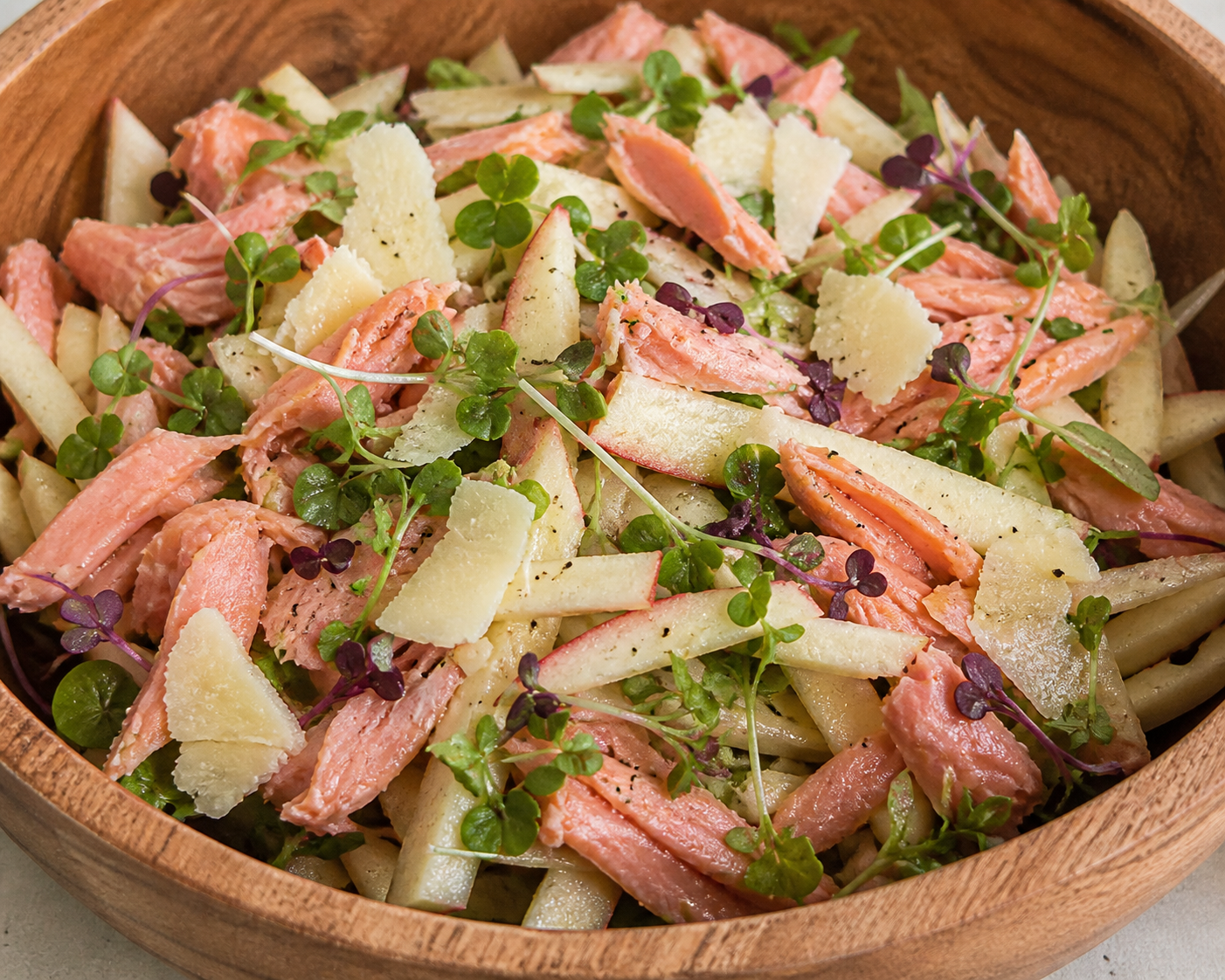
Smoked Trout Salad with Apple, Manchego, and Microgreens
A composed autumn plate — flaked smoked trout, peppery greens, paper-thin apple, aged Manchego, and a lemon-honey-thyme dressing
Season: Autumn (peak) · Cuisine: American · Iberian-influenced · Farm-to-Table · Yield: Serves 2 (scales linearly) · Active: 15 min · Total: 20 min · Best eaten: midday or early evening
This is the lighter, brighter cousin of the roasted-and-composed sardine plate — built around smoked rainbow trout, sweet apple or pear, salty aged Manchego, and a peppery base of arugula and microgreens. Less roasted, more elegant. It works as a light lunch on its own or as a starter to a longer dinner. The architecture is foundational European cookery: peppery green plus sweet fruit plus salty aged cheese plus acid plus good olive oil — the same logic that drives the Italian arugula-pear-Parmigiano salad and the Spanish Manchego-with-membrillo plate. Adding smoked trout turns the side-salad architecture into a complete meal without disrupting the flavor balance.
Ingredients
Greens base
4 cups baby arugula (or wild rocket if available — significantly more peppery)
1 cup mixed microgreens (pea shoots, sunflower sprouts, radish microgreens, broccoli microgreens, or a wild blend)
Smoked trout
Fresh-smoked rainbow trout from a small US producer (about 4–6 oz for two servings) — see sourcing notes below for where to buy
OR 1 tin Fishwife smoked rainbow trout (or Patagonia Provisions) — both in extra virgin olive oil
Reserve any oil from the tin for finishing
Fruit
1 crisp apple (Honeycrisp, Pink Lady, Fuji, or the rare Pink Pearl) OR 1 ripe pear (Bartlett, Bosc, or Anjou), thinly sliced just before serving
½ cup pomegranate arils (autumn–winter) OR 4 ripe fresh figs, quartered (late summer)
Vegetables
½ small fennel bulb, fronds reserved, bulb thinly shaved on a mandoline
¼ small red onion or 1 small shallot, thinly shaved (soaked in cold water for 10 minutes to mellow if sharp)
Cheese
¼ cup aged Manchego DOP (12 months minimum, preferably viejo or añejo — see sourcing notes), thinly shaved with a vegetable peeler
Crunch
¼ cup toasted Marcona almonds (lightly crushed) OR ¼ cup pecans OR ¼ cup toasted hazelnuts
Lemon-honey-thyme dressing
Juice of 1 lemon (about 3 tbsp)
¼ cup fresh extra virgin olive oil (a fruity, peppery early-harvest oil if you have it)
1 tsp Dijon mustard (Edmond Fallot, small-batch Burgundian, is the chef's choice)
2 tsp raw honey
1 small garlic clove, finely grated
1 tsp fresh thyme leaves (plus more for garnish)
¼ tsp Baja Gold sea salt (or other mineral-rich finishing salt)
Generous fresh black pepper
Optional protein boost
2 soft-boiled eggs (7 minutes), halved — pasture-raised
Finishing
Additional Baja Gold sea salt
Fresh thyme sprigs and reserved fennel fronds
Additional fresh black pepper
Lemon wedges, for serving
Method
Make the dressing first. Whisk the lemon juice, olive oil, Dijon, honey, grated garlic, thyme, Baja Gold salt, and black pepper in a small bowl until emulsified. Let stand 10 minutes for the flavors to meld and the salt to fully dissolve. The honey-mustard combination needs a few minutes to come together; tasting too early will give a misleading result.
Prep the trout. If using fresh-smoked trout, gently flake the fillet into large bite-sized pieces with your fingers, removing any pin bones or skin. If using tinned, open the tin and gently lift the smoked trout fillets onto a small plate, flake the same way, and reserve 1 tbsp of the oil from the tin for finishing. Don't shred the trout — visible flakes hold their structure better in the salad and give the plate its rustic-elegant look.
Slice the apple just before serving. This is genuinely important — apple oxidizes within minutes, and the salad's beauty depends on bright white-and-pink slices, not browned ones. Use a mandoline or a very sharp knife for paper-thin slices. To slow oxidation if needed, toss the slices with a teaspoon of lemon juice immediately.
Shave the fennel and Manchego. Use a mandoline for the fennel (paper-thin ribbons), and a vegetable peeler for the Manchego (long curling shavings). The Manchego shavings should look almost like ribbons of light wood — that's the right thickness.
Compose the salad. Spread the arugula in a single layer on a large platter or two wide shallow bowls. Scatter the microgreens across the top, then layer the shaved fennel, sliced apple, and red onion across the greens. Distribute the flaked trout in visible groupings rather than mixing it through. Scatter the Manchego shavings — let some fall over the trout, some over the greens. Add the pomegranate arils (or quartered figs) and toasted nuts. If using soft-boiled eggs, nestle the halves into the salad cut-side up at the end.
Finish. Drizzle the lemon-honey-thyme dressing across the entire salad. Add the reserved trout-tin oil if using tinned trout (it carries smoke and salt that the dressing alone does not). Sprinkle a final pinch of Baja Gold sea salt, scatter fresh thyme sprigs and the reserved fennel fronds, and grind additional black pepper across the top.
Serve immediately. Plate with lemon wedges alongside. Eat with both a fork and your hands — this is a salad that wants to be picked at.
Storage: Best assembled and eaten immediately. Dressing alone keeps refrigerated 1 week (the flavors actually improve over 24 hours). An opened trout tin keeps 2 days refrigerated, sealed in a glass container with its oil. Toasted nuts keep at room temperature for 1 month, sealed.
Enhancement Options
Make-ahead components
The dressing keeps a full week refrigerated and the flavors deepen over 24 hours — make it the day before for richer flavor. Toasted nuts can be done up to a month ahead, kept sealed at room temperature. The fennel can be shaved and held in cold lemon water for up to 4 hours (the acid prevents browning and mellows the licorice intensity). The trout can be flaked and kept refrigerated in its oil for up to a day. With these prepped, the actual assembly is 5 minutes — making this an ideal dinner-party first course you can plate the moment guests sit down.
Bread accompaniment
Sourdough crostini brushed with EVOO and rubbed with raw garlic, then toasted, is the classic Iberian companion. Seedy gluten-free crackers (Mary's Gone Crackers, Simple Mills, or Jilz) work for grain-free eaters. A torn loaf of warm sprouted-grain bread (One Degree or local sourdough) on the table is the genuinely European treatment — guests tear pieces and use them to mop up dressing.
Texture additions
Toasted pumpkin seeds (pepitas) or sunflower seeds add a different crunch profile than the nuts and lighten the whole plate; ¼ cup, dry-toasted in a cast iron pan over medium-low heat for 3–4 minutes. Crispy roasted chickpeas (½ cup, roasted at 400°F for 25–30 minutes with EVOO and smoked paprika) turn the salad more substantial. A small handful of soft herbs (dill, tarragon, chervil) folded in with the microgreens adds a different aromatic register.
Drizzle finishings
A few drops of high-quality chili oil (Fly By Jing or homemade) add gentle heat without disrupting the flavor balance. A drizzle of aged balsamic (a true 12-year traditional from Modena, not the commercial supermarket version) over the figs in the late-summer variation is genuinely transformative. A lemon-thyme oil — EVOO infused with strips of lemon zest and thyme sprigs over low heat — can replace the reserved tin oil for an even brighter finish.
Egg variations
Soft-boiled at 7 minutes is the recipe default. Jammy at 6.5 minutes gives you a more flowing yolk that becomes part of the dressing as you eat. A poached egg (3 minutes in barely simmering water) gives the most elegant presentation but requires last-minute timing. A hard-boiled egg would be the last optionk, since the dry yolk may fight the salad's silkiness.
Scaling for a gathering
The recipe scales linearly. For 4, double everything (one whole tin or 8–12 oz fresh-smoked trout). For 6, triple. For 8 or more, plate as a long composed platter rather than individual bowls — visually more dramatic, and easier to assemble all at once. Reserve extra dressing on the side for those who want more.
Seasonal Variations
Late summer: Swap pomegranate for ripe figs (Black Mission or Brown Turkey, quartered). Swap apple for white peach or yellow nectarine, sliced thin. The peach-fig combination brings the salad fully into late-August, early-September territory.
Spring: Swap apple for fresh strawberries (halved or quartered, depending on size). Swap pomegranate for shelled fresh peas or sugar snap peas, blanched 30 seconds. Add radish slices for additional crunch and pepper. The result is a meaningfully different plate — green and bright rather than autumnal and warm.
Winter: Swap apple for blood orange segments (cut into supremes for the cleanest presentation). Swap pomegranate for dried sour cherries (or fresh-made pomegranate molasses dotted across the plate). Add roasted beets (golden or Chioggia for visual contrast). The winter version is genuinely the most luxurious — the deeply colored fruit, the rich earth from the beets, the aged cheese all reading at peak.
Foundational meal version: Add a small grain (toasted farro, kamut, einkorn, or quinoa, ¼ cup cooked per serving) tossed with a splash of the dressing while still warm so the grain absorbs flavor. This turns the salad from light-lunch architecture into a complete dinner. Sprouted-and-cooked grains are nutritionally cleaner and more digestible than standard preparations — One Degree Organic Foods is the source for sprouted versions of all four grains.
Nourishment Notes
Smoked rainbow trout is one of the cleanest small-fish options on the modern American plate. Trout is a freshwater fish, and unlike many farmed marine fish, freshwater rainbow trout from US producers (particularly the Idaho, North Carolina, and Pennsylvania spring-fed systems) are typically raised in cold-water environments with low contamination risk and verifiable testing — the best producers can show you their lab results for PCBs, mercury, and pesticides. Cold-smoking preserves the fat content and the omega-3 profile (rainbow trout is roughly equivalent to wild salmon in EPA and DHA), and the smoke itself adds compounds — notably guaiacol and other smoke phenols — that have mild antimicrobial properties. The producers worth seeking out (Sunburst, Fishwife, Patagonia Provisions, Browne Trading) handle the smoke and the salt cure with traditional methods rather than the liquid-smoke shortcut found in commodity smoked fish.
The fruit-cheese-greens architecture of this salad is one of the foundational compositions of European cookery. Insalata di rucola, pera e parmigiano — arugula, pear, and Parmigiano — appears across central Italian menus year-round; the Spanish version with Manchego and quince paste (membrillo) is structurally identical. The principle is simple: peppery green plus sweet fruit plus salty aged cheese plus acid plus good olive oil produces a balanced bite that satisfies all five tastes simultaneously. Adding smoked trout turns the side-salad architecture into a complete meal without disrupting the flavor balance, and the substantial fat from the cheese, the olive oil, and the trout itself is what allows the body to absorb the fat-soluble nutrients (vitamins A, D, E, K from the fish; carotenoids from the apple skin and the greens) — a low-fat version of this salad would leave most of the nutritional value behind.
The Manchego choice matters more than most home cooks realize. Manchego is a Spanish sheep's-milk cheese aged anywhere from 60 days to 2 years; the flavor profile shifts dramatically across that aging window. Younger Manchego (60–90 days, semicurado) is mild, slightly sweet, and milky — pleasant but flat in a salad. Aged Manchego (12+ months, curado or viejo) develops sharp tyrosine crystals (the small white crunchy bits in aged hard cheese), concentrated savory depth, and a slight grassy bitterness from the sheep's milk that pairs especially well with sweet fruit and bitter greens. The 12-month aging window is the right minimum for this salad; a 2-year añejo is the genuinely top-tier choice if you can find it. Sheep's milk specifically carries a different fatty acid profile than cow's milk — higher in conjugated linoleic acid, higher in medium-chain triglycerides, and (for many people who don't tolerate cow dairy) much easier to digest. The same flavor logic drives the Italian use of aged Pecorino Romano with pear and arugula.
Microgreens are nutritionally distinct from both sprouts and full-grown greens. Harvested 7–14 days after germination, microgreens contain 4–40 times the nutrient concentration of their mature counterparts depending on the species — particularly for vitamins C, E, K, and beta-carotene precursors. The varieties recommended here each bring their own flavor: pea shoots are sweet and mild, sunflower sprouts are nutty and substantial, radish microgreens are peppery-sharp, and broccoli microgreens carry the highest sulforaphane concentration (roughly 50× that of mature broccoli, with significant implications for cellular detoxification pathways). Used together with arugula as a base, they multiply the dish's flavor complexity without adding bulk. Microgreens are also one of the easiest crops to grow on a kitchen windowsill — a tray of broccoli microgreens takes 8 days from seed to harvest, and a continuous rotation of two trays gives you fresh microgreens every other week year-round.
Baja Gold sea salt — sometimes called “the world's first sea salt” — is harvested from the Sea of Cortez in Baja California, where the unique geological conditions concentrate over 90 trace minerals (compared to the 60+ in most quality sea salts). Used as a finishing salt rather than a cooking salt, its complex mineral profile contributes both flavor depth and the slight sweet-and-mineral aftertaste that elevates a finished dish. The same role is played by Maldon flake salt in British cooking, fleur de sel in French Provençal preparations, and Persian blue salt in Iranian dishes — all artisanal finishing salts whose value comes not just from sodium but from the trace mineral profile.
As a circadian and seasonal food, this salad is midday-to-early-evening eating. The protein from the trout and the substantial fat from the cheese and olive oil produce a sustained-energy curve that carries gracefully through the afternoon — this is not a salad that leaves you hungry an hour later. The acid from the lemon and the bitter compounds from the arugula support digestion if eaten before a longer meal (the traditional Mediterranean role of bitter greens at the start of dinner). Autumn is peak season — apples are at harvest, pomegranates are coming in, microgreens are still abundant from late-season growers — but the seasonal variations let the same architecture serve year-round.
Sourcing:
Smoked rainbow trout — fresh-smoked (the genuine peak): Sunburst Trout Farms (North Carolina, third-generation family-owned since 1948, raised in spring water from the Shining Rock Wilderness in the Pisgah National Forest, lab-tested free of PCBs and mercury, no antibiotics or hormones — they ship nationwide and this is the gold standard) is the top recommendation. Browne Trading Company (Maine, Rod Mitchell's legendary purveyor — chefs across the country source from them) for cold-smoked trout in the Scottish-style. Catsmo (New York, artisan smokehouse). Spence & Co. (Massachusetts). For local pickup, almost every region has a small-scale smokehouse worth seeking out — ask at a farmers' market or a serious fishmonger.
Smoked rainbow trout — tinned (always in extra virgin olive oil, never seed oils): Fishwife Smoked Rainbow Trout (organic EVOO, sustainably sourced from US trout farms, BPA-free packaging — this is the cleanest widely-available tinned option). Patagonia Provisions Smoked Rainbow Trout (raised regeneratively, in olive oil, traceable to specific farms). Wild Planet (in olive oil, sustainably sourced). Avoid commodity tinned smoked fish that lists “soybean oil,” “sunflower oil,” “canola oil,” or “vegetable oil” in the ingredient list — these are seed oils and structurally different from olive oil, with significantly higher omega-6 loads and oxidation rates that compromise the otherwise-clean fat profile of the trout itself.
Aged Manchego DOP — what to look for: First, the DOP (Denominación de Origen Protegida) seal is non-negotiable — it certifies the cheese was made in La Mancha, Spain, from 100% Manchega sheep's milk, and aged according to traditional methods. Without DOP, you're getting a generic sheep's-milk cheese that may or may not be Spanish. Second, the aging window: “semicurado” (3–6 months) is too young for this salad; “curado” (3–6 months for young curado, 6–12 for older) is the entry point; “viejo” (1+ year) is the recommended choice; “añejo” (2+ years) is the genuine top tier. The older the cheese, the more pronounced the tyrosine crystals (the small white crunchy specks in the cheese), the deeper the savory complexity, and the more pronounced the grassy-bitter sheep's-milk character. Third, look for raw-milk Manchego if available — many DOP Manchegos are made from raw sheep's milk and aged long enough to be legal in the US (60+ days). Specific producers worth seeking out at a serious cheese counter: Don Juan, Pasamontes, Mitica, Estepa, Murcia al Vino, or whatever your cheese counter recommends as their oldest available Manchego DOP. Forever Cheese imports several of the more artisanal small-producer Manchegos; Mitica is widely available at Whole Foods and serious cheese shops. Avoid pre-packaged “Manchego” from supermarket dairy cases — much of it is younger than 60 days and lacks the depth this salad depends on.
Baby arugula and microgreens: local farmers' market is the genuine peak — many small growers do microgreens specifically because the rotation is fast and the margins are good. For shipped: Fresh Origins (California, the largest specialty microgreens grower) at specialty grocers, or local CSA shares. Backyard or windowsill growing is genuinely easy: 8 days from seed to harvest for broccoli microgreens.
Apples and pears: local farmers' market or orchard at peak harvest — Pink Pearl apples specifically are a rare heirloom variety with pink flesh, worth seeking out. Backyard fruit if you have it. For shipped, Frog Hollow Farm (California, biodynamic) or local heritage-orchard CSA shares.
Pomegranate: California-grown in season (October–January), local farmers' market. Wonderful is the dominant commercial variety and is fine; heirloom varieties (Eversweet, Parfianka) are sweeter and more complex if you can find them.
Fresh figs (late-summer variation): local farmers' market in late summer — Black Mission, Brown Turkey, or Calimyrna varieties. Backyard fig trees are productive in USDA zones 7+. Out of fresh-fig season, skip and use pomegranate.
Fennel: local farmers' market in autumn–winter — heirloom Florence fennel has the most pronounced flavor. Backyard fennel grows easily in zones 6+.
Marcona almonds: La Tienda or Despaña for genuine Spanish imports (fried in olive oil specifically — check the label, some commercial Marconas are fried in seed oils which defeats the entire point). Mitica also imports them. Trader Joe's carries acceptable Marconas at lower price points. Avoid commodity “Marcona-style” almonds — these are typically California almonds rebranded.
Single-estate extra virgin olive oil: Gustiamo, Eataly, or Olio2Go for shipped imports. Named benchmarks include Olio Verde (Sicily, Frantoia family), Castelines (Provence), and Frantoia for cooking-grade. For finishing, the early-harvest oils are the genuine peak — these are pressed from green olives in October–November and carry the most pronounced peppery-grassy character. Look for harvest dates on the bottle, not just “best by” dates.
Lemons: local farmers' market in subtropical regions; backyard tree in USDA zones 9+; for shipped, Frog Hollow or specialty California citrus growers. Meyer lemons are the most aromatic for dressings. Avoid waxed supermarket lemons if zest is involved.
Raw honey: local apiarist is the genuine peak; for shipped, Really Raw Honey or Beekeeper's Naturals.
Dijon mustard: Edmond Fallot (small-batch Burgundian, the chef's choice) — significantly more complex than commodity Grey Poupon.
Garlic: heirloom hardneck (Music, Spanish Roja, German Red, Chesnok Red) from a farmers' market or backyard. Heirloom varieties have dramatically more flavor than commodity garlic and store well through winter.
Fresh thyme: windowsill or backyard — thyme is one of the easiest perennial herbs to grow and pays dividends year-round. Local farmers' market in winter when home plants are dormant.
Baja Gold sea salt: direct from BajaGoldSaltCo.com or Amazon. Maldon (English flake), Jacobsen Salt Co. (Oregon), or Halen Môn PDO (Welsh) are the high-quality alternatives if Baja Gold isn't available.
Pasture-raised eggs (for optional protein boost): local farm direct, Alexandre Family Farm, or Apricot Lane Farms direct.
Marcona almonds (alternative — pecans or hazelnuts): for pecans, Pearson Farm (Georgia, fifth-generation) or local farmers' market vendors; for hazelnuts, Holmquist Hazelnuts (Pacific Northwest, multi-generational) or Freddy Guys Hazelnuts (Oregon).