Ancestral Quiches: Six Seasonal Variations with Three Crust Options
Yield: 6-8 servings per quiche · Active: 30 min · Total: 1 hr 30 min · Year-round with seasonal peaks · Best eaten: brunch, light supper, or picnic
A note on this collection
Real quiche is honestly one of the most nourishing egg dishes you can make: a classic French dish that stretches a few eggs and some cream into a complete meal that feeds a table. The custard of eggs and cream delivers complete protein, choline (essential for cellular membrane function, liver health, and brain health), fat-soluble vitamins (A, D, E, K2), and the kind of satisfaction that carries you for hours. Each seasonal variation showcases peak-season vegetables and traditional cheese pairings.
This collection rebuilds the classic quiche around whole-food ingredients: pasture-raised eggs, raw milk and cream, real cheese from small dairies, and three thoughtful crust options for different bodies and preferences.
A Note on Pan Sizes
Everything here is written for a 9x13 pan (or a 10-inch deep-dish pie). The cauliflower and sweet potato crusts work best in a 9-inch pie dish, so for those, halve the custard and the filling and bake 30-35 minutes. Making the almond crust or sprouted wheat crust in a 9-inch pie dish? Halve the crust too.
Three Crust Options — Pros and Cons
Before we get to the fillings, let's walk through your three crust options. Each delivers a real ancestral quiche experience, and each has trade-offs worth knowing.
Option A — Grain-Free Almond Press-In Crust
Press-in, no rolling required. Buttery, tender, holds its shape beautifully.
Pros:
Grain-free (works for those avoiding gluten and grains)
Rich, buttery flavor that reads like traditional pastry
Simple press-in method: no rolling, no chilling required
Holds its shape well during long baking
Cons:
High in almond content, which is worth noting for those sensitive to almond flours or who don't want to eat 3 cups of almonds in one meal
Requires tapioca flour (a specialty flour some pantries don't stock)
Denser than traditional pastry: more like shortbread than flaky puff
Ingredients:
3 cups blanched almond flour
¾ cup tapioca flour
1 tsp Baja Gold sea salt
8 tbsp cold pastured butter, cubed
1 pastured egg
Method: Pulse the flours and salt in a food processor. Add the butter and pulse until the mix looks like wet sand. Pulse in the egg until it clumps together. Press evenly into a parchment-lined 9x13 pan (or halve the recipe for a 9-inch pie dish), up the sides about 1 inch. Prick all over with a fork. Blind bake at 350°F for 12-15 minutes until just golden at the edges. Cool 10 minutes before filling.
Option B — Cauliflower or Sweet Potato Crust (Nut-Free and Grain-Free)
Vegetable-based crust. Much lighter than the almond version. My honest pick for those avoiding both grains and nuts.
Pros:
Nut-free and grain-free, ideal for those with almond sensitivity or nut allergies
Much lighter than the almond version
Adds an extra serving of vegetables to the meal
Kids often love the sweet potato version
Cons:
Requires more prep time (cauliflower requires ricing and moisture removal; sweet potato requires thin slicing)
A little more fragile, so it's best in a 9-inch pie dish rather than a full 9x13 pan
Distinct vegetable flavor (mild, but present)
Doesn't hold crimped edges the way a flour crust does
Cauliflower Crust
Ingredients:
1 large head cauliflower (about 4 cups riced)
2 pastured eggs
1 cup grated Parmigiano-Reggiano or raw cheddar
1 tsp Baja Gold sea salt
½ tsp freshly cracked black pepper
1 tsp dried oregano or thyme
Optional: 1 tbsp arrowroot powder (helps bind)
Method: Rice the cauliflower in a food processor. Steam it 5 minutes until tender. Let it cool enough to handle, then transfer it to a clean kitchen towel and squeeze out as much moisture as possible. This step is essential; a wet crust will be soggy. In a bowl, combine the drained cauliflower, eggs, cheese, seasonings, and optional arrowroot. Press evenly into a parchment-lined 9-inch pie dish. Bake at 400°F for 20-25 minutes until golden and set. Cool 10 minutes before filling.
Sweet Potato Crust
Ingredients:
2 medium sweet potatoes, peeled and thinly sliced (⅛ inch, mandoline works best)
2 tbsp melted grass-fed butter or ghee
½ tsp Baja Gold sea salt
Method: Slice the sweet potatoes on a mandoline. Toss with melted butter and salt. Arrange them overlapping in a parchment-lined 9-inch pie dish, working from the outside in, covering the bottom and sides. Bake at 400°F for 20 minutes until softened and starting to crisp at the edges. Cool 10 minutes before filling.
Option C — Sprouted Wheat Shortcrust (Pâte Brisée)
Traditional French pastry reimagined ancestrally with sprouted wheat. My honest pick for those who tolerate wheat and want authentic French pastry texture.
Pros:
Easier to digest than conventional wheat flour for many people: sprouting activates enzymes that break down phytic acid and partially break down gluten, reducing digestive burden and improving mineral bioavailability
Delivers the classic flaky, tender French pastry experience
Familiar rolling technique for those comfortable with pastry
Uses smaller amounts of any single ingredient (no 3 cups of almonds)
Traditional French pâte brisée technique honored
Cons:
Contains gluten, so it's not appropriate for celiac disease, wheat allergy, or those strictly avoiding gluten
Requires sprouted wheat flour (specialty ingredient, though increasingly easy to find)
Requires rolling, chilling, and blind baking (more time than press-in options)
Sprouted wheat drinks more water than standard flour (see technique note below)
Ingredients:
2½ cups (300 g) sprouted wheat flour (sprouted spelt or sprouted white wheat makes the lightest pastry)
1 tsp Baja Gold sea salt
1 cup (226 g) cold pastured butter, cubed
1 pastured egg yolk
5 to 7 tbsp ice water
Method: Rub the butter into the flour and salt until pea-sized pieces remain. Add the yolk and just enough water to hold the dough together. Flatten into a rectangle, wrap, and chill 1 hour. Roll to ⅛ inch and line the pan, leaving a 1-inch rim. Chill 20 minutes. Line with parchment and fill with pie weights. Blind bake at 375°F for 20 minutes, remove the weights, and bake 5 more minutes.
A note on working with sprouted wheat
Sprouted wheat behaves quite differently from conventional wheat flour:
It drinks more water. Expect to add 1-3 tablespoons more liquid per cup than a standard recipe calls for.
Its gluten is weaker. Sprouting activates enzymes that soften gluten, so keep mixing short and chill doughs well.
Sift it for delicate pastry. Sprouted whole wheat is full of bran; for the finest crust, sift through a fine strainer.
Which crust to choose
For dinner parties, French tradition, and those without wheat sensitivity: Sprouted wheat shortcrust
For grain-free/paleo eaters, gluten-sensitive but almond-tolerant: Almond press-in
For those avoiding both grains AND nuts, or wanting an extra vegetable serving: Cauliflower or sweet potato
For a crisp bottom with any crust: right after blind baking, brush the hot crust with a lightly beaten egg white and return it to the oven for 2 minutes. It seals the crust so the custard can't soak in.
The Universal Custard Base (Same for All Six Quiches)
Every quiche in this collection uses the same custard. It's a rich, egg-forward custard that sets up beautifully and slices cleanly every time.
Ingredients:
8 large pastured eggs
1 cup raw cream
1 cup raw milk (or an additional ½ cup cream if you want it richer)
1 tsp Baja Gold sea salt
½ tsp freshly cracked black pepper
Pinch of nutmeg
Optional: 1 tbsp fresh chopped herbs matched to the filling
Method: In a large bowl, whisk the eggs until fully combined but not frothy. Whisk in the cream, milk, salt, pepper, nutmeg, and optional herbs. Set aside.
Yields enough custard for one 9x13 quiche or one 10-inch deep-dish pie. Halve for a 9-inch pie dish.
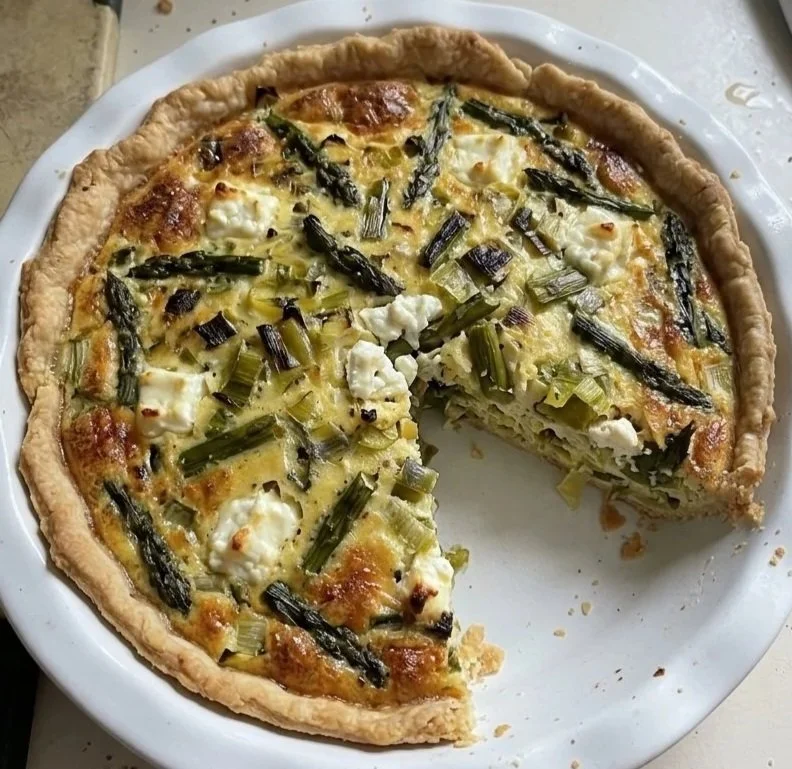
Recipe 1 — Spring Asparagus, Leek, and Goat Cheese Quiche
Peak spring flavors. Bright green asparagus, sweet caramelized leeks, tangy fresh goat cheese, and a scattering of fresh herbs. Fancy enough for company, easy enough for a Sunday morning.
Peak season: March through June
Filling ingredients
1 bunch fresh asparagus (about 1 lb), tough ends trimmed, cut into 1½-inch pieces
2 large leeks (white and light green parts only), thinly sliced and washed thoroughly
3 tbsp pastured butter or ghee
4 oz fresh goat cheese (chèvre), crumbled
½ cup raw Gruyère or Comté, grated (optional, for extra depth)
2 tbsp fresh chives, chopped
1 tbsp fresh tarragon leaves, chopped (optional but honestly beautiful)
1 tsp fresh lemon zest
½ tsp Baja Gold sea salt
¼ tsp freshly cracked black pepper
Method
Blanch the asparagus. Bring a pot of salted water to a boil. Add the asparagus and cook 90 seconds, then transfer to an ice bath. Drain and pat dry. Reserve about 8-10 whole asparagus tips for the top.
Caramelize the leeks. In a large skillet, melt the butter over medium heat. Add the sliced leeks with the salt and pepper. Cook slowly, stirring occasionally, for 15-20 minutes until sweet, silky, and lightly golden. Set aside to cool slightly.
Assemble. Spread the caramelized leeks evenly over the blind-baked crust. Scatter the blanched asparagus pieces over the leeks. Crumble the goat cheese and Gruyère over the top. Sprinkle with chives, tarragon, and lemon zest.
Pour the custard. Slowly pour the custard base over the fillings, letting it settle between the vegetables and cheese.
Arrange the asparagus tips. Lay the reserved asparagus tips decoratively on top.
Bake. Bake at 350°F for 35-40 minutes, until the center barely wobbles when you gently shake the pan. If the top browns too quickly, tent it with parchment.
Rest. Cool 15-20 minutes before slicing. Quiche is honestly better slightly warm than piping hot: the custard sets and the flavors deepen.
Recipe 2 — Summer Heirloom Tomato, Basil, and Sheep's Milk Feta Quiche
Peak summer glory. Jewel-toned heirloom tomatoes, fragrant fresh basil, salty sheep's milk feta, and a whisper of garlic. Mediterranean sunshine on a plate.
Peak season: July through September
Filling ingredients
2 medium heirloom tomatoes (mixed colors: red, yellow, orange, green zebra), sliced ¼-inch thick
1 pint mixed cherry tomatoes, halved
1 tsp Baja Gold sea salt (for salting the tomatoes)
3 tbsp extra virgin olive oil
3 garlic cloves, thinly sliced
1 small red onion, thinly sliced
6 oz sheep's milk feta, crumbled
½ cup raw ricotta or fresh goat cheese
¼ cup fresh basil leaves, torn (plus more for garnish)
1 tbsp fresh oregano, chopped
½ tsp red pepper flakes (optional)
Zest of ½ lemon
Method
Salt the tomatoes. Arrange the sliced heirloom tomatoes on a paper-towel-lined tray. Sprinkle with the salt. Let them sit 20-30 minutes to draw out excess moisture. Blot dry. This step is essential for a non-soggy quiche.
Soften the onion and garlic. In a small skillet, heat 2 tbsp olive oil over medium heat. Add the sliced red onion and cook 8-10 minutes until softened. Add the sliced garlic and cook 30 seconds more. Set aside to cool.
Assemble. Spread the onion mixture over the blind-baked crust. Scatter half the feta and all the ricotta over the onions. Layer half the cherry tomatoes over the cheese. Scatter the torn basil leaves.
Pour the custard. Slowly pour the custard base over the fillings.
Top. Arrange the sliced heirloom tomatoes decoratively across the top. Scatter the remaining cherry tomatoes and feta. Drizzle with the remaining 1 tbsp olive oil. Sprinkle with oregano, red pepper flakes, and lemon zest.
Bake. Bake at 350°F for 40-45 minutes (slightly longer than the other quiches because of the tomato moisture), until the center barely wobbles.
Finish. Cool 15-20 minutes. Scatter with extra fresh basil before serving.
Recipe 3 — Autumn Wild Mushroom, Caramelized Onion, and Gruyère Quiche
Wild-foraged mushrooms, deeply caramelized onions, aged Gruyère, and fresh thyme. Cozy Sunday supper cooking at its best.
Peak season: September through November
Filling ingredients
1½ lb mixed mushrooms (chanterelles, maitake, oyster, cremini, shiitake), cleaned and roughly torn
3 tbsp pastured butter or ghee
2 tbsp extra virgin olive oil
2 large yellow onions, thinly sliced
4 garlic cloves, minced
2 tbsp fresh thyme leaves
1 tbsp fresh rosemary, finely chopped
2 tsp raw apple cider vinegar (deglazes the pan)
1½ cups Gruyère, Comté, or Emmental, grated
½ cup grated Parmigiano-Reggiano
1 tsp Baja Gold sea salt
½ tsp freshly cracked black pepper
Method
Deeply caramelize the onions. In a large heavy skillet, melt 2 tbsp butter with 1 tbsp olive oil over medium-low heat. Add the sliced onions with a pinch of salt. Cook slowly, stirring every 5-10 minutes, for 40-50 minutes until deeply golden-brown and jammy. This step honestly can't be rushed; the depth of flavor depends on it.
Sear the mushrooms. In a separate large skillet, heat the remaining 1 tbsp butter and 1 tbsp olive oil over medium-high heat. Add the mushrooms in a single layer (work in batches if needed). Cook 5-7 minutes without moving them, then flip and cook another 3-4 minutes until deeply golden and any released moisture has evaporated.
Finish the mushrooms. Add the garlic, thyme, and rosemary. Cook 30 seconds until fragrant. Add the apple cider vinegar and let it evaporate. Season with the remaining salt and pepper. Cool slightly.
Assemble. Spread the caramelized onions evenly over the blind-baked crust. Layer the mushrooms over the onions. Scatter the Gruyère and Parmigiano over the top.
Pour the custard. Slowly pour the custard base over the fillings.
Bake. Bake at 350°F for 35-40 minutes, until the center barely wobbles.
Rest. Cool 15-20 minutes before slicing.
Recipe 4 — Winter Wild Salmon, Dill, and Crème Fraîche Quiche
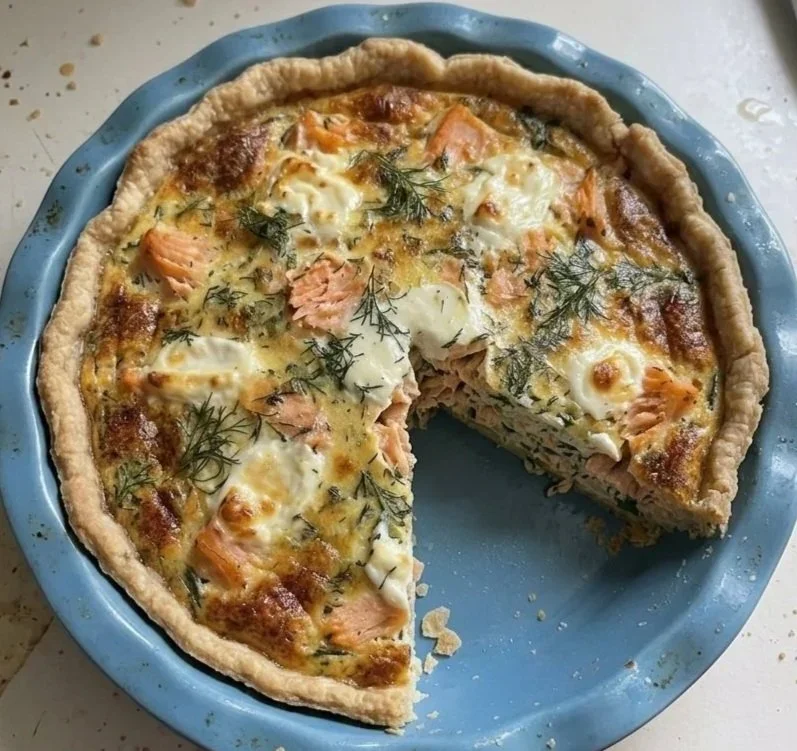
Wild-caught salmon, feathery fresh dill, crème fraîche, and a whisper of lemon zest. Special enough for a holiday brunch.
Peak season: December through March (using flash-frozen wild salmon and hardy winter herbs)
Filling ingredients
12 oz wild-caught salmon (sockeye or king), skin removed, cut into ¾-inch cubes
OR 8 oz wild-caught hot-smoked salmon, flaked (for a more traditional Nordic version)
1 tbsp extra virgin olive oil (optional, for searing)
1 large leek (white and light green parts), thinly sliced
2 tbsp pastured butter or ghee
½ cup crème fraîche (see the note below)
3 tbsp fresh dill, chopped (plus more for garnish)
2 tbsp fresh chives, chopped
1 tbsp capers, drained (optional but honestly beautiful)
Zest of 1 lemon
1 tsp Baja Gold sea salt
½ tsp freshly cracked black pepper
½ cup Gruyère or aged goat cheese, grated (optional)
Method
Sauté the leeks. In a skillet, melt the butter over medium heat. Add the sliced leeks with a pinch of salt. Cook 10-12 minutes until silky and translucent, but not browned. Set aside.
Prepare the salmon.
For fresh cubed salmon: Season lightly with salt and pepper. The raw cubes cook gently in the custard and stay tender. For a little color, you can sear them in the olive oil over medium-high heat for just 30 seconds per side first.
For smoked salmon: Simply flake it into large pieces. No pre-cooking needed.
Modify the custard. Whisk the crème fraîche into the custard base for extra richness and Nordic tang.
Assemble. Spread the leeks over the blind-baked crust. Scatter the salmon evenly. Sprinkle with dill, chives, capers, and lemon zest. Add the optional Gruyère.
Pour the custard. Slowly pour the crème fraîche-enriched custard over the fillings.
Bake. Bake at 350°F for 35-40 minutes, until the center barely wobbles.
Finish. Cool 15-20 minutes. Garnish with extra fresh dill and a few more capers.
A note on crème fraîche
Real crème fraîche is honestly one of the most nourishing traditional dairy products around: cultured cream with live probiotic bacteria, richer than sour cream, silkier than whipped cream. My top pick is Bellwether Farms, or make your own (see Sourcing). If you can't find it, substitute an equal amount of high-quality raw sour cream (Kalona SuperNatural's organic sour cream is excellent) or thick raw yogurt.
Recipe 5 — Classic Bacon, Leek, and Chèvre Quiche Lorraine (Reimagined)
The traditional French classic with an ancestral twist. Pasture-raised bacon (sugar-free), sweet caramelized leeks, and a mix of Gruyère and fresh goat cheese. Honestly one of the most satisfying meals in this collection.
Peak season: Year-round
Filling ingredients
8 oz pasture-raised bacon (sugar-free; check labels), diced
2 large leeks (white and light green parts), thinly sliced and washed thoroughly
1 medium yellow onion, thinly sliced (an Alsatian touch)
2 tbsp pastured butter or bacon fat rendered from step 1
1½ cups Gruyère or Comté, grated
3 oz fresh goat cheese (chèvre), crumbled
2 tbsp fresh chives, chopped
1 tsp fresh thyme leaves
½ tsp freshly cracked black pepper
Optional: an extra pinch of nutmeg (traditional in Lorraine)
Method
Render the bacon. In a large skillet over medium heat, cook the diced bacon 8-10 minutes until crispy and rendered. Transfer it to a paper-towel-lined plate. Reserve 2 tbsp of the rendered bacon fat in the pan; pour off the rest (or save it for other cooking).
Caramelize the leeks and onion. Add the sliced leeks and onion to the same skillet with the reserved bacon fat (add 1-2 tbsp butter if needed). Cook slowly over medium-low heat for 20-25 minutes, stirring occasionally, until deeply softened and lightly golden.
Assemble. Spread the leek-onion mixture evenly over the blind-baked crust. Scatter the bacon evenly. Distribute the Gruyère across the top. Crumble the goat cheese in dollops. Sprinkle with chives, thyme, and pepper.
Pour the custard. Slowly pour the custard base over the fillings. The base already has nutmeg; whisk in an extra pinch first if you love it.
Bake. Bake at 350°F for 35-40 minutes, until the center barely wobbles and the top is golden.
Rest. Cool 15-20 minutes before slicing.
Sourcing note on bacon
Even pasture-raised bacon can contain hidden sugars, dextrose, and preservatives. Look for truly single-ingredient bacon: just pork, salt, and optional celery powder (for natural nitrate curing). The gold standard is a local farm raising pigs on pasture, or US Wellness Meats Sugar-Free Bacon. Read every label, since even "natural" bacon brands often add cane sugar.
Recipe 6 — Vegetarian Spinach, Artichoke, and Sheep's Milk Feta Quiche
Deep green spinach, tender artichoke hearts, salty sheep's milk feta, and a scattering of fresh herbs. So satisfying, you won't miss the meat.
Peak season: Year-round (peak spring for fresh artichokes; excellent with frozen or water-packed artichokes year-round)
Filling ingredients
10 oz fresh spinach (or 2 bunches), stems removed
2 tbsp extra virgin olive oil
1 medium yellow onion, thinly sliced
4 garlic cloves, minced
1½ cups artichoke hearts (fresh, frozen, or water-packed; skip marinated jars, which are almost always in sunflower or other seed oils), roughly chopped
8 oz sheep's milk feta, crumbled
½ cup raw ricotta or fresh goat cheese
2 tbsp fresh dill, chopped
2 tbsp fresh flat-leaf parsley, chopped
Zest of 1 lemon
½ tsp red pepper flakes (optional)
1 tsp Baja Gold sea salt
½ tsp freshly cracked black pepper
Optional: an extra pinch of nutmeg
Method
Wilt the spinach. In a large skillet, heat 1 tbsp olive oil over medium heat. Add the spinach in batches, wilting each addition before adding the next (about 5 minutes total). Transfer to a colander and press out as much moisture as possible. This step is essential to avoid a soggy quiche. Roughly chop the drained spinach.
Sauté the onion and garlic. In the same skillet, heat the remaining 1 tbsp olive oil. Add the sliced onion and cook 8-10 minutes until softened and lightly golden. Add the garlic and cook 30 seconds more. Cool slightly.
Assemble. In a large bowl, combine the spinach, onion-garlic mixture, artichoke hearts, half the feta, all the ricotta, dill, parsley, lemon zest, red pepper flakes, salt, and pepper. Toss gently to combine.
Fill the crust. Spread the spinach-artichoke mixture evenly over the blind-baked crust. Scatter the remaining feta over the top.
Pour the custard. Slowly pour the custard base over the fillings (with an extra pinch of nutmeg whisked in, if you like).
Bake. Bake at 350°F for 35-40 minutes, until the center barely wobbles.
Rest. Cool 15-20 minutes before slicing.
Plating and Serving
Quiche is honestly best served slightly warm: not straight from the oven, not fully cold. Cool it 15-20 minutes so the custard can set, slice, and serve with a simple side salad (arugula with lemon vinaigrette pairs with every one of these). For brunch, add fresh fruit; for supper, add roasted vegetables; for a picnic, quiche travels beautifully at room temperature.
Sourcing (essential picks)
For the crusts
Blanched almond flour — organic, finely ground, and fresh (it goes rancid quickly, so keep it in the fridge or freezer). U.S. almonds are pasteurized by law, even when labeled "raw," so the gold standard is blanching and grinding your own from organic, unpasteurized Spanish almonds, like Terrasoul's
Tapioca flour (starch) — organic, single-ingredient
Sprouted spelt or sprouted white wheat flour — To Your Health Sprouted Flour Co. (organic, sprouted and stone-milled fresh to order on their Alabama farm) or One Degree Organic Foods. Sprouted spelt makes the lightest pastry
Sweet potatoes — organic, firm, unblemished. Garnet, Jewel, or Japanese sweet potato varieties all work
Cauliflower — organic, tight compact heads
For the fillings
Pasture-raised eggs — from a local farm where the hens truly range on pasture, ideally on soy-free feed, or Alexandre Family Farm (Regenerative Organic Certified). Yolk color alone isn't proof, since some feeds add marigold or paprika to deepen it, so ask the farmer how the hens live
Raw milk and cream — from a small pasture-raised dairy. See sourcing detail in my Raw Milk Kefir post. If you can't find raw, look for Kalona SuperNatural (grass-fed, low-temp pasteurized, non-homogenized)
Fresh asparagus — bright green, firm stalks. Peak spring
Fresh leeks — from a farmers' market or organic produce section
Fresh goat cheese (chèvre) — a farmstead chèvre from a local goat dairy, or a French raw-milk AOP chèvre such as Sainte-Maure de Touraine
Gruyère, Comté, Emmental — Le Gruyère AOP, Comté AOP, and Emmentaler AOP are all made from raw milk by law, so the AOP seal is your guarantee. For the very best, look for Rolf Beeler's cave-aged Gruyère or Comté from Marcel Petite's Fort Saint Antoine caves
Sheep's milk feta — Greek Feta PDO (by law at least 70% sheep's milk, the rest goat's), such as Dodoni or Mt. Vikos, or 100% sheep's milk Valbreso from France. A2-type casein
Heirloom tomatoes — organic, peak-season, from a farmers' market
Wild mushrooms (chanterelles, maitake, oyster, cremini, shiitake) — from a farmers' market, forager, or specialty produce section. Peak autumn for wild-foraged varieties
Wild-caught salmon — sockeye or king. Vital Choice or Loki Fish Co., both of which source directly from Alaska's wild fisheries, or a trusted fishmonger. Peak season April-September; frozen-at-sea excellent year-round
Wild-caught hot-smoked salmon — Vital Choice or Loki Fish Co. Look for just salmon, salt, and wood smoke, since many brands add sugar
Pasture-raised sugar-free bacon — a local farm raising pigs on pasture, or US Wellness Meats Sugar-Free Bacon
Fresh spinach — organic, tender leaves
Artichoke hearts — fresh in spring (trim them yourself), frozen organic, or water-packed in glass with nothing but artichokes, water, salt, and lemon or citric acid. Skip marinated jars, which are almost always in sunflower or other seed oils
Crème fraîche — Bellwether Farms, or make your own: stir 2 tbsp cultured buttermilk into 1 cup raw or low-temp pasteurized cream, cover loosely, and leave it at room temperature 12-24 hours until thick
Capers — salt-packed Capperi di Pantelleria IGP, or capers from Salina. Rinse before use
Fresh herbs (chives, dill, tarragon, thyme, rosemary, basil, oregano, parsley) — from a farmers' market, windowsill pot, or organic produce section
Fresh garlic — organic hardneck varieties
Fresh lemons — organic when using zest
Single-estate extra virgin olive oil — harvest-dated within the past year, in dark glass
Grass-fed butter or ghee — cultured butter from 100% grass-fed cows; raw butter from a local dairy is the gold standard
Raw apple cider vinegar — with the mother (Bragg)
Baja Gold sea salt for cooking; fleur de sel de Guérande or Maldon for finishing
Whole and ground spices — black peppercorns, red pepper flakes, nutmeg (whole and grated fresh). Ground fresh for much brighter flavor
Storage
Fully baked quiche: Refrigerated up to 4 days. Reheats beautifully at 300°F for 10-15 minutes, or serve it at room temperature
Uncooked crust (all three options): Refrigerated up to 2 days; frozen up to 2 months
Custard base alone: Best whisked fresh; refrigerated up to 24 hours
Fresh mushroom, spinach, caramelized onion, and other prepped fillings: Refrigerated up to 3 days ahead
Freezing whole quiche: Fully baked and cooled quiche freezes beautifully up to 2 months. Wrap tightly in parchment, then a freezer bag. Thaw overnight in the refrigerator and reheat at 300°F for 20-25 minutes
Leftover transformations: Quiche is honestly one of the best breakfast, lunch, and picnic foods there is, and leftover slices are just as delicious cold or at room temperature. Slice cold quiche into wedges for lunch boxes; crumble leftover quiche over greens for a substantial salad; scramble leftover quiche filling with a few more eggs for a quick breakfast; serve cold quiche with a bright arugula salad for a light supper.
Support for the Female Infradian Rhythm
These quiches are beautifully supportive across all cycle phases. Pasture-raised eggs deliver exceptional choline (essential for cell membrane function, liver health, and neurotransmitter production, and especially helpful for luteal-phase mood support), B12, complete protein, and fat-soluble vitamins (A, D, E, K2). Raw dairy delivers bioavailable calcium, K2, and CLA. The spring and vegetarian variations bring folate-rich asparagus and spinach and liver-loving artichoke, with glutathione precursors and cynarin supporting Phase 2 liver detoxification of hormones. Wild salmon delivers exceptional omega-3s (EPA and DHA, essential for hormonal balance and reducing menstrual inflammation) and vitamin D. Cultured cheeses (Gruyère, Comté, sheep's milk feta, chèvre) bring concentrated calcium and K2. Wild mushrooms deliver beta-glucans supporting immune modulation and vitamin D. The traditional French Lorraine variation delivers satiating fat and B vitamins alongside the eggs' choline. Each variation supports specific phases beautifully: spring asparagus during follicular renewal; summer tomato-basil during ovulatory peak metabolism; autumn mushroom during the transition into the luteal phase; winter salmon during menstrual restoration; classic bacon Lorraine for luteal-phase satiety and grounding; spinach-artichoke for daily estrogen metabolism support.
Nourishment Notes
Pasture-raised eggs — choline, B12, complete protein, fat-soluble vitamins. One of the most nutrient-dense foods there is. Pasture-raised eggs deliver far more omega-3s, vitamin D, and vitamins A and E than commodity confinement eggs.
Raw milk and cream — bioavailable calcium, K2, CLA. Raw dairy from grass-fed cows delivers a fundamentally different nutritional profile than commodity pasteurized dairy. An honest note: baking sets the custard, so raw dairy's enzymes and live cultures don't survive the oven, but its grass-fed fats, fat-soluble vitamins, and minerals all do.
Gruyère, Comté, sheep's milk feta, chèvre — concentrated calcium, K2, A2-type casein (in goat and sheep varieties). Traditional cheese aging concentrates minerals and develops deep flavor.
Fresh asparagus (spring quiche) — folate, vitamin K, glutathione precursors, inulin. One of the highest food sources of folate and glutathione support.
Fresh leeks — quercetin, prebiotic fibers, gentle allium support. Traditional French foundational vegetable.
Heirloom tomatoes (summer quiche) — lycopene, vitamin C, potassium, polyphenols. Peak-season varieties deliver concentrated lycopene amplified by the olive oil.
Fresh basil (summer quiche) — eugenol, aromatic oils, traditional Mediterranean support.
Wild mushrooms (autumn quiche) — beta-glucans, vitamin D (particularly when sun-exposed), ergothioneine (an antioxidant found in mushrooms in far higher amounts than in any other food), traditional immune modulation.
Wild-caught salmon (winter quiche) — omega-3s (EPA and DHA), astaxanthin, vitamin D, complete protein, B12.
Fresh dill (winter quiche) — anethole, carvone, traditional Nordic and Middle Eastern digestive support.
Crème fraîche — cultured dairy, K2, CLA. Traditional French fermented cream.
Pasture-raised bacon (Lorraine quiche) — B vitamins, complete protein, satiating fat. Look for sugar-free single-ingredient sourcing.
Fresh spinach (vegetarian quiche) — folate, iron, vitamin K, magnesium. Cooking amplifies bioavailability of these minerals.
Artichoke hearts (vegetarian quiche) — cynarin, luteolin, prebiotic fibers, liver support. Traditional across Mediterranean cultures for liver metabolism.
Fresh herbs (chives, dill, tarragon, thyme, rosemary, basil, oregano, parsley) — full-spectrum aromatic oils, polyphenols, vitamin K, chlorophyll.
Fresh garlic — allicin and organosulfur compounds.
Extra virgin olive oil — oleic acid, hydroxytyrosol, oleuropein, oleocanthal.
Baja Gold sea salt — over 90 trace minerals.
— Anna aka Food Marshall