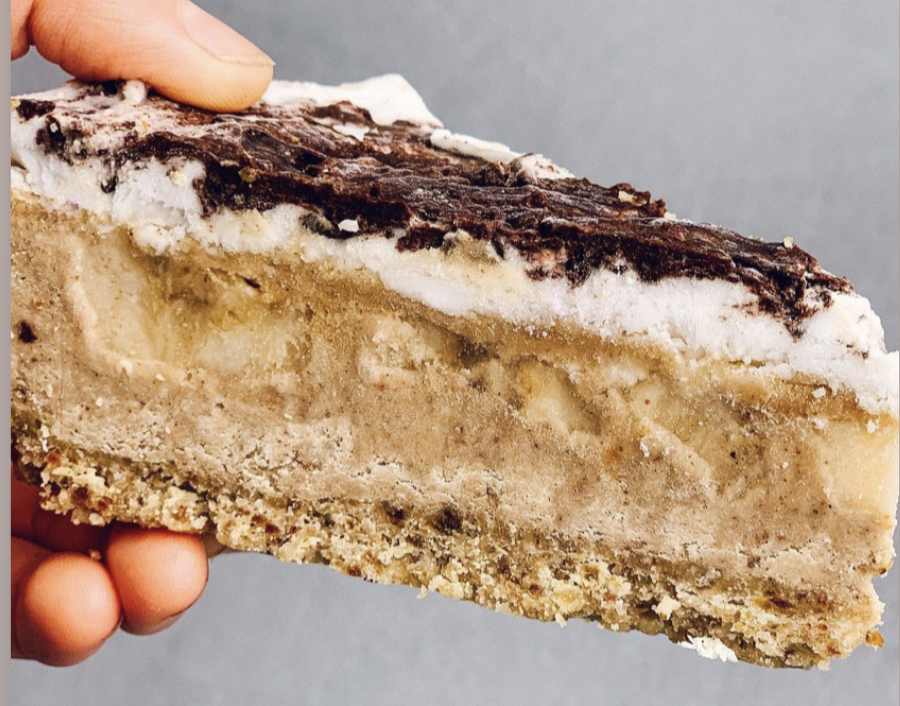
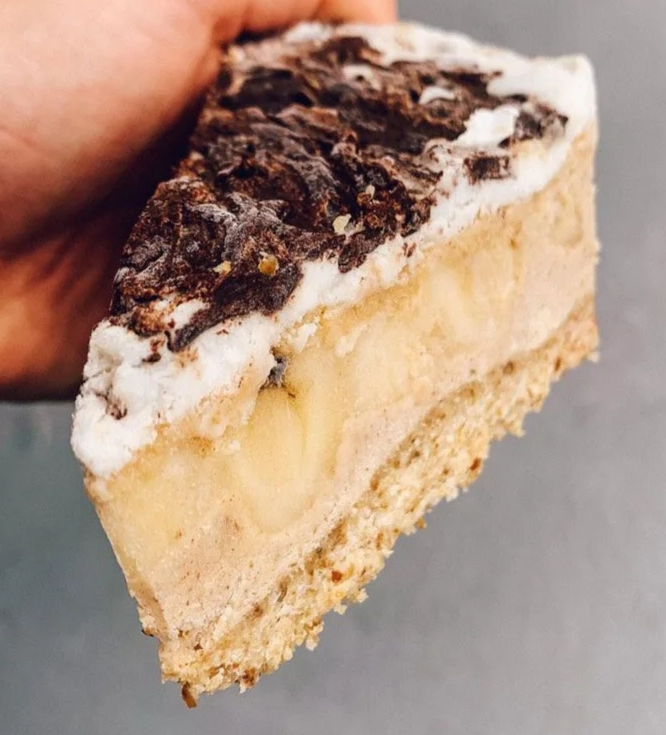
Raw Banoffee Banana Cream Pie
Cuisine: English · Reimagined Classics
Yield: One 9-inch pie, serves 10–12
Active: 30 min · Total: 4 hr+ (overnight chill preferred)
Best eaten: afternoon or early evening
Banoffee pie is an English dessert, and a surprisingly young one. It was invented in 1971 at a pub in East Sussex called The Hungry Monk, when the owner combined American banana cream pie with a Latin American dulce de leche — the caramel made by slowly cooking condensed milk down to a thick, dark syrup. The pie took off immediately, spread across England in the 1980s, and became a fixture on dessert menus across the British Isles. The name is a portmanteau: banana + toffee. The traditional version is astonishingly sweet, built on a buttery biscuit crust, a thick layer of cooked condensed-milk caramel, sliced bananas, and a generous dome of whipped cream.
This is my version of that tradition, built from whole ingredients — dates in place of condensed milk, raw cream in place of industrial whipping cream, a nut-and-coconut crust in place of digestive biscuits. The result is not a reduced-sugar imitation. It is a genuinely different dessert that happens to occupy the same silhouette as banoffee and delivers all the same pleasures — caramel, banana, cream, chocolate — while nourishing rather than depleting. What makes this version specifically mine is the raw cream layer. Most grain-free banoffee recipes built on the internet lean into cashew-coconut "whipped cream" that, while lovely, is missing something specific — the body and the faint tang that only real, grass-fed dairy can give. If your body tolerates dairy well, you can build this pie around raw cream and raw honey and the result is dramatically better than any plant-based version. The cashew variation below works for those who avoid dairy; both are delicious, but the raw dairy path is the traditional one.
A note on bananas — they are not a temperate-winter food in any ancestral sense. Bananas are tropical, grown year-round in equatorial climates, shipped to northern grocery stores throughout the year. They do not have a season the way figs or strawberries do. That said, bananas are one of the foods that has become central to the modern winter kitchen — banoffee pie, banana bread, banana pudding are all classical cold-weather comfort foods in the Anglo-American tradition. For those in subtropical climates (Florida, Southern California, coastal Gulf), bananas are regionally appropriate. For those in temperate zones, they are a long-standing imported staple. Use them in moderation, eat them paired with fat and fiber and minerals rather than as a quick sugar hit, and they earn their place at the winter table.
Ingredients
Almond-Coconut Crust
2 cups raw almonds (or 1 cup almonds + 1 cup walnuts for more depth)
½ cup unsweetened shredded coconut
2 tbsp coconut sugar (or 2 tbsp pure maple syrup)
½ tsp ground Ceylon cinnamon
2 tbsp coconut oil, melted
¼ tsp sea salt
Optional: 1 pasture-raised egg, for a slightly firmer baked crust
Date Caramel Layer
15 medjool dates, pitted and soaked in hot water 10 min if firm
¼ cup natural almond butter (single-ingredient: just almonds, maybe salt)
½ cup full-fat coconut milk (no guar gum)
½ cup fresh coconut meat (or an additional ¼ cup coconut milk if unavailable)
1 tbsp pure vanilla extract (or seeds of 1 vanilla bean)
¼ tsp sea salt
Optional elevation: 1 tsp lucuma or mesquite powder for traditional caramel depth
Banana Layer
4 medium-ripe bananas (yellow with a few small brown spots — firm enough to slice cleanly)
1 tbsp fresh lemon juice
1 tsp ground Ceylon cinnamon
1 tbsp coconut sugar
Path A — Raw Cream Topping(my preferred version, raw dairy)
2 cups very cold raw, grass-fed heavy cream
1 cup unsweetened shredded coconut
2 tbsp raw honey
1 tsp pure vanilla extract
Path B — Plant-Based Cream Topping(cashew + coconut, dairy-free)
1½ cups raw cashews, soaked 4+ hours and drained
1 cup full-fat coconut cream, chilled overnight
3 tbsp pure maple syrup
2 tbsp coconut oil, melted
1 tsp pure vanilla extract
½ tsp fresh lemon juice
Pinch sea salt
Garnish & Optional Drizzles
1 additional ripe banana, sliced into rounds at the moment of serving
Dark chocolate shavings, grated from a 75%+ raw chocolate bar (Hu Kitchen, Pascha, Eating Evolved, Raaka)
Optional: cacao nibs or chopped hazelnuts, dusting of Ceylon cinnamon
Optional raw chocolate drizzle: ⅓ cup raw cacao + ¼ cup coconut oil + 3 tbsp pure maple syrup + pinch sea salt, whisked smooth
Optional caramel drizzle: ¼ cup almond butter + ½ cup coconut cream + 1 tbsp pure maple syrup + pinch sea salt, whisked smooth
Method
Crust. In a food processor, pulse the almonds (and walnuts if using) and shredded coconut to a coarse meal — 15–20 pulses. Add coconut sugar, cinnamon, melted coconut oil, salt, and optional egg. Process until the mixture holds together when pinched. If too dry, drizzle in a teaspoon of water at a time. Press firmly and evenly into a 9-inch pie or tart pan with a removable bottom, working the crust up the sides. Freeze 15 minutes. Optional: if using the egg, bake at 350°F for 10 minutes for extra firmness, then cool before layering.
Date caramel. In the same food processor (no need to wash), combine soaked drained dates, almond butter, coconut milk, fresh coconut meat (or extra coconut milk), vanilla, salt, and optional lucuma. Process 2–3 minutes, scraping down, until completely smooth and glossy. The caramel should be thick, rich, uniformly colored — deeply sweet but not cloying, with the almond butter's savoriness coming through.
Layer the caramel. Remove the crust from the freezer. Spread the caramel evenly over the crust with an offset spatula, into the corners. Return to the refrigerator while you prepare the banana layer.
Bananas. Peel and slice the bananas into ¼-inch rounds. In a medium bowl, toss gently with lemon juice, cinnamon, and coconut sugar — the lemon juice prevents browning; the cinnamon and sugar add a caramelized note. Arrange the slices in a single overlapping layer over the caramel, covering the surface completely. Reserve about ½ cup of slices for the top garnish in a separate small bowl with a squeeze of lemon juice.
Cream topping (choose your path).
Path A — Raw Cream: chill your mixing bowl and whisk in the freezer 15 minutes. Pour the very cold raw cream into the chilled bowl and whisk (hand or mixer on medium) until soft peaks form. Do not overwhip or you'll get butter. Fold in the shredded coconut, raw honey, and vanilla gently. The texture should be pillowy, not stiff.
Path B — Plant-Based: in a high-speed blender, combine drained cashews, coconut cream, maple syrup, melted coconut oil, vanilla, lemon juice, and salt. Blend on high 2–3 minutes, scraping down, until completely silky. Refrigerate 30 minutes to firm before using.
Top the pie. Spread or dollop the cream topping over the banana layer, leaving the surface textured or smooth as you prefer. A slightly rustic look with peaks and valleys catches the eye better than a perfectly flat top.
Chill to set. Refrigerate uncovered at least 4 hours — overnight is better. The caramel firms, the bananas release their aroma into the cream, and the whole pie settles into itself.
Garnish just before serving. Scatter the dark chocolate shavings generously over the top. Arrange a few slices of the reserved banana on top, slightly overlapping, in a small spiral. If using, scatter cacao nibs or chopped hazelnuts and add a light dusting of Ceylon cinnamon. For extra drama: drizzle thin ribbons of the raw chocolate sauce and/or the caramel drizzle in a decorative pattern over the cream top.
Slice and serve. Use a warm, dry knife (run under hot water, dried between cuts) for the cleanest slicing. Serve immediately — the pie is at its best just after garnishing, while the bananas and chocolate are fresh.
Nourishment Notes
Medjool dates as caramel is the central nutritional transformation of this recipe. A traditional banoffee pie is built on dulce de leche — sweetened condensed milk cooked for hours into pure refined sugar caramelized with milk proteins. Date caramel is a different kind of food altogether. Dates are whole fruits, and their sweetness is delivered within a fiber-and-mineral matrix: each date contains potassium, magnesium, copper, B vitamins, and phenolic compounds, alongside the fructose and glucose. The fiber — particularly the soluble pectin — slows the absorption of the sugars significantly, producing a meaningfully gentler glycemic response. Dates have been the primary sweetener of the Middle East and North Africa for at least six thousand years. When blended with almond butter and coconut cream, they produce a caramel flavor and texture that genuinely rivals the dulce de leche of the original. Bananas deserve the honest treatment. A medium banana carries meaningful potassium (more than most fruits), vitamin B6, vitamin C, magnesium, and about 3 grams of fiber. Their glycemic impact varies substantially with ripeness: green and slightly underripe bananas carry resistant starch (prebiotic fiber that feeds gut bacteria, minimal blood-sugar response), while fully ripe spotted bananas have converted most of that starch to free sugars. For this pie, medium-ripe bananas are the right choice — yellow with a few small brown spots, firm enough to slice cleanly. The pairing with fat (almond butter, coconut, cream) further slows the glycemic response, and a slice of this pie contains roughly ⅓ of a banana — not a banana overload.
Raw, grass-fed heavy cream (Path A) is the ingredient that makes the raw dairy version genuinely superior. Raw cream carries intact enzymes (lipase, lactase, phosphatase), the full fat-soluble vitamin profile (A, D, K2-MK4, E), butyrate (the short-chain fatty acid that feeds gut-lining cells), and proteins that digest gently when from A2A2 breeds. When whipped, it produces a texture no plant-based cream can quite match — a specific airy, full-fat, faintly tangy quality. Raw honey (also Path A) is one of the most ancestral sweeteners in human culinary history. Real raw, unpasteurized honey contains live enzymes, trace pollen signatures from the specific region of production, small concentrations of propolis (the antimicrobial bee resin), and a gentler glycemic impact than refined sugar — particularly when delivered within a fat-and-protein matrix. Hebrew scripture names honey alongside the three other sacred foods of the ancient Middle East (wine, olive oil, and grain). It has been sweetening food across the Mediterranean and Middle East for at least seven thousand years. Commercial filtered and pasteurized honey loses its enzymes and much of its functional character. Read the label — you want unpasteurized, raw, and ideally local. Cashews (Path B), once soaked, blend into the silkiest plant-based cream possible — magnesium (one of the highest plant sources), copper, zinc, and tryptophan in concentrated form. Coconut shows up across the entire pie as a functional backbone — shredded in crust and topping, milk and cream in the caramel, oil throughout — delivering medium-chain triglycerides for cellular energy, saturated fat for satiety, and the structural fat that allows the whole pie to set. Almonds and walnuts in the crust bring vitamin E and magnesium (almonds) and alpha-linolenic acid (walnuts), with meaningful protein and fiber that keeps the glycemic response of the pie gentle. Raw cacao as the chocolate shavings on top provides the highest-polyphenol plant food most kitchens have access to: a 75%+ dark chocolate from a quality producer carries minimal sugar, meaningful magnesium and theobromine, and the specific flavonoid complexity that commercial milk chocolate has lost.
Lucuma and mesquite (optional in the caramel) deserve a brief note — both are traditional South American superfoods. Lucuma is a fruit from the Peruvian Andes, used in traditional cooking for thousands of years; its powder adds a caramel-maple note and a low-glycemic sweetness. Mesquite is the ground pod of a native desert tree used by the Sonoran Desert peoples (particularly the Tohono O'odham) as a staple food for centuries; it carries a natural caramel-malty flavor and adds depth to raw desserts. Both are optional but genuinely beautiful. As a circadian and seasonal food, this is afternoon to early-evening dessert. The combination of natural sugars (dates, banana, honey or maple) with substantial fat produces a gentle glycemic curve, but the dish still carries meaningful sweetness and is best metabolized in daylight hours when insulin sensitivity is highest. Serve after a substantial protein-forward meal rather than as an afternoon solo snack — the surrounding meal structure smooths the glycemic response further. Winter is the right season — dense caramel, rich cream, warming banana, and dark chocolate are cold-weather foods by tradition and by the body's own seasonal logic. The chilled set pie is best pulled from the refrigerator on a dark December or January afternoon, sliced into generous wedges, and served with a cup of strong tea or coffee. It is the kind of dessert that marks a gathering as celebration.
Storage: Refrigerator up to 3 days, covered. The bananas will slightly soften and darken after 24 hours, but the flavor remains good. Leftovers are genuinely welcome the next day with a cup of morning coffee. Freezing not recommended — the banana layer does not survive the thaw. The crust and caramel layers can be assembled and refrigerated up to 48 hours ahead; cream topping is best applied the day of serving (raw whipped cream loses volume after 24 hours). For a gathering of 20+, make two 9-inch pies rather than one larger pie — easier to slice and more generous on the table.