Raw Zebra Cake — Orange & ACTIVATED Charcoal-Tahini Swirl
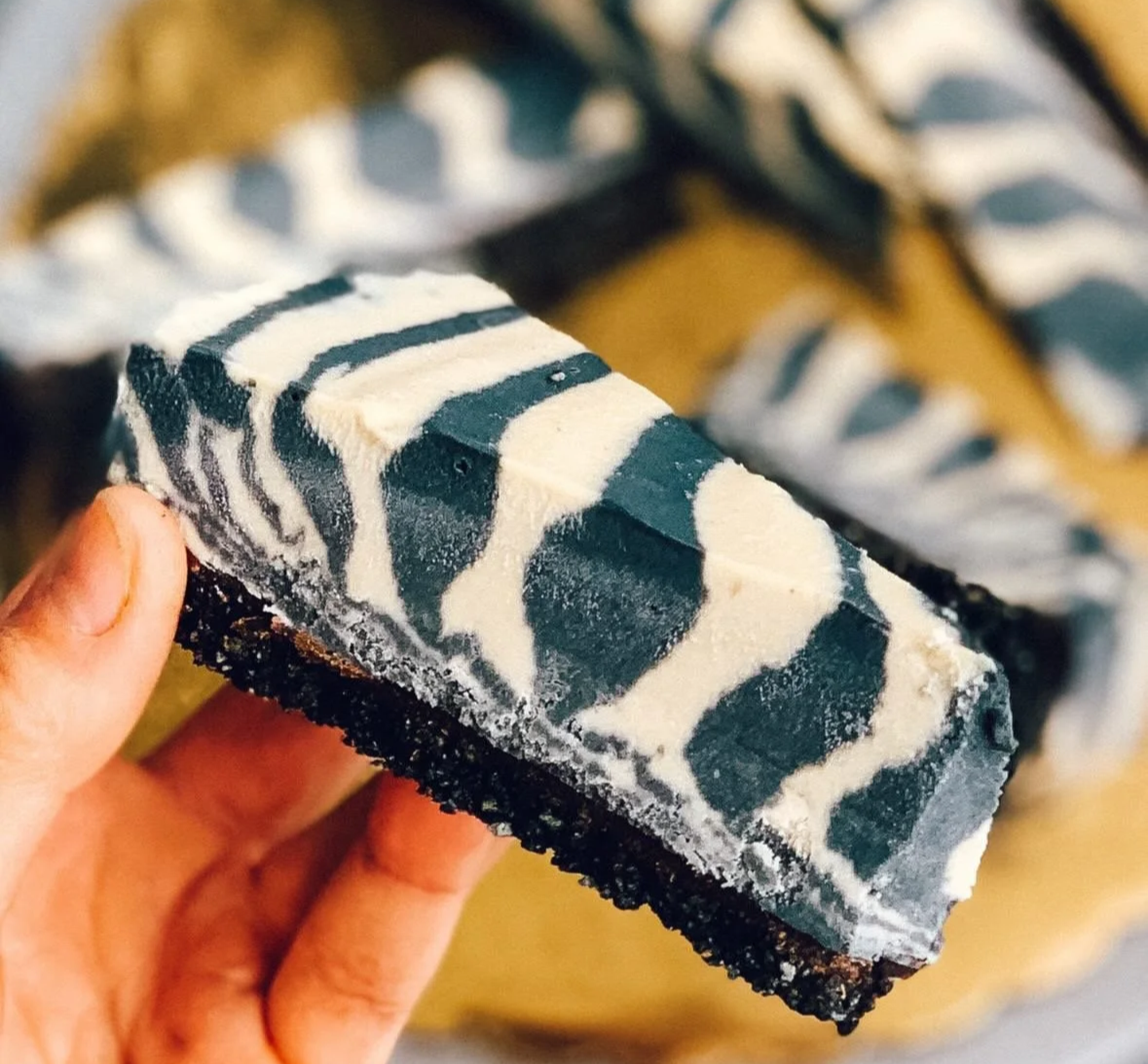
The showstopper raw cake — concentric rings of ivory-orange and charcoal-tahini.
Season: Year-Round / Foundational
Cuisine: Modern Raw · Multi-Traditional
Yield: One 8-inch cake, serves 12–14
Active: 45 min · Total: 5 hr (incl. 4 hr freeze)
Best eaten: afternoon or early evening
Ingredients
Crust
½ cup raw almonds
½ cup unsweetened shredded coconut
1¼ tsp food-grade activated charcoal powder
5–7 medjool dates, pitted (softened in hot water 5 min if firm)
2 tbsp coconut oil, melted
¼ tsp sea salt
Chocolate Ganache Layer
½ cup coconut sugar (or monk fruit sweetener)
½ cup coconut oil, melted
½ cup raw cacao powder
⅛ tsp sea salt
White-Orange Filling
1 heaping cup raw cashews, soaked 4+ hours and drained
⅔ cup full-fat coconut milk, well-shaken
½ to ⅔ cup pure maple syrup (start with ½, adjust)
½ cup coconut oil, melted
⅓ cup food-grade cacao butter, melted
½ tsp orange extract (or zest of 1 large organic orange + 1 tbsp fresh orange juice)
Pinch sea salt
Tahini & Charcoal Filling
1 heaping cup raw cashews, soaked 4+ hours and drained
½ cup full-fat coconut milk
½ cup pure maple syrup
½ cup coconut oil, melted
⅓ cup food-grade cacao butter, melted
½ tsp pure vanilla extract
⅛ tsp sea salt
⅓ cup pure tahini (black tahini if available; regular works beautifully)
2 tsp food-grade activated charcoal powder
Garnish(optional)
Fresh orange zest curls, toasted sesame seeds (black or white), dried orange slices, food-grade edible flowers
Sub: a high-speed blender (Vitamix or equivalent) is essential — regular blenders will not achieve the silky cashew texture. Two squeeze bottles or two ¼-cup measures are needed for the pour pattern.
Important: activated charcoal binds to medications and can reduce their absorption. If you take prescription medications, eat this cake at least 2 hours before or 4 hours after taking them.
Method
Crust. Cut a round of parchment to fit the bottom of an 8-inch springform pan; lightly grease the sides with coconut oil. In a food processor, pulse the almonds and shredded coconut until they reach a coarse meal — 15–20 pulses. Add the charcoal powder, dates, melted coconut oil, and salt. Process 30–45 seconds until the mixture holds together when pinched. Press firmly and evenly across the bottom of the pan, compacting with the flat bottom of a measuring cup. Freeze.
Chocolate ganache. In a small blender, combine coconut sugar, melted coconut oil, cacao powder, and salt. Blend 30–60 seconds until completely smooth and glossy. Pour evenly over the chilled crust, tilting the pan to spread. Freeze 15–20 minutes — you want the ganache just set enough to hold the pattern, not rock-hard.
White-Orange filling. In a high-speed blender, combine drained cashews, coconut milk, maple syrup, melted coconut oil, melted cacao butter, orange extract (or zest + juice), and salt. Blend on high 2–3 minutes, scraping down the sides, until completely silky-smooth — no cashew grit. Transfer to a large bowl or squeeze bottle.
Briefly rinse the blender (no need to wash thoroughly).
Tahini & Charcoal filling. In the blender, combine drained cashews, coconut milk, maple syrup, melted coconut oil, melted cacao butter, vanilla, salt, tahini, and charcoal powder. Blend on high 2–3 minutes until completely silky-smooth. Transfer to a second bowl or squeeze bottle. Both fillings should have the consistency of a thick, pourable pudding — thick enough to hold their shape but pourable enough to spread gently. If too thick, add 1 tbsp more coconut milk and re-blend.
The zebra pour. Remove the pan from the freezer — the ganache should be just set, firm to the touch but not rock-hard.
Pour about ¼ cup of the White-Orange filling directly into the center of the pan over the ganache. It will spread slightly into a circle.
Pour about ¼ cup of the Tahini & Charcoal filling directly into the center of the white circle. The second pour will sink through and push the white outward, creating a circle of white with a circle of black inside.
Continue alternating — white, black, white, black — pouring each ¼ cup directly into the center, until both fillings are used and the pan is filled to just below the rim. Each new pour displaces the existing filling, creating concentric rings. Do not stir or swirl — the pattern is already there.
Tap the pan gently on the counter several times to release trapped air bubbles.
Freeze. Cover loosely with plastic wrap (not touching the surface) or foil. Freeze at least 4 hours, ideally overnight. The cake must be fully frozen solid to slice cleanly.
Slice. Run a thin knife around the edge, then release the springform ring. Use a sharp knife dipped in hot water and dried between each cut, with a sawing motion rather than pressing down. The warm, dry blade cuts cleanly through the frozen layers.
Serve. Temper at room temperature 15–20 minutes for a creamier texture, or serve straight from the freezer for a firmer ice-cream-like consistency — both are valid. Garnish each slice with orange zest curls, a few sesame seeds, or an edible flower. Serve on chilled plates — the cake softens quickly in a warm room.
Nourishment Notes
The aesthetic is high-contrast black and white, but the components are all genuinely ancient. Tahini is one of the oldest foods in Middle Eastern cooking, dating back at least three thousand years; archaeological evidence places sesame cultivation in the Indus Valley at roughly 2500 BCE, and Babylonian tablets describe sesame oil extraction. Cacao is a Mesoamerican food used ceremonially for over four thousand years. Dates have been cultivated in the Middle East for more than six thousand years. Orange is a tropical fruit with more than two thousand years of Chinese and South Asian cultivation history. What the modern raw-cake format does is recombine these ancestral ingredients in new architectural, color-forward ways — traditional food in modern clothing. Tahini specifically deserves a note: made from ground sesame seeds, it carries remarkable nutritional density — high in calcium (about 64 mg per tablespoon), copper, manganese, and uniquely high in sesamin and sesamolin, sesame lignans with documented liver-supportive and antioxidant effects. Real tahini contains only ground sesame seeds; some commercial brands add oil or other ingredients — read the label.
Activated charcoal is a food-grade ingredient that deserves honest treatment. Made from coconut shells burned at high temperature and activated with steam to increase surface area, food-grade activated charcoal is genuinely adsorbent — it binds to a wide range of compounds, which is why it's used medically to treat certain poisonings. This same property makes it useful for mild digestive support, but it also means activated charcoal binds to medications and can reduce their absorption. If you take prescription medications, eat this cake at least 2 hours before or 4 hours after taking them. This is not a minor consideration. Beyond medications, the small amount used here (about 3 teaspoons total divided across 12–14 slices) is well within safe food-use ranges. Food-grade activated charcoal has been used in traditional European baking (France, Italy) for decades, and in Japanese traditional food (kurozome, "black" foods) for much longer. Raw cashews provide the silky cream base, contributing magnesium (one of the highest plant sources), copper, zinc, and tryptophan; soaking is non-negotiable for both digestibility and texture. Raw cacao preserves the polyphenols, theobromine, magnesium, and flavonoid complexity that processed chocolate has lost; cacao butter provides the stable saturated fat that allows the cake to set properly when chilled. Medjool dates contribute potassium, magnesium, copper, and B vitamins in a fiber matrix that meaningfully slows the glycemic impact of their natural sugars.
As a circadian and seasonal food, this is a rich, dense dessert best enjoyed as afternoon or early-evening eating. The fat-and-sweet load of a slice is substantial, best metabolized during daylight hours when blood-sugar handling is most efficient. One slice is a proper portion — the richness is concentrated, and you genuinely will not need a second. The cake works year-round because none of its ingredients are peak-seasonal, but it makes its strongest impression in cooler months when the kitchen stays cool enough to set quickly and when the heavier, richer character pairs with winter eating patterns. A summer version with citrus more prominent — orange zest doubled, less tahini — works beautifully in warm weather too. This is not a weeknight dessert; reserve it for an occasion where you want the dessert to be the memorable finish — a birthday, a holiday table, an anniversary dinner — or make it simply because the result is so beautiful that the effort is its own reward.
Storage: freezer, wrapped well, up to 3 months. Refrigerator, covered, up to 5 days (the cake will soften noticeably — still delicious but less architectural). Slice while frozen and return any unused cake immediately to the freezer. The fillings can be made the day before and kept refrigerated; re-blend briefly before pouring if they've separated.