Raw Caramel Tahini Slice Bars
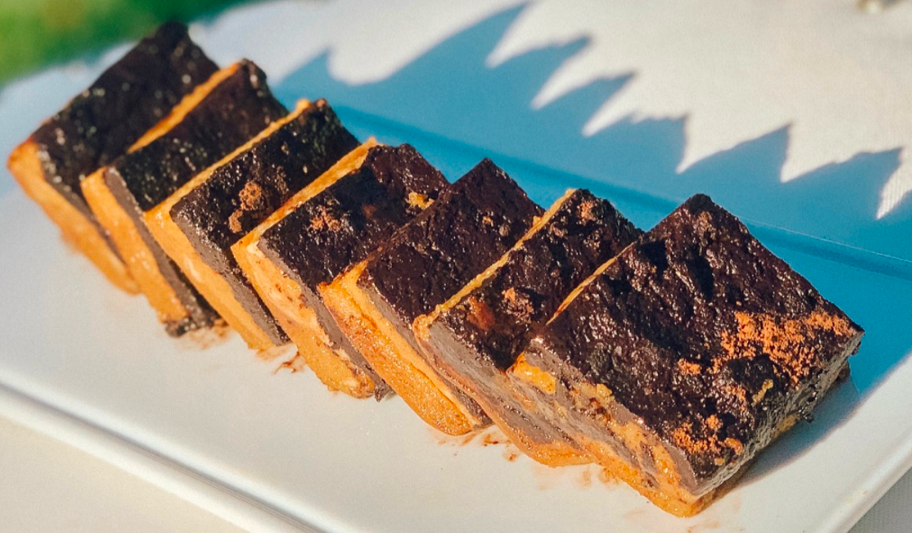
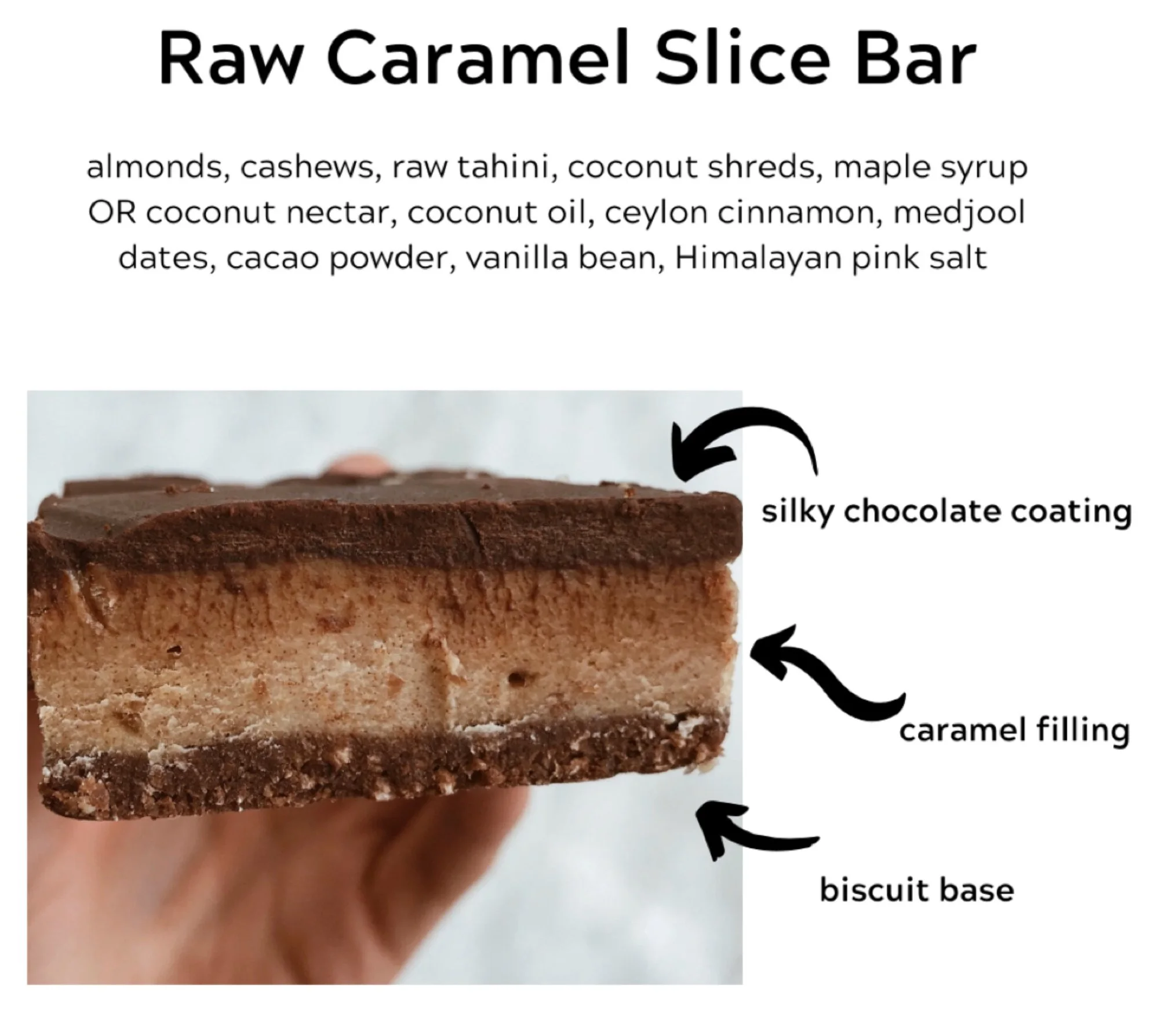
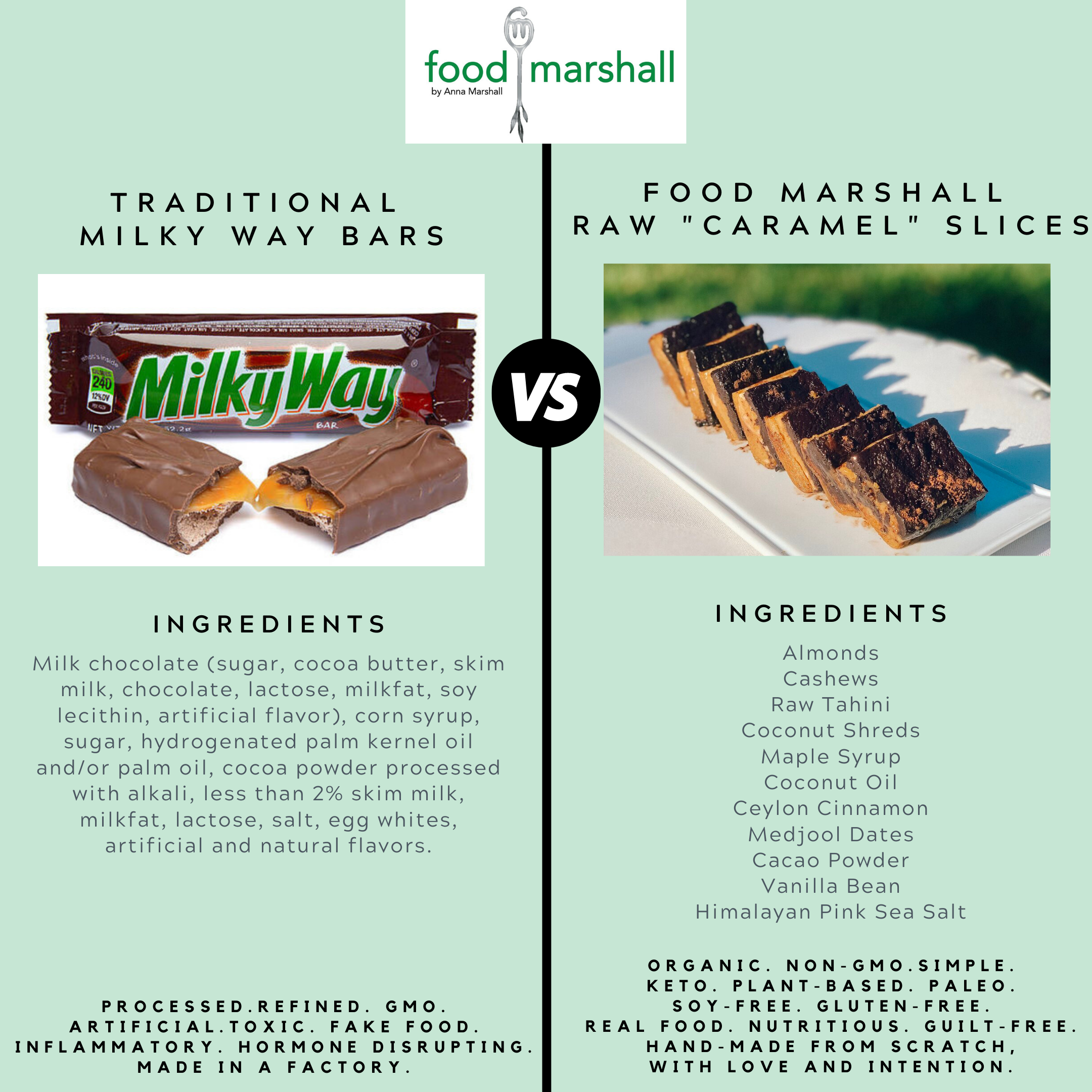
The Middle Eastern sesame tradition, layered into a modern raw dessert. The sibling to the Snickers bars.
Season: Winter · early Spring
Cuisine: Modern Raw · Middle Eastern-inspired
Yield: One 8×8-inch pan, about 16 bars
Active: 30 min · Total: 3 hr (with freezer set times)
Best eaten: afternoon, early evening
Ingredients
Nut-and-Oat Crust
1 cup raw walnuts
1 cup sprouted rolled oats (or cashews for fully grain-free)
1 cup raw almonds
1 cup unsweetened shredded coconut
10 medjool dates, pitted
8 tbsp (½ cup) coconut oil, melted
Pinch sea salt
Tahini Caramel Layer
1 cup pure tahini (only sesame seeds — no additives, no rancidity)
10 medjool dates, pitted
½ cup full-fat coconut milk (no guar gum)
¼ cup pure maple syrup
¼ cup coconut sugar
2 tbsp coconut oil, melted
Pinch sea salt
Raw Chocolate Coating
1 cup raw cacao wafers (or raw cacao paste, or 85%+ dark chocolate)
¼ cup coconut oil, melted
1–2 tbsp coconut sugar (optional)
Pinch sea salt
Flaky sea salt, to finish
Optional: 2 tbsp white or black sesame seeds, for scattering
Sub: rancid tahini is the single biggest failure point in sesame-based recipes — if yours is extremely bitter or off-smelling, replace it. Fresh, recently-harvested tahini has a brighter, nutty flavor.
Method
Line an 8×8-inch baking pan with parchment, leaving overhang on two sides.
Crust: in a food processor, pulse the walnuts, oats (or cashews), almonds, and shredded coconut until broken down to a coarse meal — some texture is desirable. Add the dates, melted coconut oil, and salt. Process until the mixture holds together when pinched. If too dry, add 1 tbsp water; if too wet, add a spoonful more oats. Press firmly and evenly into the pan with the bottom of a measuring cup. Freeze.
Tahini caramel: in the same food processor (no need to wash), combine tahini, dates, coconut milk, maple syrup, coconut sugar, melted coconut oil, and salt. Process 2–3 minutes, scraping down the sides, until completely smooth and glossy — the color will be deep golden-amber. Taste and adjust; the caramel should be richly sweet with the tahini's earthy bitterness clearly present.
Pour the caramel evenly over the chilled crust, smoothing with a spatula. Freeze 60–90 minutes, until firm.
Chocolate coating: gently melt the cacao wafers over a pot of barely-simmering water (or in short microwave bursts). Stir in melted coconut oil, optional coconut sugar, and salt until smooth and glossy. Do not overheat — stay below 110°F to preserve raw cacao integrity.
Pour the warm chocolate over the firm tahini caramel, tilting the pan to spread evenly. Sprinkle with flaky sea salt and optional sesame seeds while the chocolate is still wet.
Freeze 20–30 minutes, until the chocolate is firm but not brittle. Lift the slab out by the parchment and slice into 16 rectangles with a sharp warm knife (run under hot water and dried between cuts).
Nourishment Notes
There is a recipe tradition six thousand years old that almost no one in the American kitchen thinks about. Halva — the sesame-based dessert of the Middle East and Eastern Mediterranean — is made by grinding sesame seeds into paste, combining with honey or sugar syrup, and allowing the mixture to set into a dense, crumbly, nutty block. It has been continuously produced in Egypt, Greece, Turkey, Lebanon, Iran, and across the Levant since at least 3500 BCE. Long before Europe had chocolate, before the Americas had sugar, halva was how the ancient world ate sweet richness. This bar is the modern raw-food descendant of that tradition. Egyptian tomb paintings from 4,000 years ago depict sesame cultivation; the Babylonians ground sesame for tahini; the Greeks and Romans knew it. Unlike peanut butter, which is a relatively modern invention (industrial peanut grinding became common only in the early 20th century), tahini is genuinely ancient.
Sesame seeds are nutritionally remarkable: exceptionally high in calcium (a quarter-cup of tahini provides roughly 350mg, more than a glass of milk), copper, magnesium, zinc, and the unique lignans sesamin and sesamolin, which have been studied for liver-supportive and cardiovascular effects. The calcium-to-phosphorus ratio in sesame is favorable for bone health, which is part of why traditional Middle Eastern populations, despite relatively modest dairy intake, have historically had strong bone density. Walnuts and almonds together provide a more complete profile than either nut alone — walnuts deliver alpha-linolenic acid (ALA, one of the only plant-based omega-3 sources), vitamin E, magnesium, copper, and ellagic acid; almonds bring vitamin E in its full tocopherol complex, monounsaturated fats, fiber, and meaningful protein. Both are shelf-stable ancestral foods that have been part of Mediterranean and Middle Eastern diets for thousands of years. Twenty medjool dates across the recipe deliver substantial potassium, magnesium, and copper in whole-food form. Coconut sugar specifically — made from the sap of the coconut blossom, never processed with bone char or industrial refinement — retains trace minerals and inulin (a prebiotic fiber), with a glycemic index lower than cane sugar's. Raw cacao preserves the polyphenols, theobromine, magnesium, and mineral complexity that commercial chocolate has lost.
As a seasonal food, this dessert belongs to winter for specific reasons. Sesame seeds are traditionally a warming food in Ayurvedic and Traditional Chinese Medicine practice — supporting the kidneys, circulation, and the yang energy that the body draws on through the cold months. The oils in sesame are dense, calorically substantial, and richly satisfying in the way winter food needs to be. Paired with the grounding quality of dates, the tropical warmth of coconut, and the neurologically active compounds of raw cacao, the result is a dessert that genuinely supports the body through the season of contraction and conservation. As a circadian food, the same logic that applies to the Snickers sibling applies here: this is an afternoon food, not an evening one. The natural sugars in dates, maple, and coconut sugar — though delivered within a substantial fat-and-fiber matrix — metabolize best in daylight hours. A slice at three or four with tea or coffee is the ideal placement; late-night sweet eating, of any kind, pushes the body's cooling and melatonin curve back. The bar is rich enough that one square satisfies; eat as a planned afternoon pleasure rather than an unconscious snack.
Storage: refrigerated 2 weeks (tahini is naturally antimicrobial and these keep longer than peanut-butter-based bars). Frozen up to 3 months. The bars improve with a day or two of rest as the flavors marry — they are explicitly built for making ahead. Best eaten slightly chilled — remove from the freezer 10 minutes before serving.