Raw Peanut Caramel Swirl Cheesecake
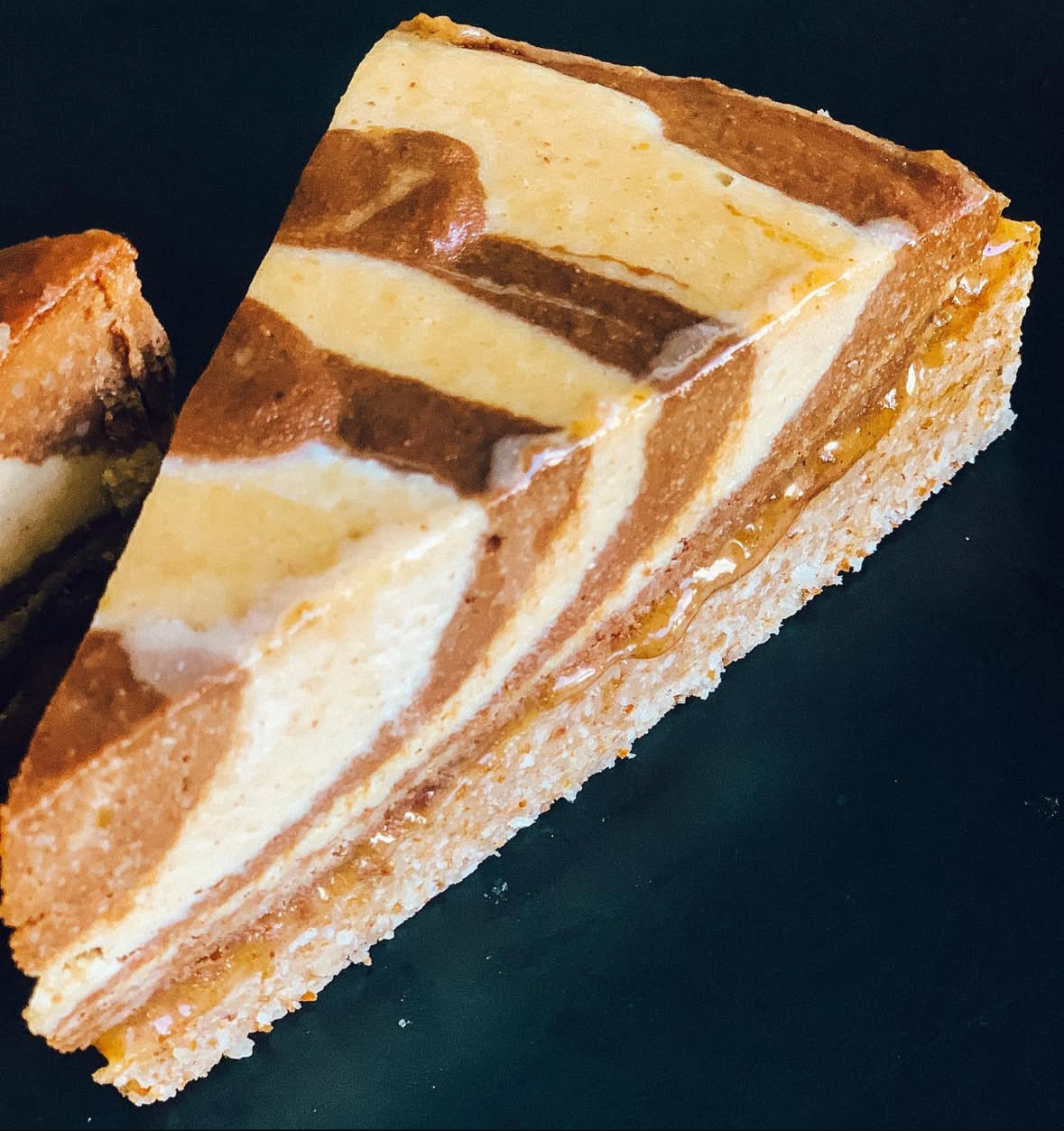
A marbled raw cheesecake — peanut caramel swirled through vanilla and chocolate cashew cream on a coconut-almond base, finished with chocolate drizzle and crushed peanuts
Yield: One 9-inch springform cake (10-12 slices) · Active: 45 min · Total: 8 hr (with freezer set times)
A note from the kitchen
This is a raw cashew cheesecake doing real things — a marbled cross-section of vanilla and chocolate cream, with peanut caramel pockets running through it, all sitting on a coconut-almond date base. Finished with a dark chocolate drizzle, crushed peanuts, and (optional) raw peanut butter bliss balls. The visual reveals itself only at the cut — when the knife passes through the layers, the marbling and caramel pockets become the dessert's signature.
The technique is two parallel paths: a marbled “zebra” pour where alternating spoonfuls of vanilla and chocolate create the marble pattern automatically, or a caramel-pocket version where the peanut caramel is dropped between the vanilla and chocolate layers and a gentle swirl marbles everything together. Both work; the caramel-pocket version is more visually dramatic.
This dessert is a Snickers-adjacent celebration cake — peanut, caramel, chocolate, and the substantial richness of cashew cream working together. A single thin slice is satisfying. The cake keeps in the freezer for 2-3 months, which makes it a real workhorse for last-minute entertaining.
Ingredients
Coconut-almond base
1 cup raw almonds
1 cup unsweetened coconut flakes
10-12 medjool dates, pitted
1 tbsp coconut oil, melted
¼ tsp Ceylon cinnamon
Pinch sea salt
Peanut-date caramel (swirled through filling)
10 medjool dates, pitted (soaked 10 min if firm)
½ cup pure maple syrup
4 tbsp natural peanut butter (only peanuts + sea salt, no seed oils)
1 tbsp coconut oil, melted
1 tsp pure vanilla bean powder
½ tsp sea salt
Vanilla and chocolate marbled cheesecake filling
3½ cups raw cashews, soaked at least 4 hours and drained
1¼ cups full-fat coconut milk (no gums or added sugars), divided
¾ cup pure maple syrup
¾ cup coconut oil, melted
2-3 tbsp natural peanut butter
2 tsp pure vanilla bean powder
¼ tsp Ceylon cinnamon
Pinch sea salt
¼ cup raw cacao powder (for chocolate version of half the filling)
6-8 tbsp raw coconut butter (optional, for the chocolate filling — adds extra body)
Chocolate drizzle topping
½ cup coconut oil, melted
½ cup raw cacao powder
¼ cup pure maple syrup
Pinch sea salt
Garnish
¼ cup roasted unsalted peanuts, roughly chopped
2 tbsp raw cacao nibs
Flaky sea salt
Additional caramel drizzle (reserved from caramel — see method)
Optional: peanut butter bliss balls (recipe below)
Optional: small pieces of homemade raw "Snickers" bars
Optional peanut butter bliss balls (12-16 small balls)
½ cup raw cashews
½ cup raw almonds
½ cup unsweetened coconut flakes
10 medjool dates, pitted
1 tbsp pure maple syrup
1 tbsp natural peanut butter
¼ tsp Ceylon cinnamon
1 tbsp raw cacao powder (for half the balls)
Pinch sea salt
Method
Prep the pan
Line the pan. Line the bottom of a 9-inch springform pan with parchment. Lightly grease the sides with coconut oil.
Make the coconut-almond base
Pulse the dry base. In a food processor, pulse the almonds and coconut flakes until they form a coarse meal.
Add the binders. Add the dates, melted coconut oil, cinnamon, and salt. Process until a sticky cohesive dough forms — pinch a small amount between your fingers; it should hold together.
Press and chill. Press firmly and evenly into the bottom of the springform pan. Freeze 20 minutes to firm up.
Make the peanut-date caramel
Blend the caramel. In a food processor, combine all caramel ingredients (dates, maple syrup, peanut butter, coconut oil, vanilla, salt). Process 2-3 minutes until completely smooth and glossy.
Reserve for garnish. Set aside at room temperature. Reserve 2-3 tbsp in a small bowl for final garnish drizzle.
Make the vanilla cheesecake filling
Blend the base filling. In a high-speed blender, combine the drained cashews, 1 cup of the coconut milk, maple syrup, melted coconut oil, peanut butter, vanilla, cinnamon, and salt. Blend on high 2-3 minutes until completely silky-smooth — stop and scrape down sides as needed.
Divide the filling. Pour exactly half (about 3 cups) of the silky filling into a separate bowl — this is the vanilla half. Reserve.
Make the chocolate filling
Add cacao to the second half. To the remaining filling in the blender, add the ¼ cup cacao powder, the remaining ¼ cup coconut milk, and the optional 6-8 tbsp coconut butter. Blend until completely smooth and uniformly chocolate-colored.
Choose your swirl architecture
Pick a method. Two options below — pick one before assembling.
Method A: Marbled zebra pour (no swirl needed)
11a. Alternate the pours. Pour 2 tbsp of vanilla cream into the center of the pan, then 2 tbsp of chocolate cream directly on top of the vanilla — alternating in concentric pours, until both bowls are empty. The pours layer themselves into a marbled cross-section automatically. Don't stir — the layering creates the pattern.
12a. Add caramel pockets. Drop 6-8 small globs of peanut caramel (about 1 tbsp each) across the surface at random intervals. They'll sink slightly into the cream.
13a. Tap the pan. Tap the pan gently on the counter to release any air bubbles.
Method B: Caramel-pocket layered version (with swirl)
11b. First vanilla layer. Pour ⅔ of the vanilla cream over the base. Smooth gently.
12b. Drop caramel pockets. Drop globs of caramel (about 1 tbsp each, bite-size) randomly across the vanilla cream surface.
13b. Pour chocolate. Pour the chocolate cream over the top, using a marbled pour technique (alternate sections).
14b. Gentle swirl. Use a spatula or knife to gently swirl through both layers in concentric circles or figure-eight motions — don't over-swirl; you want distinct vanilla-and-chocolate marbled patterns, not a uniformly blended brown filling.
15b. Tap the pan. Tap gently on the counter to release air bubbles.
Set the cheesecake
Freeze. Cover with plastic wrap or a fitted lid. Freeze at least 8 hours, ideally overnight, for the cleanest slicing.
Make the chocolate drizzle topping
Melt and combine. In a small saucepan over very low heat (under 110°F), melt the coconut oil. Whisk in the cacao powder, maple syrup, and salt until smooth and glossy. Cool slightly to thicken to a drizzle consistency.
Make the optional bliss balls
Blend the base. In a food processor, blend the cashews, almonds, coconut flakes, dates, maple syrup, peanut butter, cinnamon, and salt until a cohesive dough forms.
Roll and divide. Take half the mixture and roll into small ½-inch balls. Add the cacao powder to the remaining mixture, blend briefly, and roll the second half into balls.
Chill. Refrigerate 30 minutes to firm up.
Unmold and decorate
Release the springform. Run a thin warm knife around the edge of the cake. Release the springform sides. Place on a serving plate.
Drizzle the chocolate. Drizzle the chocolate topping decoratively across the top of the cake, allowing it to drip down the sides.
Garnish. Scatter chopped peanuts, cacao nibs, and a pinch of flaky sea salt across the top. Drizzle the reserved peanut caramel decoratively. Place the optional bliss balls around the top edge. Optional: arrange small pieces of raw "Snickers" bars on top.
Set the topping. Refrigerate 30 minutes for the chocolate drizzle to set.
Slice and serve
Slice with a hot dry knife. Allow 5-10 minutes thawing at room temperature for the cleanest cut. The cross-section reveals the marbled pattern with visible caramel pockets — a striking visual reward for the technique.
Variations
Pure marble (no caramel) — the original direction: Skip the peanut caramel entirely. Make the vanilla and chocolate fillings as written and use the marbled zebra pour technique. The dessert reads as a classic marble cake. The original inspiration for this recipe.
Salted caramel version: Skip the chocolate filling. Use the full filling as vanilla and pour into the pan. Drop caramel pockets randomly across the surface and swirl gently with a knife. Top with extra flaky salt.
Pure chocolate version: Skip the vanilla filling. Blend the full filling with ¼ cup cacao + ¼ cup coconut milk. Pour over the base. Drop caramel pockets and swirl. A deeply chocolate dessert.
With berry swirl (instead of peanut caramel): Substitute the peanut caramel with a fresh berry compote (1½ cups raspberries or strawberries simmered with 2 tbsp maple syrup until jammy, then cooled). A summer variation.
With espresso (mocha version): Add 1 tbsp finely ground espresso powder to the chocolate filling. Deepens the chocolate character.
With salted caramel + chocolate (no marble): Pour the chocolate filling over the base. Drop peanut caramel globs across the surface. Skip the vanilla half entirely. Simpler, more focused dessert.
Mini cheesecakes: Press the base into a 12-cup muffin tin lined with parchment cupcake liners. Divide the vanilla and chocolate fillings into each cup, swirl with a toothpick, and add small caramel pockets. Freeze 4-5 hours. Makes 12 portion-controlled mini cheesecakes — beautiful for parties or as individual gifts.
Make ahead: The entire cake can be made up to 2-3 months ahead and stored in the freezer, well-wrapped. The chocolate drizzle and garnishes are best added the day of serving for visual freshness.
Pairs Well With
A small cup of strong black coffee, espresso, fresh peppermint tea, or chai tea — the warmth and slight bitterness cuts the sweetness beautifully. Sparkling water with fresh mint and lemon for a lighter accompaniment. A small bowl of fresh berries or a few thin slices of ripe pear alongside for visual freshness and bright acidity. For a fuller dessert spread, serve alongside additional raw treats — Banana Nut-Butter Mousse Cake, Raw Snickers Bars, or Magic Layer Nut Butter Shortbread Bars.
Sourcing
Raw almonds and cashews. Single-ingredient raw nuts — never roasted or salted. Anthony's Goods, Big Tree Farms, Terrasoul, or One Degree Organic Foods. For almonds, Apricot Lane Farms direct or local Central Valley California growers. Avoid bulk-bin "raw" cashews from supermarkets — most are steamed (which technically isn't raw). Store in the refrigerator or freezer once opened.
Medjool dates. Bautista Family Organic Date Ranch or Joolies (small Coachella Valley producer). Avoid commercial bulk dates — they're often dry, fibrous, and lack the caramel depth of fresh medjools.
Unsweetened coconut flakes. Big Tree Farms, Bob's Red Mill organic, or Let's Do Organic. Look for finely shredded (not flake) for cleaner texture in the base.
Full-fat coconut milk. Single-ingredient — just coconut, no gums (guar gum, xanthan gum). Native Forest Simple (BPA-free cans, no gums) is the cleanest option. Aroy-D (cardboard packaging, no gums) is also excellent. Avoid coconut milk with stabilizers.
Natural peanut butter. Single-ingredient (just peanuts + sea salt). Look for organic Valencia peanuts when possible (lower aflatoxin risk). Crazy Richard's, MaraNatha Organic, or small-batch local producers. Avoid commercial peanut butters with hydrogenated oils, added sugars, or preservatives.
Raw almond butter. Big Spoon Roasters, Once Again Nut Butter, or Artisana.
Coconut oil. Cold-pressed, unrefined, organic. Nutiva, Garden of Life, or Dr. Bronner's. Should smell distinctly of fresh coconut.
Raw coconut butter. Single-ingredient — just dehydrated coconut puréed into butter. Nutiva, Artisana, or homemade in a high-speed blender.
Pure maple syrup. Grade A dark or amber. Crown Maple, Hidden Springs Maple, Coombs Family Farms, or Anderson's.
Raw cacao powder. Cold-processed, unsweetened, organic. Sunfood, Navitas Organics, or Big Tree Farms. Avoid Dutch-processed cocoa powder — alkalization destroys the polyphenols.
Pure vanilla bean powder. Single-ingredient ground vanilla bean. Singing Dog Vanilla (single-origin Madagascar) is the benchmark. Vanilla extract (pure, no added sugar) works as a substitute — use 2 tsp where 1 tsp vanilla bean powder is called for.
Ceylon cinnamon. True Ceylon cinnamon (not Cassia). Burlap & Barrel or Diaspora Co. (single-origin Sri Lankan).
Raw cacao nibs. Navitas Organics or Big Tree Farms.
Roasted unsalted peanuts (for garnish). Crazy Richard's organic Valencia or Wild Friends.
Flaky sea salt. Maldon or Jacobsen Salt Co. for finishing. Baja Gold for cooking salt throughout.
Storage
Whole cake (frozen): Up to 2-3 months, well-wrapped in parchment then sealed in a glass container or bag. The cake holds beautifully.
Whole cake (refrigerated): Up to 7 days, sealed. Best eaten slightly thawed — 10-15 minutes from the freezer or 30 minutes from the refrigerator.
Individual slices: Slice the cake, wrap each portion individually in parchment, then store in a sealed glass container in the freezer. Easy to pull single portions for everyday treats.
Peanut caramel alone: Refrigerated up to 2 weeks in a sealed glass jar. Spreads beautifully on toast, drizzles over fruit, or stirs into yogurt.
Chocolate drizzle topping: Refrigerated up to 2 weeks in a sealed glass jar. Re-warm gently before using.
Bliss balls: Refrigerated up to 2 weeks, frozen up to 2 months.
Why This Dessert
This is a celebration cake doing real nourishment work — every component built from whole-food ingredients, with concentrated nutrients in a satisfying format.
Raw cashews — magnesium, copper, and tryptophan. Cashews are technically seeds (not nuts), lower in oxalates than most tree nuts, and rich in magnesium (one of the highest plant sources), copper, zinc, and tryptophan. Soaking is non-negotiable for the silky texture — it neutralizes phytic acid and softens the seed for proper blending. The high-speed blender requirement is essential — anything less leaves residual cashew grit.
Medjool dates — slow-burning sweetness with fiber. Medjool dates deliver concentrated sweetness with substantial fiber (about 1.6g per date), potassium, magnesium, and B vitamins. The fiber buffers the sugar release, producing a gentler blood-glucose response than refined sweeteners. Used as the primary binder and sweetener in the base, caramel, and bliss balls, dates do the work that refined cane sugar does in commercial baking — but with intact nutrients.
Coconut oil, coconut butter, and coconut milk — medium-chain triglycerides. All three coconut products contribute medium-chain triglycerides (MCTs), lauric acid (antimicrobial), and the fats that allow the layers to set firmly when frozen while remaining sliceable when slightly thawed. Coconut is also one of the most ancestrally consumed fats in tropical cuisines worldwide — Filipino, Thai, South Indian, Caribbean, West African.
Raw cacao powder — flavanols, magnesium, and theobromine. Raw cacao preserves the polyphenols and theobromine that commercial processed chocolate has lost. Cacao carries one of the highest antioxidant loads measured in any common food — comparable to or exceeding acai, blueberries, and goji berries by ORAC value. The dark chocolate drizzle topping uses cacao raw and unsweetened (with maple syrup added separately) to preserve the polyphenol density.
Peanuts — honest discussion. Peanuts are technically legumes (not nuts) and are nutrient-dense (substantial protein, vitamin E, niacin, magnesium, resveratrol) but prone to aflatoxin contamination from improper storage. Organic Valencia peanuts are traditionally the cleanest variety. Used in moderation here (about 4 tbsp peanut butter across an entire cake serving 10-12), the protein and fat content slows blood-sugar response further.
Pure maple syrup — manganese, zinc, and polyphenols. Maple syrup delivers manganese, zinc, calcium, potassium, and over 65 documented polyphenol compounds. Used in moderation across the recipe (about 1¾ cups total across an entire cake of 10-12 servings — roughly 2 tbsp per slice), the sweetness lands gently with cofactors that refined sugar lacks entirely.
Almonds — vitamin E and magnesium. Raw almonds deliver vitamin E (alpha-tocopherol form), magnesium, copper, riboflavin, and monounsaturated fats. Used in the base and the optional bliss balls, almonds anchor the dessert with substantial protein and fat.
Why this kind of dessert matters. A single slice is deeply satisfying — the polyphenol density and substantial fat content means the body registers the cake as food rather than as a sugar trigger. Most commercial desserts deliver refined sugar, hydrogenated industrial fats, ultra-processed dairy, and artificial flavors — a fundamentally different chemical experience than this raw, whole-food celebration cake. The marbled visual signature also makes this an exceptional photography-friendly dessert for social gatherings or restaurant-style presentation.
— Anna aka Food Marshall