Poached Wild Fish (or fish Cheeks) in green sauce with seasonal vegetables
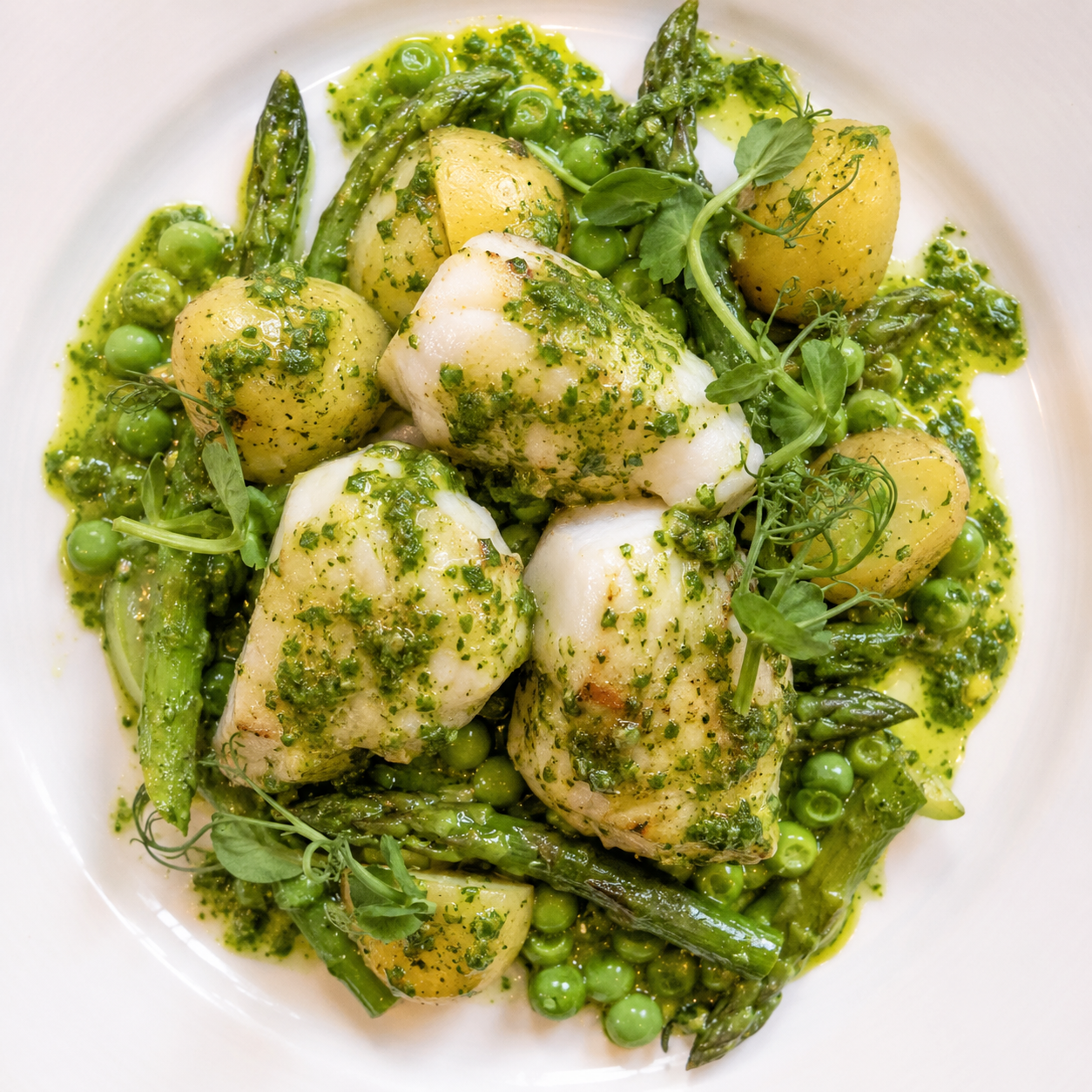
Pan-poached wild fish — hake, cod, halibut, or sea bass — (or fish cheeks) in a vibrant white wine and garlic-parsley sauce with asparagus, peas, and optional clams.
Yield: 4 servings · Active: 25 min · Total: 35-40 min · Spring (peak asparagus and peas) · Best eaten: midday or early evening
A note from the kitchen
If you can access fresh cod or hake cheeks (kokotxas in Spanish Basque Country), they make an exceptional version of this dish — see the Variations section below. Fish cheeks are small, gelatinous, almost translucent pockets of fish flesh with a delicate, soft texture that has no real American equivalent. Hard to source but worth seeking out at high-end fishmongers, Spanish specialty importers, or directly from Spanish/Portuguese seafood wholesalers.
A simple plate of well-sourced wild fish in green sauce is one of the most satisfying meals in the Spanish Basque coastal tradition — and one of the most deeply nourishing
Best made in spring (April-June) when asparagus and fresh peas are at peak. Out of season, the recipe still works with other in-season vegetables
Ingredients
For the green sauce base
½ cup high-quality Spanish extra virgin olive oil
6 cloves garlic, thinly sliced
½ cup dry white wine
2 tbsp fresh flat-leaf parsley, finely chopped, divided
¼ tsp sea salt
½ tsp freshly cracked black pepper
Pinch of crushed red pepper flakes (optional)
For the fish (choose one — all work)
1½ lb wild hake fillets, OR
1½ lb wild cod fillets (Atlantic or Pacific), OR
1½ lb wild halibut fillets, OR
1½ lb wild sea bass fillets
Skin-on when possible, cut into 4 equal portions of about 6 oz each.
For seasoning the fish
Sea salt and freshly cracked black pepper
Optional clams (traditional addition)
1 lb fresh small clams (Manila, littleneck, or cockles)
For the spring vegetables
8 oz asparagus, trimmed and cut into 2-inch pieces
½ cup fresh peas (or thawed frozen peas if fresh isn't available)
2 tbsp grass-fed butter (optional, for finishing richness)
For finishing
Lemon wedges
Flaky sea salt
Additional fresh parsley
A drizzle of high-quality olive oil
Method
Prep the fish
Dry and season. Pat the fish fillets completely dry with paper towels. Season both sides with sea salt and freshly cracked black pepper. Let sit at room temperature 10 minutes while you prep everything else.
Purge the clams (if using)
Rinse and purge. Place the clams in a bowl of cold water with 1 tbsp sea salt for 20 minutes. The clams will spit out any sand. Drain and rinse. Discard any clams that don't close when tapped — they're already dead.
Build the green sauce base
Warm the olive oil with garlic. In a wide heavy skillet or shallow Dutch oven (large enough to hold all the fish in a single layer), pour the olive oil. Add the sliced garlic. Place over low heat. Cook 4-5 minutes, stirring occasionally, until the garlic is fragrant and pale golden — never browned. Browned garlic turns bitter and ruins the delicate sauce.
Add the wine and aromatics. Pour in the white wine. Add half the chopped parsley, the salt, pepper, and optional red pepper flakes. Simmer gently 2 minutes — the alcohol will burn off and the wine will reduce slightly.
Poach the fish
Add the fish skin-side down. Place the fish fillets skin-side down in the warm sauce. Don't crowd the pan. Lower the heat to its lowest setting. Cover with a lid (or parchment paper topped with a heatproof plate if no matching lid). Poach gently 4-5 minutes.
Add clams and asparagus
Add clams and asparagus. After 4-5 minutes, scatter the clams (if using) and asparagus pieces around the fish in the pan. Cover and cook 3-4 more minutes. The clams should open; the asparagus should turn bright green and tender-crisp. The fish should flake easily with a fork.
Add peas
Add peas at the very end. Scatter the peas across the top of everything. Cover for 1 final minute, just to warm the peas through and lock in their bright color. Don't overcook the peas — they should stay vibrant green.
Finish the sauce
Discard unopened clams. Remove the pan from heat. Discard any clams that haven't opened (they were not viable). Add the optional butter and gently swirl the pan to emulsify it into the sauce. Stir in the remaining chopped parsley.
Plate the dish
Lift the fish. Use a slotted fish spatula to lift each fish portion onto a warm shallow bowl or wide plate.
Spoon the sauce. Spoon the asparagus, peas, clams (if using), and warm olive oil sauce generously around and over the fish.
Finish
Final touches. Top each plate with a small extra pinch of parsley, a drizzle of high-quality olive oil, and a tiny pinch of flaky sea salt. Serve immediately, with lemon wedges on the side.
Variations
With fish cheeks : Substitute the fish fillets with 1 lb fresh or frozen cod cheeks or hake cheeks. Reduce poaching time to 4-6 minutes (cheeks are smaller and more delicate). The texture is uniquely gelatinous and tender — a real seafood revelation. Cod cheeks are most accessible; hake cheeks are slightly larger and even more delicate.
With wild grouper cheeks: Substitute with grouper cheeks for a meatier, almost lobster-like texture. Cook 5-6 minutes.
With salt cod (bacalao): Use soaked, desalted salt cod (bacalao) instead of fresh fish. Soak the salt cod in cold water 24-48 hours, changing the water every 6-8 hours, until the salt has drawn out and the cod is rehydrated. Increase poaching time to 6-8 minutes.
Without clams: Skip them entirely. The dish is still complete and beautiful — sometimes more elegant without the shells.
Without wine (alcohol-free version): Substitute ½ cup bone broth (fish or chicken) + 2 tbsp aged sherry vinegar + 1 tsp lemon juice. Different flavor character but works the same way.
With more spring vegetables: Add 1 cup baby spinach, pea shoots, or watercress in the last minute. Wilts beautifully into the sauce.
With piquillo peppers: Add 4-6 jarred piquillo peppers (drained, sliced into strips) to the warm olive oil with the garlic. Adds subtle smoky sweetness — common in Spanish home cooking.
Herbier version: Add fresh tarragon, chives, chervil, or dill along with the parsley. Spring herb abundance.
With fingerling potatoes (heartier dinner): Add 1 lb very small fingerling potatoes (halved if larger) to the pan when you add the wine. They'll cook gently in the sauce and become part of the dish. Adds another 10-15 minutes to total cooking time.
With fresh asparagus and a poached egg on top: Skip the clams. Add 2 poached eggs alongside the fish (or 1 per serving). The runny yolk emulsifies with the green sauce as it breaks — closer to a brunch presentation.
With cooked white beans (Spanish alubias blancas): Add 1 cup cooked white beans (cannellini or great northern) to the sauce in the last 5 minutes. Adds substance and traditional Iberian comfort.
Autumn variation: Substitute the asparagus with thinly sliced fennel, the peas with shaved Brussels sprouts, and finish with toasted hazelnuts. Different season, same green-sauce-and-wild-fish framework.
Make ahead: The green sauce base can be made (with garlic and wine, before the fish goes in) up to 1 day ahead and refrigerated. Reheat gently and proceed with the fish. The asparagus and peas should always be added fresh.
Pairs Well With
Sparkling water with cucumber, lemon, and fresh mint, or chilled hibiscus tea. Serve as a complete spring dinner with a simple green salad (arugula, lemon, olive oil, shaved Manchego). Roasted fingerling potatoes alongside for a heartier meal. A small board of olives (Castelvetrano, Niçoise, or Spanish gordal), Marcona almonds, and quality Spanish anchovies as an aperitif. For dessert, fresh berries with a small wedge of aged Manchego, or a small portion of grain-free almond cake with lemon zest.
Sourcing
Wild hake (best option if available). Sustainable wild-caught Atlantic hake. Sources: Vital Choice, Sea to Table, local fishmongers carrying Spanish or Portuguese imports. Look for "merluza" at Spanish or Portuguese markets.
Wild cod (best widely available substitute). Wild-caught Pacific or Alaskan cod. Vital Choice, Sea to Table, Wild Alaskan Company, Whole Foods (wild-caught only), local fishmongers. Avoid farmed Atlantic cod.
Wild halibut. Sustainable wild-caught Pacific or Alaskan halibut. Vital Choice, SeaBear, Wild Pacific Halibut Council-certified suppliers, local fishmongers.
Wild sea bass. Wild-caught Pacific or Atlantic sea bass. NOT Chilean sea bass (which is actually Patagonian toothfish — typically not sustainable). Local fishmongers, Sea to Table.
Cod or hake cheeks (for the variation). This is the hard-to-find specialty ingredient. Best sources: high-end fishmongers, Spanish or Portuguese specialty importers, or direct wholesale from Spanish seafood suppliers like La Tienda or Despaña Brand Foods. Look for fresh or flash-frozen, never canned.
Fresh small clams. Manila clams, littleneck, or cockles. Local fishmongers, Whole Foods, Asian markets. Buy day-of for the freshest. Look for clams that close tightly when tapped — open clams that don't close are already dead.
Single-estate Spanish extra virgin olive oil. Quality matters enormously here. Castillo de Canena, Núñez de Prado, Castillo de Tabernas, or Frantoia. Harvest-dated within the last 12 months. Use your best bottle.
Dry white wine. Albariño (Rías Baixas, Galicia), Txakolí (Basque Country), Verdejo (Rueda), or any dry crisp white. Pinot Grigio or Sauvignon Blanc work as substitutes if Spanish wines aren't available.
Fresh asparagus and peas. Local farmers' market during peak spring season (April-June). Look for medium-thickness asparagus (not thick "jumbo" asparagus, which can be woody) and fresh peas in their pods if possible.
Fresh flat-leaf parsley. Italian flat-leaf, not curly. From a farmers' market or windowsill pot. Fresh is essential — dried doesn't work in this sauce.
Garlic. Heirloom hardneck varieties (Music, German Red, Spanish Roja) from a local farmers' market. Hardneck garlic has more complex flavor than commodity softneck supermarket garlic.
Grass-fed butter (optional). Vital Farms, Organic Valley Pasture Butter, Beurre d'Isigny, Kerrygold Reserve, or Lurpak.
Sea salt. Baja Gold mineral sea salt for cooking, fleur de sel or Maldon for finishing.
Storage
Assembled dish: Best the day made. The fish texture is best fresh — it will dry out slightly on reheating. Leftovers refrigerate up to 2 days, sealed.
Reheating: Reheat very gently — warm slowly over low heat with a splash of additional olive oil or bone broth. Don't simmer or boil.
Green sauce base (made ahead): Refrigerated up to 1 day, sealed. The garlic-infused olive oil can be strained and reserved for other uses (dressing salads, finishing roasted vegetables) — keeps refrigerated up to 1 month.
Cooked clams: Best the day made. Don't reheat clams — they overcook quickly and become rubbery.
Why This Dish
Wild hake, cod, halibut, or sea bass — complete protein and omega-3 fatty acids. Wild white fish delivers high-quality complete protein (about 20g per 3.5-oz serving), the omega-3 fatty acids EPA and DHA (especially important for brain and cardiovascular health), iodine (essential for thyroid function), selenium, vitamin B12, and vitamin D. Wild fish has a meaningfully different nutritional profile from farmed fish — higher omega-3 to omega-6 ratio, more trace minerals, and the bioactive compounds that come from a varied wild diet.
Fish cheeks (kokotxas) — concentrated collagen and gelatin. Fish cheeks specifically deliver concentrated collagen, gelatin, and the gelatinous compounds that support skin, joint, and gut health. The texture is meaningfully different from fillet — softer, more luscious, and naturally rich without the addition of fat.
Fresh clams — bioavailable B12, iron, and zinc. Clams are one of the most concentrated dietary sources of vitamin B12 (a single 3-oz serving delivers over 1,000% of the recommended daily intake), heme iron, zinc, selenium, and omega-3 fatty acids. The clam liquor adds briny minerality to the sauce and delivers concentrated trace minerals.
Spring asparagus — folate, vitamin K, and prebiotic fiber. Asparagus delivers folate (especially important for cellular methylation and pregnancy), vitamin K (essential for blood clotting and calcium metabolism), vitamin C, and inulin (a prebiotic fiber that feeds beneficial gut bacteria). Spring asparagus is at peak nutritional density.
Fresh peas — vegetable protein and slow-burning carbohydrate. Fresh peas deliver vegetable protein (about 5g per ½ cup), fiber, vitamin K, vitamin C, manganese, and the small amount of slow-burning carbohydrate that makes this dish satisfying without being heavy.
Single-estate Spanish olive oil — oleic acid and polyphenols. Quality olive oil delivers oleic acid, olive polyphenols (hydroxytyrosol, oleuropein, oleocanthal with documented anti-inflammatory effects), and squalene.
Garlic — sulfur compounds and allicin. Slow-warming garlic in olive oil produces a different chemistry than aggressive sautéing — the harsh sulfur compounds soften into the oil while preserving the allicin (the bioactive compound with documented antimicrobial and cardiovascular effects).
Fresh parsley — vitamin K and chlorophyll. Fresh flat-leaf parsley delivers exceptional vitamin K, chlorophyll, vitamin C, and folate. Used generously in the green sauce, parsley is doing real nutritional work, not just flavoring.
— Anna aka Food Marshall