Rosemary-Thyme Chicken Thighs with Roasted Tricolor Cauliflower, Coco-Lime Cabbage, Golden Beet & Feta Salad, and Marinated Fennel-Red Onion
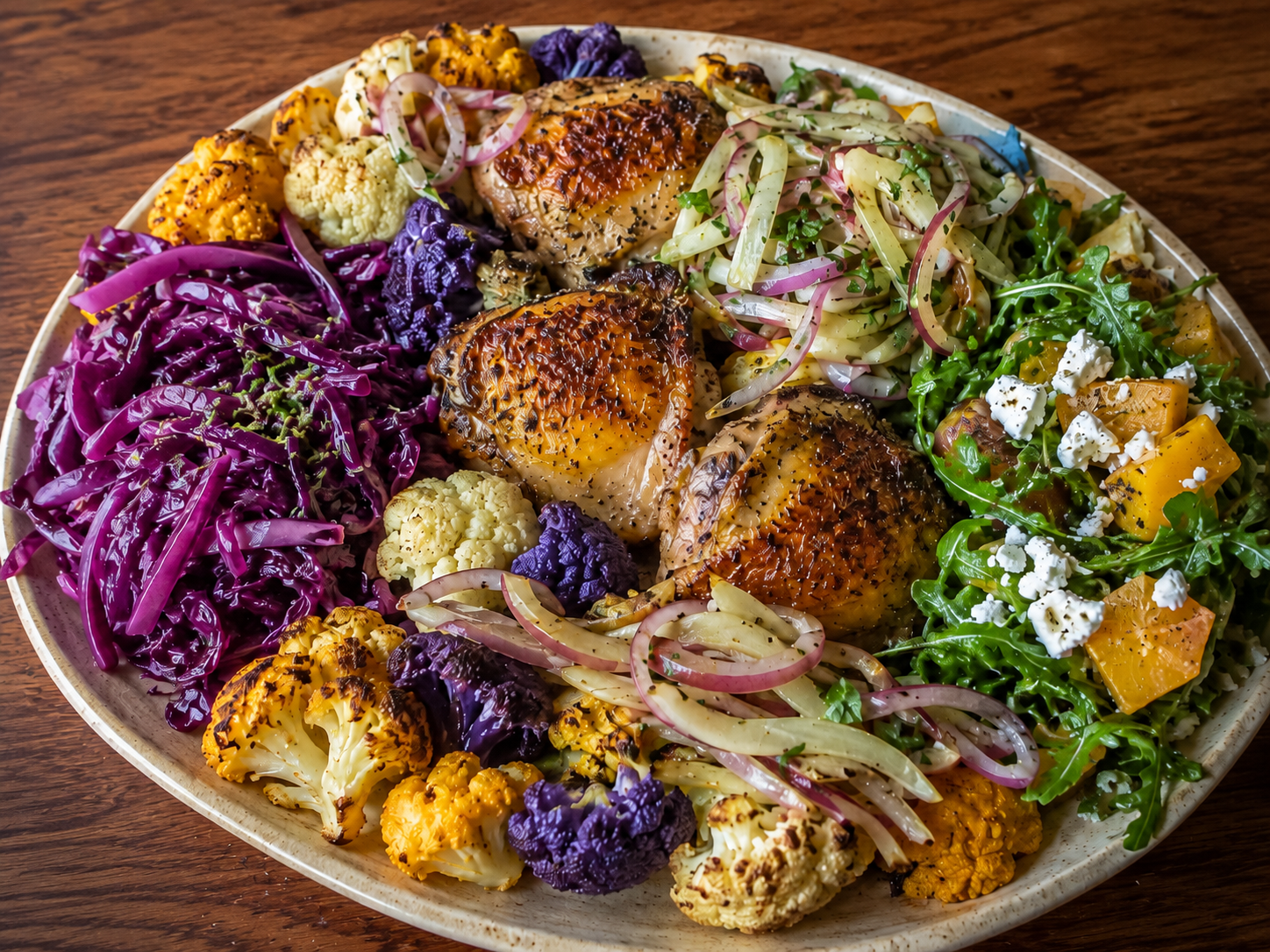
Yield: 4 servings · Active: 50 min · Total: 1 hr 30 min (plus 30 min chicken marinade and 45-60 min beet roasting, which can be done ahead) · Year-round · Best eaten: early evening
Complete Menu
Rosemary-Thyme Marinated Chicken Thighs
Roasted Tricolor Cauliflower with Olive Oil, Salt, and Pepper
Coco-Lime Sautéed Cabbage
Golden Beet Salad with Sheep's Milk Feta, Arugula, and Sherry Vinaigrette
Marinated Fennel and Red Onion in Champagne Vinegar
Optional accompaniments: fresh lemon wedges, additional shaved fennel fronds, flaky sea salt, single-estate olive oil at the table.
Recipe 1 — Rosemary-Thyme Marinated Chicken Thighs
Yield: 4 servings · Active: 15 min · Total: 45 min (plus 30 min marinade)
Ingredients
2 lb pasture-raised bone-in skin-on chicken thighs (or boneless skinless for quicker weeknight)
3 tbsp extra virgin olive oil
3 sprigs fresh rosemary, leaves stripped and finely chopped
6 sprigs fresh thyme, leaves stripped
5 garlic cloves, finely minced
Zest of 1 lemon
Juice of ½ lemon
1½ tsp sea salt
½ tsp freshly cracked black pepper
½ tsp red pepper flakes (optional)
Method
Marinate. In a large bowl, combine olive oil, chopped rosemary, thyme leaves, minced garlic, lemon zest, lemon juice, salt, pepper, and optional chili flakes. Add chicken thighs and turn to coat. Cover and refrigerate at least 30 minutes (2-4 hours ideal).
Bring to room temperature. Remove chicken from refrigerator 20 minutes before cooking.
Cook (choose your method):Grilling (best flavor): Heat grill to medium-high (425-450°F). Grill bone-in thighs 6-7 minutes skin-side down, then 8-10 minutes on the other side. Boneless: 5-6 minutes per side. Internal temperature 165°F. Pan-searing then oven (weeknight): Heat 2 tbsp olive oil in a cast iron skillet over medium-high heat. Sear bone-in skin-side down 5-6 minutes until deeply golden. Flip. Transfer skillet to a 400°F oven for 15-18 minutes. Boneless: 4-5 minutes per side, no oven finish needed.
Rest. Transfer to a warm platter. Rest 5-7 minutes.
Serve as the anchor of the plate, with a squeeze of fresh lemon over.
Recipe 2 — Roasted Tricolor Cauliflower with Olive Oil, Salt, and Pepper
Yield: 4 servings · Active: 10 min · Total: 35 min
Ingredients
1 large head tricolor cauliflower (or 1 white + 1 purple + 1 orange/yellow head, cut into florets — about 2 lb total)
3 tbsp extra virgin olive oil
1 tsp sea salt
½ tsp freshly cracked black pepper
Optional: pinch of red pepper flakes
Optional: flaky sea salt to finish
Method
Preheat oven to 425°F. Line a large sheet pan with parchment paper.
Toss the cauliflower. In a large bowl, toss the tricolor florets with olive oil, salt, pepper, and optional chili flakes.
Roast. Spread on the sheet pan in a single layer. Roast 25-30 minutes, tossing once at the 15-minute mark, until deeply caramelized at the edges and tender when pierced.
Finish. Transfer to a warm serving platter. Sprinkle with flaky sea salt.
Recipe 3 — Coco-Lime Sautéed Cabbage
Yield: 4-6 servings · Active: 15 min · Total: 20 min
Ingredients
1 medium head purple cabbage (about 2 lb), cored and thinly sliced
2 tbsp cold-pressed unrefined coconut oil
2 garlic cloves, thinly sliced (optional)
1 tsp sea salt
½ tsp freshly cracked black pepper
3 tbsp fresh lime juice (from about 1½-2 limes)
Zest of 1 lime
Fresh cilantro, chopped (optional)
Flaky sea salt
Method
Heat the coconut oil. In a large skillet or wok, melt the coconut oil over medium-high heat until shimmering.
Add garlic (if using). Cook 20-30 seconds until fragrant — don't let it brown.
Add cabbage. Add the sliced cabbage in batches, tossing to coat with the coconut oil. Sprinkle with salt and pepper.
Sauté. Cook, tossing frequently, 6-8 minutes until the cabbage is tender-crisp and the edges are lightly caramelized. Don't overcook — you want texture, not mushiness.
Finish with lime. Remove from heat. Add fresh lime juice and lime zest. Toss to combine.
Plate. Transfer to a warm serving bowl. Sprinkle with fresh cilantro (if using) and flaky sea salt.
Recipe 4 — Golden Beet Salad with Sheep's Milk Feta, Arugula, and Sherry Vinaigrette
Yield: 4-6 servings · Active: 15 min · Total: 1 hr 15 min (including beet roasting — can be done ahead)
Ingredients
Roasted golden beets (can be done 24 hours ahead)
4 medium golden (yellow) beets, scrubbed
1 tbsp extra virgin olive oil
Pinch of sea salt
Salad
5 cups baby arugula (about 5 oz)
½ cup crumbled sheep's milk feta (Bulgarian or Greek)
2 tbsp fresh flat-leaf parsley, chopped (optional)
Sherry vinaigrette
¼ cup extra virgin olive oil
2 tbsp raw sherry vinegar (traditionally fermented Spanish sherry vinegar)
1 tbsp fresh lemon juice
1 tsp Dijon mustard
1 small garlic clove, finely grated
1 tsp raw honey (optional — balances the acid)
½ tsp sea salt
¼ tsp freshly cracked black pepper
To finish
Additional crumbled sheep's milk feta
Flaky sea salt
A drizzle of high-quality olive oil
Optional garnish: crushed pistachios or hazelnuts
Method
Roast the golden beets (can be done 24 hours ahead):
Preheat oven to 400°F.
Wrap and roast. Scrub beets. Wrap each in parchment paper. Place on a sheet pan. Roast 45-60 minutes, until a knife slides in with no resistance.
Cool and peel. Let cool 10-15 minutes. Rub off the skins with paper towels (they slip off easily when warm).
Slice. Cut peeled beets into thin wedges or ½-inch dice.
Assemble:
Combine base. In a large salad bowl, combine baby arugula, roasted beets, and optional parsley.
Make the vinaigrette. In a small jar, whisk together olive oil, sherry vinegar, lemon juice, Dijon mustard, grated garlic, optional honey, salt, and pepper.
Dress. Pour vinaigrette over the salad. Toss gently.
Plate. Transfer to a serving platter. Scatter crumbled feta across the top. Finish with flaky sea salt and a drizzle of high-quality olive oil.
Recipe 5 — Marinated Fennel and Red Onion in Champagne Vinegar
Yield: 4-6 servings · Active: 10 min · Total: 30 min (including marinating time)
Ingredients
1 large fennel bulb, thinly shaved (mandoline works best); reserve fronds
1 medium red onion, very thinly sliced
3 tbsp extra virgin olive oil
2 tbsp raw champagne vinegar (or raw sherry vinegar)
1 tbsp fresh lemon juice
Zest of ½ lemon
½ tsp sea salt
¼ tsp freshly cracked black pepper
Optional: pinch of red pepper flakes
Reserved fennel fronds
Flaky sea salt
Method
Prep the fennel. Trim the fennel bulb (reserve fronds). Halve lengthwise. Shave into paper-thin slices with a mandoline or very sharp knife.
Prep the red onion. Peel and halve. Shave into paper-thin slices.
Combine in a bowl. In a shallow bowl or platter, combine shaved fennel and red onion.
Whisk the marinade. In a small jar, whisk together olive oil, champagne vinegar, lemon juice, lemon zest, salt, pepper, and optional chili flakes.
Marinate. Pour the marinade over the fennel and red onion. Toss gently. Let sit 20-30 minutes at room temperature. The onion softens slightly and takes on a light pink hue from the acid; the fennel stays crisp but develops brighter flavor.
Finish. Toss again. Scatter reserved fennel fronds and flaky sea salt.
Serve as a bright acidic complement alongside the chicken and the other sides.
Plating the Complete Meal
Build family-style on a large warm platter, or in individual shallow bowls: place the chicken thighs at the center; arrange the tricolor cauliflower alongside; pile the coco-lime cabbage in one corner; place the golden beet-arugula salad in another; scatter the marinated fennel-red onion across the top or on the side.
The visual impact is jewel-toned — deep golden chicken skin, tricolor cauliflower florets (white, purple, orange), bright green cabbage flecked with lime zest, golden beet wedges with white crumbled feta and green arugula, and paper-thin pink-tinged onion with pale green fennel.
Serve with fresh lemon wedges at the table, single-estate olive oil for drizzling, and additional flaky sea salt.
Sourcing
Pasture-raised bone-in chicken thighs — yolk-orange skin indicates true pasture access. Farmers' market, local butcher, or pasture-raised producer clearly labeled non-medicated. Skin-on delivers meaningfully more flavor and glycine from the collagen breakdown
Tricolor cauliflower — mixed varieties (white, purple, orange, and yellow/cheddar cauliflower). At farmers' markets, Whole Foods, or specialty grocers. If unavailable, three individual heads (one of each color) works beautifully. Purple cauliflower delivers anthocyanins; orange delivers beta-carotene; yellow delivers additional carotenoids
Fresh green or savoy cabbage — firm, dense heads with tight leaves. Savoy cabbage delivers slightly more tender leaves; green cabbage delivers a more classic crisp texture
Cold-pressed unrefined coconut oil — single-ingredient, expeller-pressed, non-hydrogenated. Traditional Southeast Asian and Caribbean producers deliver deeper coconut flavor. Look for Nutiva, Dr. Bronner's, Kelapo, or Barlean's as widely accessible options
Fresh limes — organic when using zest
Golden (yellow) beets — organic, firm bulbs with fresh green tops attached (indicates recent harvest). The tops are excellent sautéed like Swiss chard
Fresh baby arugula — vibrant green, tender leaves, from a farmers' market or organic produce section
Sheep's milk feta — traditional Bulgarian or Greek 100% sheep's milk feta with A2 casein. Look for Dodoni, Mt. Vikos, or Valbreso as widely accessible options.
Raw sherry vinegar (Vinagre de Jerez) — traditional Spanish sherry vinegar from Jerez de la Frontera. Look for producers with DOP certification (Denominación de Origen Protegida). Aged sherry vinegar (12+ years) delivers exceptional depth. Widely accessible options: Napa Valley Naturals Organic, Columela, or Vinagre de Jerez Reserva
Raw champagne vinegar — traditionally fermented, single-ingredient. Look for producers from Champagne region of France or high-quality traditional producers
Fresh fennel — firm bulb, no browning at the base, fresh green fronds attached. From a farmers' market or Mediterranean grocer
Fresh red onion — organic, firm, no soft spots
Fresh rosemary, thyme, flat-leaf parsley, cilantro — Italian flat-leaf parsley (not curly), vibrant green, from a farmers' market or windowsill pot
Fresh garlic — organic hardneck varieties for more complex flavor
Fresh lemons — organic when using zest
Dijon mustard — single-ingredient (mustard seeds, vinegar, salt), no sugar
Raw honey (optional) — local, unfiltered, single-origin
Single-estate extra virgin olive oil — Portuguese, Italian, Spanish, or Greek. This meal uses substantial olive oil throughout — quality but accessible for cooking and dressing, reserve your best for finishing
Baja Gold sea salt for cooking; fleur de sel or Maldon for finishing
Whole and ground spices (organic, non-irradiated, single-origin) — chili flakes, black pepper. Ground fresh from whole peppercorns and dried chilies for meaningfully brighter flavor
Storage
Marinated chicken (before cooking): Refrigerated up to 24 hours. Freeze marinated raw chicken up to 2 months
Cooked chicken thighs: Refrigerated up to 4 days. Excellent shredded over salads or into wraps
Roasted tricolor cauliflower: Refrigerated up to 4 days. Reheat at 400°F for 5-6 minutes to recrisp
Coco-lime cabbage: Refrigerated up to 3 days. Best fresh; the coconut oil solidifies when cold but re-melts when reheated
Golden beet salad (dressed): Refrigerated up to 2 days. Actually improves after several hours as flavors meld
Roasted golden beets alone: Refrigerated up to 5 days
Marinated fennel and red onion: Refrigerated up to 5 days in a sealed jar — actually improves over 24 hours as flavors meld. Excellent as a bright topping over any grilled protein or roasted vegetables for future meals
Sherry vinaigrette alone: Refrigerated up to 1 week
Leftover transformations: Shred leftover chicken with the marinated fennel-onion over greens for a next-day lunch bowl; toss coco-lime cabbage with fresh cilantro and lime for a warm slaw base; combine roasted beets and cauliflower with fresh greens and sherry vinaigrette for a warm autumn salad; the marinated fennel-red onion is one of the best fridge staples — excellent on grilled fish, over eggs, in wraps, or as a topping for any grain-free bowl.
Support for the Female Infradian Rhythm
This meal is beautifully supportive across all cycle phases. Pasture-raised chicken thighs deliver B12, complete protein, glycine (from the bone-in skin-on preparation), and choline — meaningful for menstrual replenishment and progesterone synthesis. Cruciferous cauliflower delivers exceptional sulforaphane for estrogen metabolism through Phase 2 liver detoxification during follicular and luteal phases; the tricolor variety adds anthocyanins (purple), carotenoids (orange/yellow), and full-spectrum polyphenol support. Cabbage delivers additional cruciferous compounds plus indole-3-carbinol (DIM precursor) supporting estrogen balance. Coconut oil delivers MCTs and lauric acid (antimicrobial); lime delivers d-limonene supporting liver detoxification. Golden beets deliver betalains (betaxanthins) and nitrates supporting nitric oxide production and healthy blood flow — particularly meaningful during heavier menstrual bleeding. Sheep's milk feta delivers calcium, K2, and A2 casein. Fresh fennel's anethole supports estrogen modulation and digestive comfort during PMS. Raw sherry vinegar and champagne vinegar deliver polyphenols and acetic acid supporting blood-sugar regulation. Fresh herbs (rosemary, thyme, parsley, cilantro) deliver rosmarinic acid, thymol, and chlorophyll supporting liver hormone metabolism. This is deeply grounding, mineral-rich, cellular-nourishing food — real Sunday feast restoration.
Nourishment Notes
Pasture-raised chicken thighs — B12, complete protein, choline, iron, glycine. Dark meat delivers meaningfully more B vitamins, iron, and choline than white meat. Bone-in skin-on chicken delivers substantial glycine (from the collagen breakdown during cooking), gelatin, and B vitamins. Pasture-raised chicken delivers a fundamentally different fatty acid profile than commodity confinement chicken — meaningfully more omega-3s, vitamin D, and beta-carotene from the pasture-based diet.
Tricolor cauliflower — sulforaphane, anthocyanins, carotenoids, choline. Cauliflower delivers exceptional sulforaphane (with documented anti-inflammatory and estrogen-metabolism-supporting effects), vitamin C, folate, choline, and vitamin K. Purple cauliflower delivers anthocyanins (the same compound in blueberries and purple carrots); orange/cheddar cauliflower delivers beta-carotene; yellow cauliflower delivers additional carotenoids. The tricolor combination delivers meaningfully more full-spectrum antioxidant support than white cauliflower alone.
Green or savoy cabbage — indole-3-carbinol, DIM precursors, sulforaphane. Cruciferous vegetable delivering indole-3-carbinol (which converts to DIM — diindolylmethane — supporting estrogen metabolism), sulforaphane, vitamin K, vitamin C, and fiber. Traditional across every ancestral culture as a foundational vegetable.
Coconut oil — MCTs, lauric acid, ancestral cellular support. Cold-pressed unrefined coconut oil delivers medium-chain triglycerides (metabolized differently than long-chain fats), lauric acid (with documented antimicrobial effects), and traditional Southeast Asian and Caribbean cooking depth. Cooking with coconut oil is stable at high heat because of the saturated fat structure.
Fresh lime — d-limonene, vitamin C. Liver detoxification support and gentle acid balance.
Golden beets — betalains (betaxanthins), nitrates, folate, potassium. Golden beets deliver the yellow betaxanthin pigments with documented antioxidant effects, plus dietary nitrates supporting nitric oxide production and healthy blood flow, folate, potassium, and manganese. Beets have been prized across ancestral cultures for centuries for their blood-supportive properties.
Baby arugula — sulforaphane, folate, vitamin K. Peppery cruciferous compound supports estrogen metabolism and delivers folate and vitamin K.
Sheep's milk feta — calcium, K2, A2 casein. Concentrated calcium (about 700mg per 100g) and vitamin K2. Sheep's milk contains only A2 beta-casein — not the A1 variant that can trigger inflammatory responses.
Fresh fennel — anethole, vitamin C, digestive support. Anethole delivers estrogen-modulating and digestive-soothing effects. Traditional across Mediterranean cultures for both flavor and gentle medicinal effect during menstruation and PMS.
Red onion — quercetin and organosulfur compounds. The concentrated quercetin in the outer layers has documented anti-inflammatory effects. Marinating in champagne vinegar amplifies the quercetin bioavailability and mellows the raw pungency.
Raw sherry vinegar — polyphenols and organic acids. Traditional Spanish sherry vinegar develops concentrated polyphenols during traditional fermentation and aging in sherry barrels. Supports blood-sugar regulation and gentle probiotic activity.
Raw champagne vinegar — polyphenols and organic acids from traditional French fermentation. Blood-sugar regulation.
Fresh rosemary and thyme — rosmarinic acid, carnosic acid, thymol. Traditional Mediterranean ingredients with documented neuroprotective, antimicrobial, and anti-inflammatory effects.
Fresh parsley and cilantro — vitamin K, chlorophyll, folate. Parsley delivers exceptional vitamin K; cilantro binds heavy metals.
Fresh garlic — allicin and organosulfur compounds. Cardiovascular and antimicrobial support.
Fresh lemon — d-limonene, vitamin C. Concentrated in the zest, supports Phase 2 liver detoxification.
Dijon mustard — glucosinolates and pungent aromatics. Whole seed mustard delivers sinigrin (a glucosinolate that converts to isothiocyanates supporting Phase 2 detoxification).
Extra virgin olive oil — oleic acid and polyphenols. Used throughout this meal, delivers oleic acid, hydroxytyrosol, oleuropein, and oleocanthal — with documented anti-inflammatory effects. Amplifies absorption of the fat-soluble carotenoids in the cauliflower, betalains in the beets, and vitamin K in the greens.
Raw honey (optional) — trace minerals and gentle sweetness.
— Anna aka Food Marshall