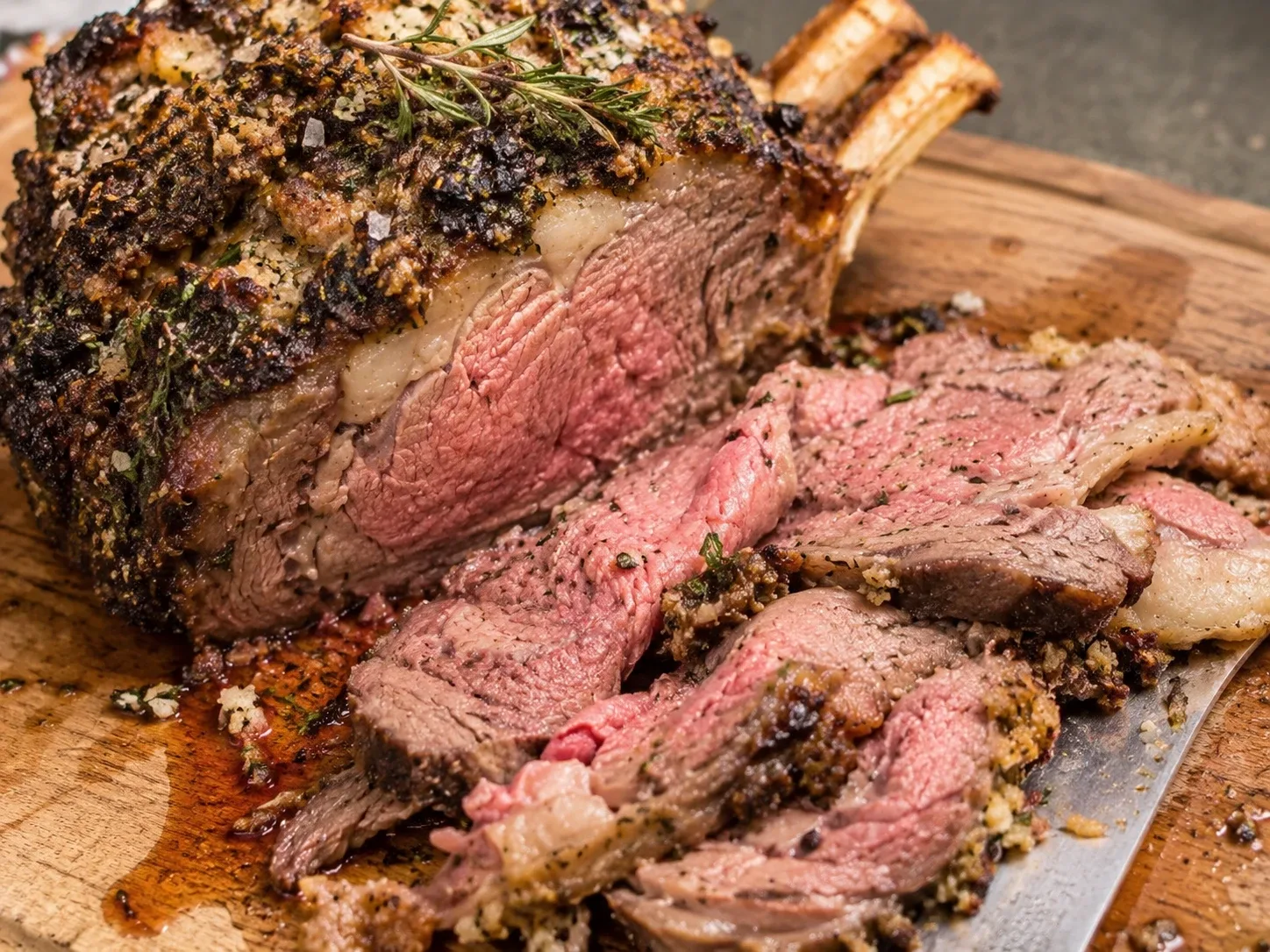
Standing Rib Roast with Horseradish-Herb Crust and Pan Jus
The Christmas centerpiece. A grass-fed rib roast, dry-brined for two days, slow-roasted to rosy edge-to-edge pink under a horseradish-herb crust, and served with a simple pan jus and horseradish cream.
Yield: Serves 8 · Active: 45 min · Total: 2 days dry-brining, plus about 5 hr on the day · Season: Best in North America in winter, when fresh horseradish root and hardy herbs are at their peak · Best eaten: early evening
Ingredients
For the roast
- One 7–8 lb grass-fed standing rib roast (3–4 ribs), bones Frenched by your butcher
- 2½ tbsp coarse sea salt (about 1 tsp per pound)
- Freshly cracked black pepper
For the horseradish-herb crust
- 4 garlic cloves, grated
- 3 tbsp freshly grated horseradish (or 2 tbsp prepared horseradish)
- 2 tbsp Dijon mustard
- 3 tbsp minced fresh rosemary
- 2 tbsp fresh thyme leaves
- 2 tbsp minced fresh flat-leaf parsley
- ¼ cup extra virgin olive oil
- ½ tsp freshly cracked black pepper
- Pinch of flaky sea salt
For the horseradish cream
- 1 cup cultured sour cream or crème fraîche
- ¼ cup freshly grated horseradish (or 3 tbsp prepared)
- 1 tbsp Dijon mustard
- 1 tbsp minced fresh chives
- 1 tsp fresh lemon juice
- Sea salt and white pepper, to taste
For the pan jus
- Pan drippings from the roast
- 1 shallot, minced
- ½ cup dry red wine
- 2 cups beef bone broth
- 1 sprig fresh thyme
- 1 sprig fresh rosemary
- 1 tbsp cold grass-fed butter
Method
For the roast
- Dry-brine (two days ahead). Pat the roast very dry. Rub the salt evenly over every surface, including the gap between the bones and the meat. Set it bone side down on a rack over a sheet pan and refrigerate, uncovered, for 48 hours. Dry-brining simply means salting ahead without liquid. The salt seasons the meat deeply and dries the surface so it browns well. Don’t skip it.
- Temper. On the day, take the roast out of the fridge 2 hours before cooking. Heat the oven to 225°F.
- Crust. Stir together all the crust ingredients. Spread the paste over the top and sides of the roast, leaving the bones bare.
- Slow-roast. Set the roast on a rack in a heavy roasting pan, bone side down. Roast at 225°F until a thermometer in the thickest part reads 120°F, about 15 minutes per pound (roughly 2 hours for a 7-lb roast). Low and slow is the key. Start checking early.
- Rest. Take the roast out, tent it loosely with parchment, and let it rest 30 minutes. Meanwhile, turn the oven up to 500°F.
- Sear. This is the “reverse sear”: slow-cook first, then brown at the end. Uncover the roast and return it to the hot oven for 8–12 minutes, rotating the pan once, until the crust is deep brown and the center reads about 130°F for medium-rare. Rest 15 minutes more before carving.
For the horseradish cream
- Mix and chill. Stir together all the ingredients and season with salt and white pepper. Chill at least 30 minutes so the flavors come together. It can be made a day ahead.
For the pan jus
- Start with the drippings. While the roast has its final rest, pour off all but 2 tbsp fat from the roasting pan. Set the pan over medium heat (across two burners if needed).
- Build the jus. Cook the shallot 2 minutes, until soft. Pour in the wine, scrape up the browned bits, and simmer until reduced by half, 2–3 minutes. Add the broth and herbs and simmer until reduced by about a third, 8–10 minutes.
- Finish. Strain the jus and return it to the pan. Off the heat, whisk in the cold butter. Season with salt and pepper.
To serve
- Carve. Cut the meat away from the bones in one piece, following the curve of the bones with your knife. Slice the roast across the grain, about ½ inch thick. Save the bones for second helpings or for broth.
- Plate. Spoon the warm jus over the slices and pass the horseradish cream alongside.
Storage
- Leftover roast keeps up to 4 days in the fridge, wrapped tightly or in a covered glass container. Slice thin and serve cold, or warm the slices briefly in a little jus so they don’t overcook.
- The jus keeps 5 days in the fridge or 3 months in the freezer.
- Horseradish cream keeps 4–5 days in the fridge.
- Roast the leftover bones with a few vegetables for a deep, rich broth.
Variations
- Smaller gathering: A 2-rib roast (about 4–5 lb) serves 4–5. Roasting time drops to about 1 hr 15 min at 225°F; go by the thermometer.
- Garlic-peppercorn crust: Skip the horseradish and press 2 tbsp coarsely cracked black peppercorns into the garlic-herb paste.
- Boneless: Use a boneless rib roast, tied every 2 inches with twine. It cooks a bit faster, so start checking the temperature after 1½ hours.
- Medium: For medium, pull the roast at 130°F before the rest and finish to about 140°F.
Season & Circadian Timing
This is the anchor of the winter holiday table, a once-a-year roast carved at the table. Plan for an early evening meal so this hearty, protein-rich dinner has time to settle before bed. The low oven also gives you a calm afternoon to prepare the sides.
Nourishment Notes
- Grass-fed beef — a complete protein with highly absorbable iron, zinc, vitamin B12, and naturally occurring creatine and carnitine.
- Grass-fed fat — fat from grass-finished cattle carries more omega-3s, CLA (conjugated linoleic acid), and fat-soluble vitamins than fat from grain-finished beef.
- Horseradish — freshly grated root brings a sinus-clearing heat from the same kind of sulfur compounds found in mustard and cabbage.
- Cultured sour cream — adds cooling tang and live cultures if you choose an unheated, cultured product.
- Rosemary and thyme — aromatic herbs that season the crust and add flavor with no extra effort.
Sourcing
- Beef — 100% grass-fed and grass-finished, from a local farm (White Oak Pastures or US Wellness Meats). A good grass-fed rib roast is an investment; order it about 2 weeks ahead.
- Sour cream / crème fraîche — cultured, organic, from grass-fed cows, or raw cream cultured at home
- Grass-fed butter — organic, cultured butter from 100% grass-fed cows, or raw butter from a local dairy
- Bone broth — homemade from pasture-raised bones, or organic and sold frozen (Bonafide Provisions)
- Extra virgin olive oil — organic, single-estate, harvest-dated, in dark glass
- Horseradish — fresh root from a farmers’ market, or prepared horseradish with no added sugar or seed oil
- Salt — unrefined sea salt (Baja Gold); flaky sea salt for finishing (Maldon)
- Fruits, vegetables, and herbs — organic, from a farmers’ market or local farm
You might also like: Grass-Fed Ribeye or Lamb with Marrow Butter, Chimichurri, and Three Roasted Sides · Roasted Potatoes Four Ways · Silky Purées Three Ways: Buttery Mashed Potatoes, Whipped Cauliflower Purée, and Roasted Carrot Purée
With Love, Light, and Health,
Anna (aka Food Marshall)
Food Marshall Approved. Grain-free, seed-oil-free and refined-sugar-free, made from organic, local and seasonal ingredients. Our standards
More Meat
Get new recipes and essays
Seasonal recipes and writing on light, circadian health, and living with nature.
Subscribe on Substack