WILD SALMON WITH HERB CREAM
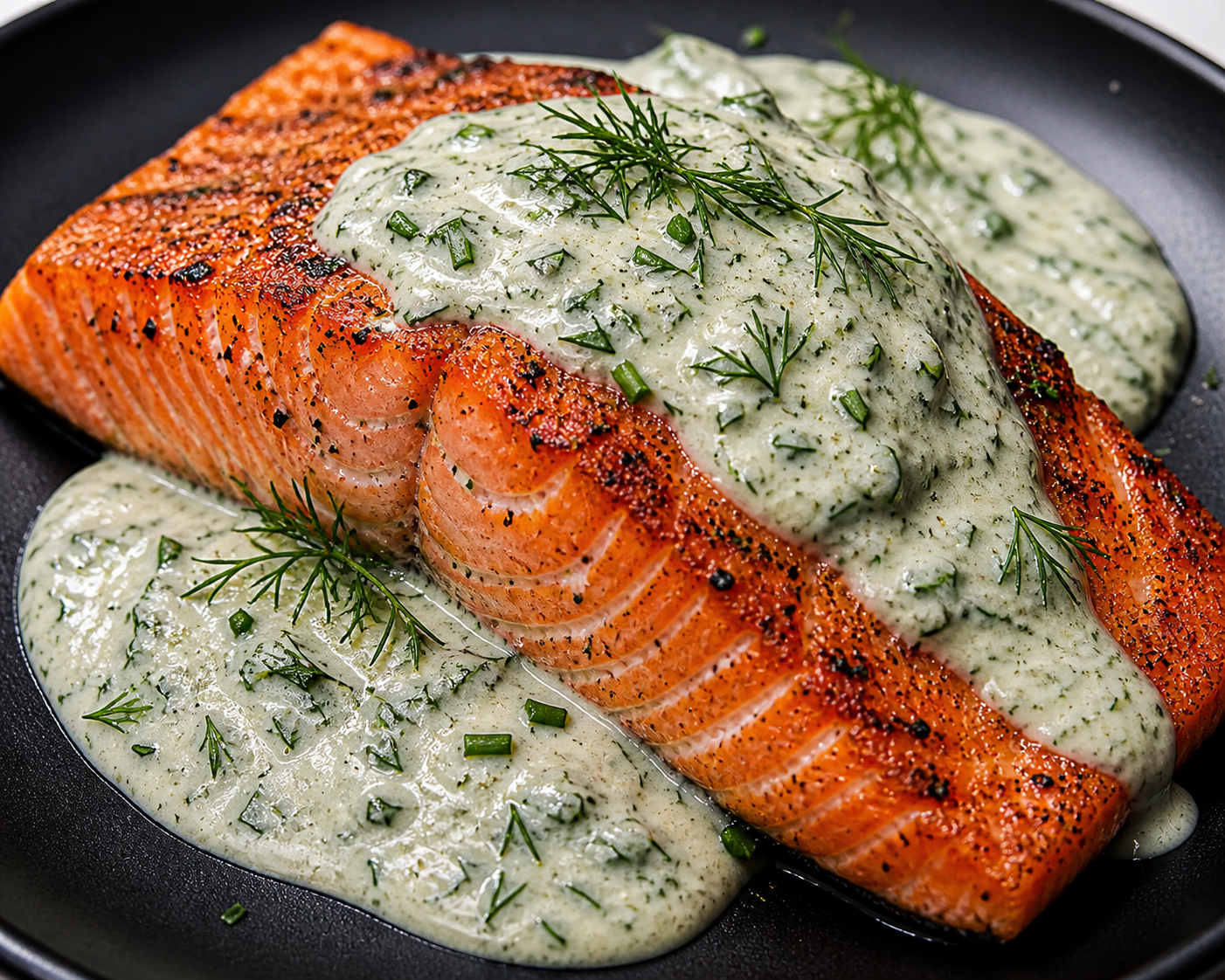
Pan-seared wild salmon with two French-Scandinavian sauces — tarragon mustard or dill lemon.
Season: Year-round (wild salmon peaks in summer; sustainable from frozen the rest of the year)
Cuisine: French · Scandinavian
Yield: Serves 4
Active: 25 min · Total: 30 min
Best eaten: midday or early evening
INGREDIENTS
Salmon
4 wild-caught salmon fillets (4–6 oz each), skin-on
2 tbsp grass-fed butter or extra virgin olive oil
Sea salt and freshly cracked black pepper
Choose a sauce direction
Tarragon Mustard Cream
2 tbsp grass-fed butter
2 small shallots, finely minced
2 garlic cloves, minced
½ cup dry white wine (or chicken bone broth for alcohol-free)
1 cup grass-fed heavy cream
3 tbsp Dijon mustard
1 tbsp whole-grain mustard (optional)
3 tbsp fresh tarragon, finely chopped
1 tsp fresh lemon juice
Sea salt, freshly cracked black pepper
Dill Lemon Cream
2 tbsp grass-fed butter
2 small shallots, finely minced
½ cup dry white wine (or chicken bone broth)
1 cup grass-fed heavy cream
¼ cup fresh dill, finely chopped
Zest of 1 organic lemon
2 tbsp fresh lemon juice
Sea salt, freshly cracked black pepper
Sub: coconut cream works in place of dairy cream — finish with extra lemon juice to balance the sweetness. Frozen wild salmon, fully thawed and patted very dry, is preferable to fresh farmed.
METHOD
Bring the salmon to room temperature 15 minutes before cooking. Pat very dry — moisture is the enemy of a crispy skin. Season with salt and pepper.
Start the sauce. Melt 2 tbsp butter in a saucepan over medium heat. Add shallots and cook 3 minutes until soft. (Add garlic for the tarragon version; cook 1 minute more.)
Pour in the wine and reduce by half, about 5 minutes.
Stir in the cream and simmer 5 minutes until lightly thickened.
Finish the sauce: whisk in the Dijon, whole-grain mustard, tarragon, and lemon juice (tarragon version), or the dill, lemon zest, and lemon juice (dill version). Season with salt and pepper. Keep warm.
Sear the salmon. Heat butter in a large skillet over medium-high. Place the salmon skin-side down and cook 4–5 minutes until the skin is crispy and deeply golden.
Flip carefully and cook 1–2 minutes more, until just opaque. Wild salmon cooks faster than farmed — do not overcook. The center should still be slightly translucent when pulled from heat; it finishes on the plate.
Transfer to plates skin-side up. Spoon the cream sauce around (not directly over) the salmon to preserve the crispy skin. Garnish with additional fresh herbs and lemon wedges.
NOURISHMENT NOTES
Wild-caught salmon is one of the most nutrient-dense fish available — delivering complete protein, the long-chain omega-3 fatty acids EPA and DHA in exceptional concentrations, vitamin D in the rare animal-source form, selenium, B12, and astaxanthin. Astaxanthin is the carotenoid that gives wild salmon its deep pink-red color and is among the most powerful antioxidants studied. Crucially, wild salmon's astaxanthin comes from its diet of small crustaceans and algae; farmed salmon's pink color is typically synthetic astaxanthin added to feed and does not carry the same biological activity. The wild-versus-farmed distinction is structural here, not marginal. DHA specifically is one of the most important nutrients for nervous system function, retinal health, and the structural integrity of cell membranes throughout the body — and it is concentrated in wild fatty fish at levels no plant source can match.
The cream-sauce format is functionally important, not decorative. Omega-3 fatty acids and fat-soluble vitamins (A, D, E, K2) are absorbed in the presence of additional fat — and the substantial cream and butter in these sauces ensures the salmon's nutritional payload is fully extracted by the body. Grass-fed dairy from cows on green pasture delivers butyrate, conjugated linoleic acid, and the same fat-soluble vitamin spectrum as the fish itself. Dijon mustard contributes glucosinolates from the mustard family — the same compounds that make broccoli and arugula functional foods. Tarragon, one of the four classic French fines herbes, carries anethole and methyl chavicol, the compounds responsible for its distinctive licorice character; dill carries carvone, fresh and slightly grass-like. Both have been paired with fish across European cooking traditions for centuries — the herbs are not garnish, they are digestive support and aromatic counter-balance to the richness of the fish and cream.
As a circadian food, salmon belongs to midday and early evening rather than late at night. The body's capacity to process protein and fat peaks during daylight, when digestive fire and metabolic capacity are highest. DHA absorbed earlier in the day reaches the brain and nervous system during the body's active phase, where it is most readily incorporated into membrane structure and signaling. Salmon is genuinely year-round food, but it lands most cleanly in late spring through summer when wild Alaskan and Pacific salmon are at peak season — frozen-at-sea wild salmon outside that window is preferable to fresh farmed at any point.
Storage: salmon is best fresh; refrigerate cooked leftovers up to 2 days, gently warmed in a low oven or eaten cold over greens. The cream sauces refrigerate up to 3 days separately and reheat gently over low heat — do not boil. For sourcing, look for wild Alaskan, Pacific, or sustainably managed Atlantic salmon (Vital Choice, Wild For Salmon, or local fishmongers with traceable sourcing). Avoid farmed Atlantic salmon — the omega-3 profile is significantly diminished and the astaxanthin is synthetic.