Piri-Piri Chicken with Homemade Piri-Piri Sauce
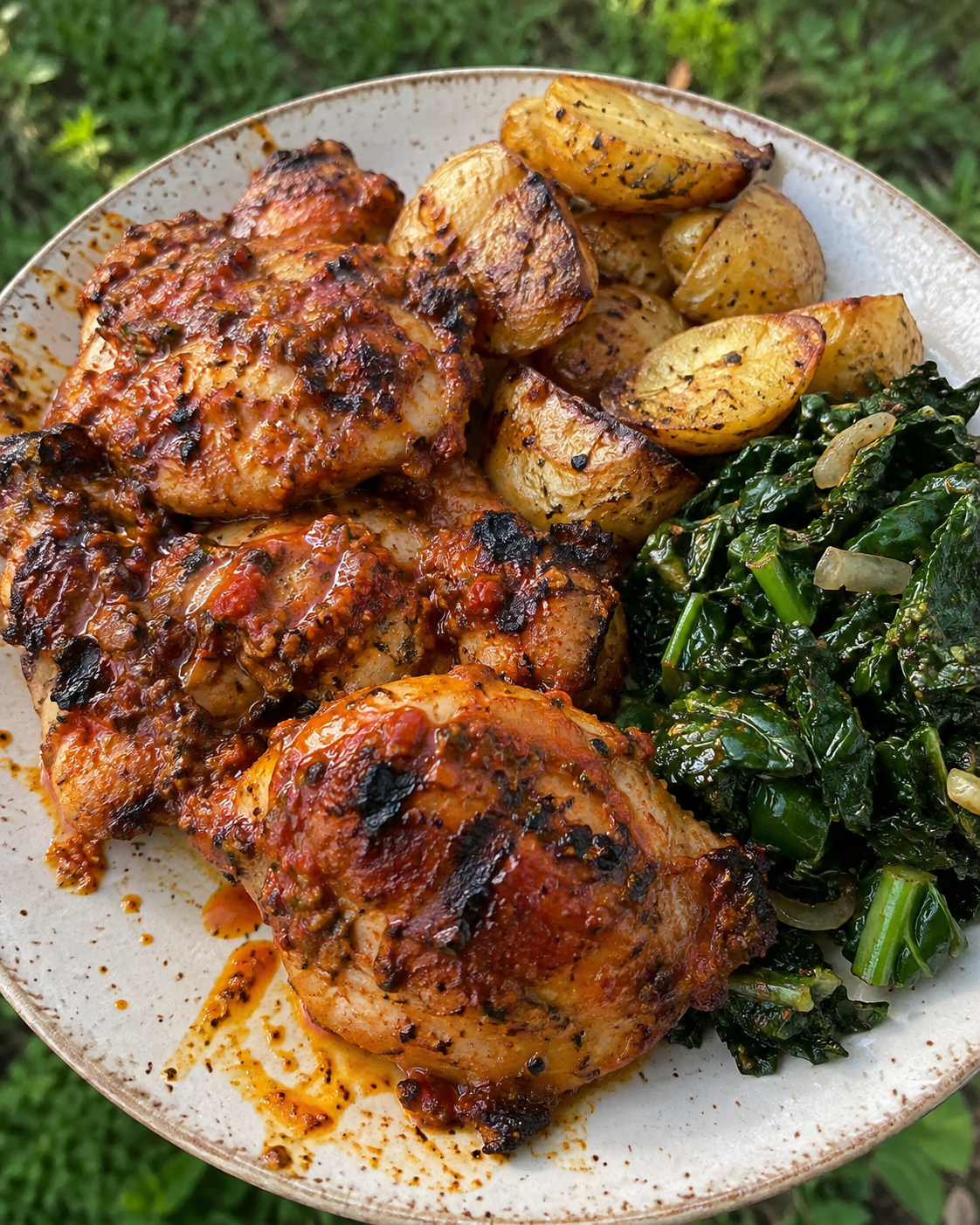
A whole pastured chicken, butterflied flat, slathered in a smoky, fiery roasted red pepper and bird’s eye chili sauce and roasted until the skin is crisp and blistered. Plus four ways to make it a meal.
Yield: serves 4 (about 1½ cups sauce) · Active: 35 min · Total: 2 hr (plus 4–24 hours dry-brining, optional) · Season: red peppers peak August–October, and summer is grill season; it’s great year-round in the oven · Cuisine: Portuguese-Mozambican · Best eaten: midday or early evening
Piri-piri means “pepper-pepper” in Swahili. It’s the name for the small, fiery African bird’s eye chili and the sauce made from it. Portuguese sailors carried chilies from the Americas to their colonies in Mozambique and Angola, where the bird’s eye chili took hold. The sauce came back to Portugal and became a national favorite. In the Algarve, the little town of Guia is famous for its frango piri-piri: whole chickens split open, grilled over charcoal and brushed with chili oil until blistered.
Make a double batch of sauce. It’s great on eggs, shrimp, roasted vegetables and soups.
Ingredients
Piri-piri sauce (about 1½ cups)
2 red bell peppers, cut into large pieces
1 red onion, cut into large chunks
6 cloves garlic, peeled
2 fresh red chilies (serrano or Fresno), halved and seeded (keep the seeds for more heat)
½ cup extra virgin olive oil, divided
1 tsp sweet paprika
1 tsp smoked paprika
1–2 tsp cayenne pepper (to taste)
1½ tsp Baja Gold sea salt
4–10 dried African bird’s eye (piri-piri) chilies, to taste: 4 is spicy, 10 is fiery
Zest and juice of 1 lemon
3 tbsp red wine vinegar
⅓ cup fresh parsley and cilantro (either or both)
½ tsp dried oregano
¼ tsp dried rosemary
¼ tsp white pepper
Chicken
1 whole pasture-raised chicken (3½–4 lb)
2 tsp Baja Gold sea salt, for dry-brining
½ tsp freshly ground black pepper
Lemon wedges and fresh cilantro or parsley, to serve
Wear gloves when handling the chilies and rubbing the sauce on the chicken. It burns!
Method
Dry-brine the chicken (4–24 hours ahead, optional but worth it)
Spatchcock. Pat the chicken dry. Set it breast-side down with the legs toward you. With sturdy poultry shears, cut along both sides of the backbone and remove it; save it for broth. Flip the chicken over and press down firmly on the breastbone with both palms until it cracks and the bird lies flat. Want two halves instead? Cut straight down through the breastbone to split it into two pieces.
Salt. Season all over with the 2 tsp salt. Refrigerate uncovered on a rack for 4–24 hours. This dries out the skin so it roasts up crisp instead of flabby. (No time? Salt it and go.)
Make the sauce
3. Roast the vegetables. Heat the oven to 375°F. On a sheet pan, toss the bell peppers and onion with 2 tbsp of the olive oil, the sweet and smoked paprika, cayenne and 1 tsp of the salt. Roast 20 minutes. Add the garlic and fresh chilies, toss and roast 10 minutes more, until soft and charred at the edges.
4. Blend. Scrape everything, juices included, into a blender. Add the dried chilies, lemon zest and juice, vinegar, parsley and cilantro, oregano, rosemary, white pepper, the remaining salt and the rest of the olive oil. Blend until smooth. Taste for heat and salt.
5. Divide. Pour half the sauce into a jar for serving and set it aside. It never touches raw chicken. Use the other half to marinate.
Marinate and roast
6. Marinate. Set the chicken skin-side up in a large roasting pan or on a sheet pan. Loosen the skin over the breasts and thighs with your fingers and rub some sauce underneath, then coat the whole bird, top and bottom, with the marinating half. Sprinkle with black pepper. Let it sit 30–45 minutes at room temperature, or cover and refrigerate overnight; take it out 45 minutes before roasting.
7. Roast. Heat the oven to 425°F. Roast the chicken, skin-side up, on the center rack for 40–50 minutes. Baste once halfway through with the pan juices. It’s done when the thickest part of the breast reads 165°F and the thigh reads 175°F. You can pull it when the breast hits 160°F, since it climbs to 165°F as it rests.
8. Char. For extra color, slide it under the broiler for 1–3 minutes at the end, watching closely.
9. Rest. Tent loosely with foil and rest 10 minutes.
10. Serve. Carve into halves or quarters, or serve it whole on a board. Spoon the pan juices over, add lemon wedges and fresh herbs, and pass the reserved sauce at the table.
On the grill: Set up a hot zone and a medium-low zone. Grill the chicken skin-side up on the cooler side with the lid closed, turning it 90 degrees every 15 minutes, until the breast reaches about 155°F (30–45 minutes). Flip it skin-side down onto the hot side for 2–3 minutes to char and crisp, until the breast reaches 165°F and the thigh 175°F. Rest 10 minutes.
Storage: Leftover chicken keeps 3–4 days refrigerated and makes great salads and lettuce wraps. Keep the sauce in the fridge, since it has fresh garlic in oil, and use it within 1 week. Or freeze it in ice cube trays for up to 3 months.
Make It a Meal
1. Algarve café plate (the classic)
Piri-piri chicken, cut into quarters
Crispy roasted potato wedges (see Roasted Potatoes Four Ways)
Portuguese salada mista: tomato, onion, green pepper and cucumber with olive oil, red wine vinegar, oregano and Baja Gold
Extra piri-piri sauce for the potatoes
2. Mozambique coast plate
Piri-piri chicken
Coconut rice to soak up the sauce
Charred broccolini or grilled zucchini
Lime wedges and a bowl of cilantro-lime yogurt to cool the heat
3. Cozy fall plate
Piri-piri chicken
Roasted sweet potato wedges with smoked paprika
Garlicky sautéed collards or kale (a nod to caldo verde)
Shaved fennel and orange salad with olives
4. Light summer plate
Piri-piri chicken, grilled
A big green salad with avocado, cucumber and herbs (see Seasonal Mixed Greens)
Blistered peppers and cherry tomatoes off the grill
Herby lemon cauliflower rice
Feeding a crowd? Roast two chickens and set out the potatoes, coconut rice, salada mista and a green vegetable family-style, with bowls of piri-piri sauce and yogurt sauce on the table so everyone can choose their own heat.
More side ideas
Roasted cauliflower or broccoli (see my Roasted Brassicas: A Foundation Guide)
A tangy slaw of purple cabbage, carrots and cilantro with lime
Sliced cucumbers and avocado with lime and flaky salt
More roasted vegetable ideas in Roasted Sides: A Library
Cilantro-lime yogurt: stir together 1 cup whole-milk Greek yogurt, the zest of 1 lime, 1 tbsp lime juice, 1 small grated garlic clove, 2 tbsp chopped cilantro and a pinch of Baja Gold.
Nourishment Notes
Pasture-raised chicken brings complete protein, B vitamins (especially niacin and B6) and selenium. The dark thigh and leg meat carries more iron and zinc than the breast. Roasting skin-on keeps the meat juicy, and the skin brings collagen. Save the backbone and carcass for bone broth.
Bird’s eye chilies and cayenne get their heat from capsaicin, which warms the body, gets circulation moving and can give a gentle lift to metabolism. Capsaicin is fat-soluble, which is one reason chili sauces are made with oil: the fat carries the heat and the flavor.
Red bell peppers are one of the richest sources of vitamin C, with more than an orange, plus beta-carotene. Roasting makes them sweet and smoky. Paprika is ground dried red peppers, full of carotenoids like capsanthin, which gives it its deep red color.
Garlic and onion bring sulfur compounds (garlic’s allicin forms when it’s crushed or chopped), plus prebiotic fibers. Lemon adds vitamin C and brightness. Parsley and cilantro bring vitamin K, chlorophyll and freshness.
Extra virgin olive oil carries the fat-soluble carotenoids from the peppers and paprika and brings its own polyphenols. Red wine vinegar adds tang and helps the sauce keep.
For your cycle: in the luteal phase, warming, spicy food and plenty of protein can help with the low energy and cravings that come before your period. Pair the chicken with sweet potatoes for slow carbs. During menstruation, the iron in the dark meat, along with the vitamin C in the peppers and lemon to help absorb it, makes a good replenishing plate. If your digestion is sensitive that week, go easy on the chilies.
Sourcing
Chicken: pasture-raised whole chicken from a local farm, or a pastured brand from your butcher. Ask the butcher to spatchcock it for you.
Dried African bird’s eye (piri-piri) chilies: specialty spice shops, African or Portuguese markets, or online. Dried Thai bird’s eye chilies are a fine stand-in.
Red peppers, onions, garlic and fresh chilies: a farmers’ market, at their peak in late summer and fall
Smoked paprika: La Chinata (pimentón de la Vera)
Extra virgin olive oil: single-estate, from a small producer. A Portuguese olive oil from the Alentejo fits right in.
Red wine vinegar: a naturally fermented, unpasteurized one
Greek yogurt: grass-fed whole-milk, like Maple Hill Creamery or a local dairy
Lemons and limes: organic, since you’re using the zest
Sea salt: Baja Gold
— Anna aka Food Marshall