Crispy Blackened Cauliflower, Brussels Sprouts, Carrots & Shallots with Burrata and Herbs
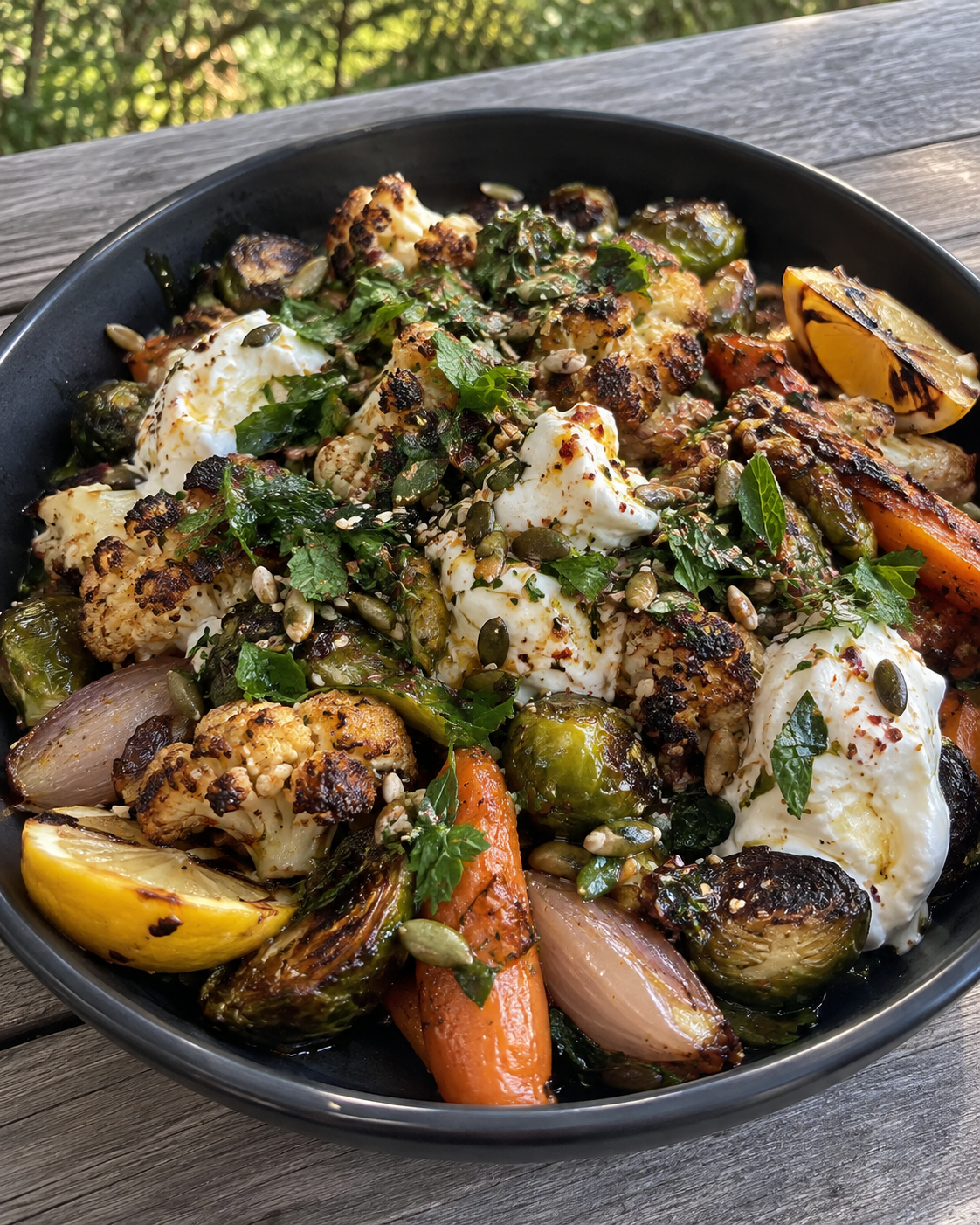
Spice-crusted roasted vegetables, charred at the edges, piled on a platter with torn melty burrata, a bright herb-and-seed salad and roasted lemon.
Yield: serves 4–6 as a main, 8 as a side · Active: 20 min · Total: 55 min · Season: fall through spring. Brussels sprouts peak October–February (sweetest after frost), cauliflower October–April (California and Arizona through winter), carrots fall into winter, and shallots keep all year. · Cuisine: modern Mediterranean · Best eaten: midday or early evening
This is the vegetable platter that makes people forget there’s no meat on the table. Cauliflower, Brussels sprouts, carrots and shallots get tossed in a smoky blackening spice and roasted hot until crispy and charred at the edges. The shallots turn soft and jammy, and the lemon wedges roast right alongside. Everything goes on a big platter with a ball of burrata torn over the top, so the cool, creamy center spills into the warm vegetables, then a scatter of fresh herbs and toasted seeds with garlic and vinegar.
Serve it as a vegetarian main with a green salad, or as a side to roast chicken, steak or fish. Adapted from Half Baked Harvest. More roasted vegetables: Roasted Cauliflower Two Ways with Chermoula, Roasted Brussels Sprouts Two Ways and Roasted Sides: A Library.
Ingredients
Vegetables
1 large head cauliflower, cut into florets or small wedges
1 lb Brussels sprouts, trimmed and halved
1 lb carrots (rainbow if you can find them), halved lengthwise (quartered if thick), cut into 3-inch pieces
6 shallots, peeled and halved lengthwise, root end left on (or 10 oz pearl onions, peeled; see note)
½ cup extra virgin olive oil
1 lemon, cut into wedges
Blackening spice
1½ tsp smoked paprika
1 tbsp pure chili powder (like ancho)
1½ tsp ground cumin
1½ tsp garlic powder
1½ tsp onion powder
¼–½ tsp cayenne pepper
Pinch red pepper flakes
1½ tsp Baja Gold sea salt
½ tsp freshly ground black pepper
Herb-and-seed salad
1 cup chopped mixed fresh herbs (basil, dill, cilantro and parsley; in winter, use parsley, mint, dill and cilantro)
¼ cup mixed toasted nuts and seeds (pumpkin seeds, pine nuts and almonds), chopped
1 clove garlic, grated
1 tbsp red wine vinegar
2 tbsp extra virgin olive oil
Pinch red pepper flakes and Baja Gold sea salt
To finish
8 oz burrata, at room temperature (or fresh buffalo mozzarella)
Extra virgin olive oil and flaky salt, for drizzling
Swaps
Dairy-free: skip the burrata and drizzle with lemon-tahini sauce (¼ cup tahini, juice of 1 lemon, 1 small grated garlic clove, a pinch of salt and enough cold water to make it pourable).
Nut-free: use only pumpkin and sunflower seeds.
Pearl onions: blanch them 1 minute in boiling water, then slip off the skins and trim the root ends before roasting.
Allergy note: contains dairy and tree nuts.
Method
Prep. Heat the oven to 425°F and line two sheet pans with parchment. Take the burrata out of the fridge to come to room temperature. Cut the cauliflower and Brussels sprouts first and let them sit while you prep the rest; that 30-minute rest gives their sulforaphane time to form.
Spice. Mix all the blackening spice ingredients in a small bowl.
Toss. Divide the vegetables between the pans. Drizzle with the olive oil, sprinkle with the spice mix and toss thoroughly until everything is coated. Turn the Brussels sprouts and shallots cut-side down and spread everything into a single layer. Crowded vegetables steam instead of crisping.
Roast. Roast 15 minutes. Toss the vegetables, add the lemon wedges and swap the pans’ positions in the oven. Roast 15–20 minutes more, until tender, charred and crispy at the edges.
Make the herb salad. While the vegetables roast, stir together the herbs, nuts and seeds, garlic, vinegar, olive oil, red pepper flakes and salt.
Plate. Pile the vegetables on a large platter and squeeze the roasted lemon wedges over the top.
Finish. Tear the burrata over the vegetables in large pieces, letting the creamy center spill out. Scatter the herb salad over everything, drizzle with olive oil and add a pinch of flaky salt. Eat warm.
Make it a meal: serve it with roast chicken, a seared ribeye or pan-seared fish, or as a vegetarian main with a soft-boiled egg and a green salad.
Storage: It’s best assembled and eaten right away. The roasted vegetables keep 3 days in the fridge (re-crisp at 400°F for 8–10 minutes), and the herb salad keeps 1 day.
Nourishment Notes
Cauliflower and Brussels sprouts are cruciferous vegetables, rich in vitamin C, vitamin K, folate and fiber, plus glucosinolates, which turn into sulforaphane when they’re cut. That’s why chopping them first and letting them sit before roasting is worth it. Brussels sprouts get sweeter after a frost, which makes them a cold-weather treat.
Carrots bring beta-carotene, which the body turns into vitamin A with the help of fat, so roasting them in olive oil with burrata on top is exactly right. Rainbow carrots each bring something different: orange has beta-carotene, yellow has lutein and purple has anthocyanins. Shallots bring quercetin and the same family of sulfur compounds as onions and garlic, and they turn jammy and sweet in the oven.
The blackening spices (smoked paprika, chili, cumin, cayenne, garlic and onion) are inspired by the Cajun blackening tradition that Paul Prudhomme made famous in 1980s New Orleans. They give the vegetables a deep, savory crust. Paprika and chili bring carotenoids, and cayenne brings capsaicin.
Burrata is fresh mozzarella’s richer cousin: a pouch of pulled mozzarella filled with stracciatella (shreds of curd soaked in cream). It comes from Andria, in Puglia, where it was created in the early 1900s as a way to use mozzarella scraps and extra cream. It brings protein, calcium and fat-soluble vitamins. Serve it at room temperature; cold from the fridge, the cream firms up and tastes flat.
The herb-and-seed salad brings fresh herbs, toasted seeds, garlic and acid, the same bright counterpoint you’ll find in Lebanese tabbouleh, the Persian herb platter sabzi khordan and Italian gremolata. Herbs bring vitamin K, chlorophyll and aromatic compounds. Pumpkin seeds bring magnesium and zinc, and almonds and pine nuts add vitamin E.
Extra virgin olive oil carries the fat-soluble carotenoids and brings its own polyphenols. Lemon adds vitamin C and brightness.
For your cycle: cruciferous vegetables like cauliflower and Brussels sprouts are often recommended through the follicular and luteal phases, since compounds like sulforaphane and indole-3-carbinol are studied for their role in healthy estrogen metabolism. In the luteal phase, the pumpkin seeds’ magnesium and zinc and the burrata’s fat and protein help keep cravings steady.
Sourcing
Cauliflower, Brussels sprouts, carrots and shallots: a farmers’ market in fall and winter, organic where possible. Look for tight, heavy cauliflower and small, firm Brussels sprouts.
Burrata: fresh and as local as possible, eaten within a day or two. Look for one made with pasteurized milk if you’re pregnant.
Spices: organic, and pure chili powder (like ancho) rather than blends with fillers
Smoked paprika: La Chinata (pimentón de la Vera)
Nuts and seeds: raw, organic, toasted at home for the freshest flavor
Fresh herbs: a farmers’ market or a windowsill pot
Extra virgin olive oil: single-estate, from a small producer
Red wine vinegar: naturally fermented
Sea salt: Baja Gold
— Anna aka Food Marshall