Ribeye with Anchovy-Herb Butter, Peppers, Chanterelles & Garlicky Greens
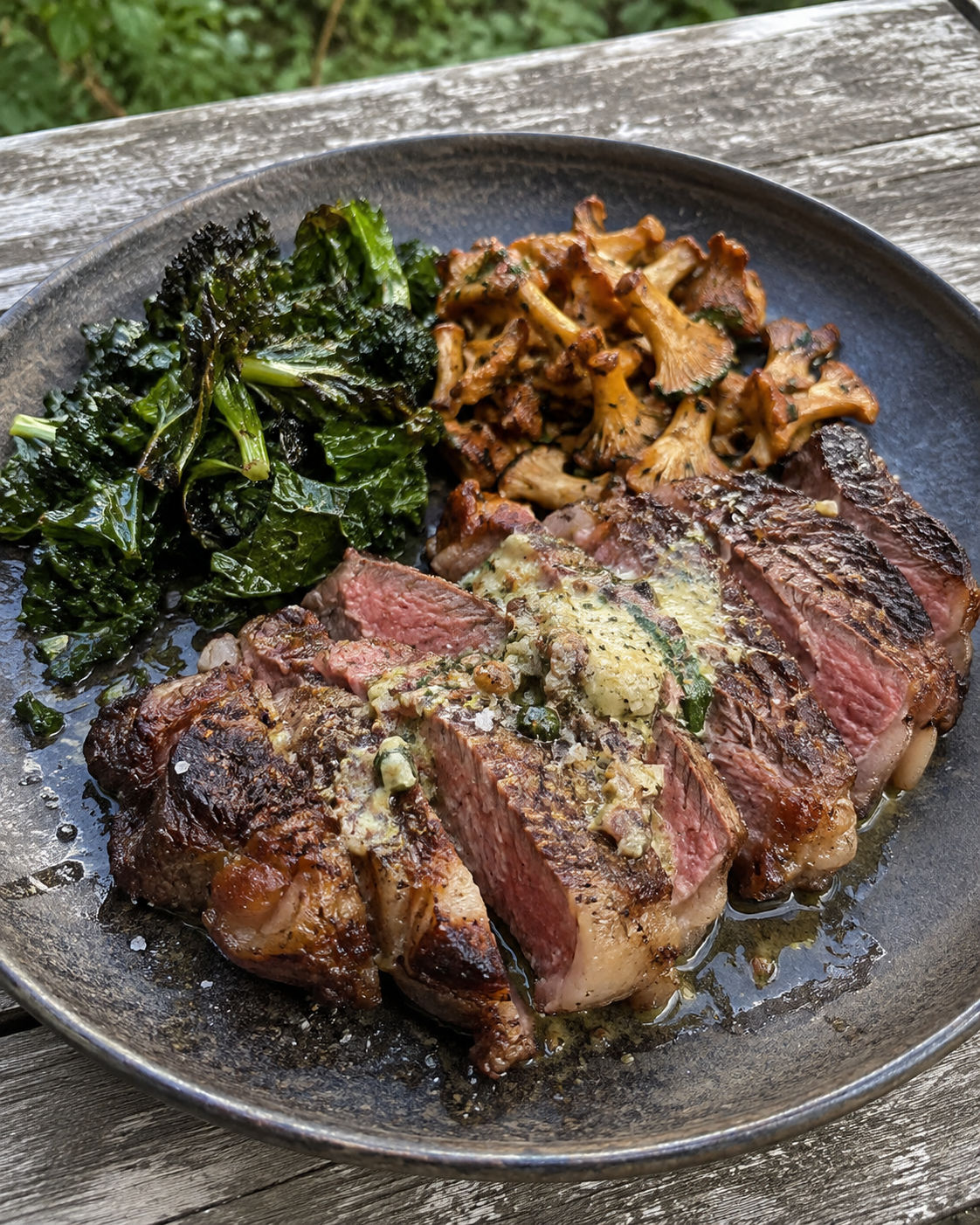
Butter-basted grass-fed ribeye topped with melting anchovy-herb butter, served with blistered sweet Italian peppers, golden chanterelles and garlicky kale: a late-summer Italian steak dinner. Plus a year-round swap.
Yield: serves 4 · Active: 45 min · Total: 1 hr 15 min (plus 2 hours to chill the butter and 45 minutes to overnight for salting) · Season: Corno di Toro peppers peak August–October. Chanterelles run July–September in the East and Midwest, September–November in the Pacific Northwest and November–February in California. Out of season, use the cauliflower-broccolini swap. · Cuisine: Italian, with a French technique · Best eaten: midday or early evening
Don’t like anchovies? Give this butter a chance. It doesn’t taste fishy, just deeply savory, like the steak is more itself. And when peppers and chanterelles aren’t in season, the year-round swap of roasted cauliflower and broccolini with pine nuts and basil is just as good under that butter.
More anchovies: Visiting the World’s Best Anchovies & Ways to Eat Them. More ribeye: Ribeye with Herb Mushrooms, Béarnaise & Shallot Jus.
Ingredients
Anchovy-herb butter (makes about ½ cup)
½ cup grass-fed butter, softened
4 anchovy fillets in olive oil, plus 1 tsp of their oil
2 cloves garlic, finely grated
2 tbsp fresh basil, finely chopped
1 tbsp fresh parsley, finely chopped
1 tbsp capers, drained and chopped (optional)
1 tsp Dijon mustard (Delouis Fils or Maison Orphée)
1 tsp fresh lemon juice
Freshly cracked black pepper
Ribeye
4 grass-fed ribeye steaks (about 10 oz each, 1 inch thick)
2 tsp Baja Gold sea salt
Freshly cracked black pepper
2 tbsp beef tallow or grass-fed ghee, for searing
2 tbsp grass-fed butter, for basting
4 cloves garlic, smashed
3 sprigs fresh rosemary
Blistered Corno di Toro peppers
8 Corno di Toro peppers (or other sweet Italian frying peppers), whole or halved lengthwise
3 tbsp extra virgin olive oil
Baja Gold sea salt and flaky salt
Chanterelles
8 oz fresh chanterelles, brushed clean and torn if large
2 tbsp grass-fed butter
1 small shallot, minced
Leaves from 2 sprigs fresh thyme
Baja Gold sea salt and black pepper
Garlicky greens
1 large bunch lacinato kale or rainbow chard, stems removed, roughly chopped
3 tbsp extra virgin olive oil
4 cloves garlic, smashed
½–1 tsp red pepper flakes
Squeeze of lemon and a pinch of Baja Gold
Year-round swap: roasted cauliflower and broccolini (use instead of the peppers and chanterelles)
1 large head cauliflower, cut into large florets
2 bunches broccolini
3 tbsp extra virgin olive oil, plus 2 tbsp to finish
¼ cup pine nuts, lightly toasted
¼ cup each fresh parsley and basil, torn
Zest and juice of 1 organic lemon
Baja Gold sea salt and black pepper
Method
Ahead of time
Make the anchovy butter (up to 1 week ahead). Mash the anchovies and their oil into a paste with a fork, then mash in the softened butter, garlic, basil, parsley, capers, Dijon, lemon juice and pepper until evenly combined. Roll into a log in parchment and refrigerate at least 2 hours.
Salt the steaks at least 45 minutes ahead, or up to overnight. Pat them dry and season all over with the salt. Overnight, uncovered on a rack in the fridge, gives you the best crust. (In a rush? Salt right before cooking instead. The in-between window of 10–40 minutes leaves a wet surface that won’t brown as well.) Take them out of the fridge 30–45 minutes before searing.
Chop the greens (and the broccolini, if using the swap) 30–40 minutes before cooking and let them sit. This gives their sulforaphane time to form before heat.
Cook the sides
4. Blister the peppers. Heat the olive oil in a large skillet over medium-high heat. Add the peppers and cook 8–10 minutes, turning now and then, until blistered and tender. Season with salt and keep warm.
5. Brown the chanterelles. In the same skillet over medium-high heat, melt the butter. Add the chanterelles in a single layer and cook undisturbed for 3 minutes, then stir and cook 2–4 minutes more, until golden and their liquid has cooked off. Add the shallot and thyme for the last minute. Season and keep warm.
6. Wilt the greens. In another skillet over medium heat, warm the olive oil with the garlic and red pepper flakes for 30–60 seconds, until fragrant. Add the greens and a pinch of salt and toss 3–5 minutes, until just wilted. Finish with lemon.
Year-round swap instead of steps 4–5: Heat the oven to 425°F. Toss the cauliflower and broccolini with 3 tbsp olive oil, salt and pepper and roast 30–40 minutes, turning once, until deeply charred and tender (the broccolini may finish 10 minutes sooner). Toss with the pine nuts, herbs, lemon zest and juice, and the finishing olive oil.
Cook the steaks
7. Sear. Pat the steaks dry and season with pepper. Heat a large cast-iron skillet over high heat until very hot, then add the tallow or ghee. When it shimmers, lay in the steaks (work in two batches or two skillets for 4). Sear undisturbed 3 minutes, until a deep crust forms, then flip.
8. Baste. After about 2 minutes on the second side, lower the heat to medium and add the butter, smashed garlic and rosemary. Tilt the pan and spoon the foaming butter over the steaks again and again for 1–2 minutes. This French technique (arrosage) layers garlic and herb flavor right onto the crust. Pull the steaks at 125–130°F for medium-rare.
9. Rest 5–8 minutes on a board, so the juices settle back into the meat instead of running out.
Plate
10. Slice the steaks against the grain into ½-inch slices. Top each with a thick coin of anchovy-herb butter and let it melt. Serve with the peppers, chanterelles and greens (or the cauliflower and broccolini), with flaky salt over everything.
Storage: The anchovy butter keeps 1 week in the fridge (it has raw garlic, so keep it cold) or 3 months frozen; slice coins straight from the freezer onto hot steak. Leftover vegetables keep 2 days. Leftover steak keeps 3 days and is great cold over greens. For 8 guests, double everything and sear in two skillets at once.
Doneness note: medium-rare is 125–130°F pulled, rising about 5 degrees as it rests. The USDA recommends 145°F, so cook to 145°F for pregnancy and young children.
Nourishment Notes
Grass-fed ribeye brings complete protein, heme iron, zinc, B12, B6 and creatine in their most absorbable forms. Ribeye is one of the most marbled steak cuts, and that fat carries most of the fat-soluble vitamins (A, D, E and K2) plus CLA. Grass-finished beef has more omega-3s, vitamin E and carotenoids than grain-finished, which is why its fat has a faint golden tint.
Butter-basting coats the crust in foaming butter infused with rosemary and garlic, layering in their aromatic compounds while keeping the inside juicy. Rosemary’s antioxidants may also help protect the meat’s fats at high heat.
Anchovies are one of the most underrated traditional foods: small, fatty fish rich in omega-3s (EPA and DHA), selenium and vitamin D. Because they’re small and short-lived, they’re low in mercury. Mashed into butter, they turn into pure savory depth. Cantabrian, Sicilian or Portuguese anchovies packed in good olive oil are worth seeking out.
Corno di Toro peppers are an Italian heirloom sweet pepper, named “bull’s horn” for their long, curved shape. Like red bell peppers, they’re loaded with vitamin C and beta-carotene, and blistering them in olive oil helps you absorb the carotenoids.
Chanterelles have a delicate, apricot-like aroma and bring B vitamins, beta-glucans and vitamin D2. They’re one of the better mushroom sources of vitamin D, especially wild ones that grew in the sun-dappled forest.
Lacinato kale and chard bring vitamin K, vitamin A (as carotenoids), magnesium and potassium. Cooking them in olive oil helps you absorb their fat-soluble vitamins. Cauliflower and broccolini in the swap bring vitamin C, folate and glucosinolates, which form sulforaphane when chopped. Pine nuts add vitamin E, magnesium and pinolenic acid, a fatty acid found in few other foods. Capers bring quercetin and rutin.
For your cycle: red meat is one of the best foods for the menstrual phase. Heme iron, zinc and B12 help replenish what you lose, and the vitamin C in the peppers, greens and lemon helps you absorb the iron. In the luteal phase, the protein and fat keep blood sugar and cravings steady, and the leafy greens add magnesium.
Sourcing
Ribeye: grass-fed and grass-finished, from a local rancher, White Oak Pastures or US Wellness Meats
Anchovies: packed in olive oil, from Ortiz, Agostino Recca or Don Bocarte
Corno di Toro peppers: a farmers’ market in late summer, or grow them yourself; they’re easy and prolific. Any sweet Italian frying pepper works.
Chanterelles: a farmers’ market, a specialty grocer or a local forager whose name you know
Kale, chard, cauliflower and broccolini: a farmers’ market, organic where possible
Butter, ghee and tallow: grass-fed
Dijon mustard: Delouis Fils or Maison Orphée
Pine nuts: look for Italian or Mediterranean pine nuts. Some cheaper pine nuts can cause a temporary bitter or metallic taste (“pine mouth”).
Extra virgin olive oil: single-estate, from a small producer
Sea salt: Baja Gold
— Anna aka Food Marshall