Grass-Fed Beef Back Ribs with Sautéed Fennel & Leeks
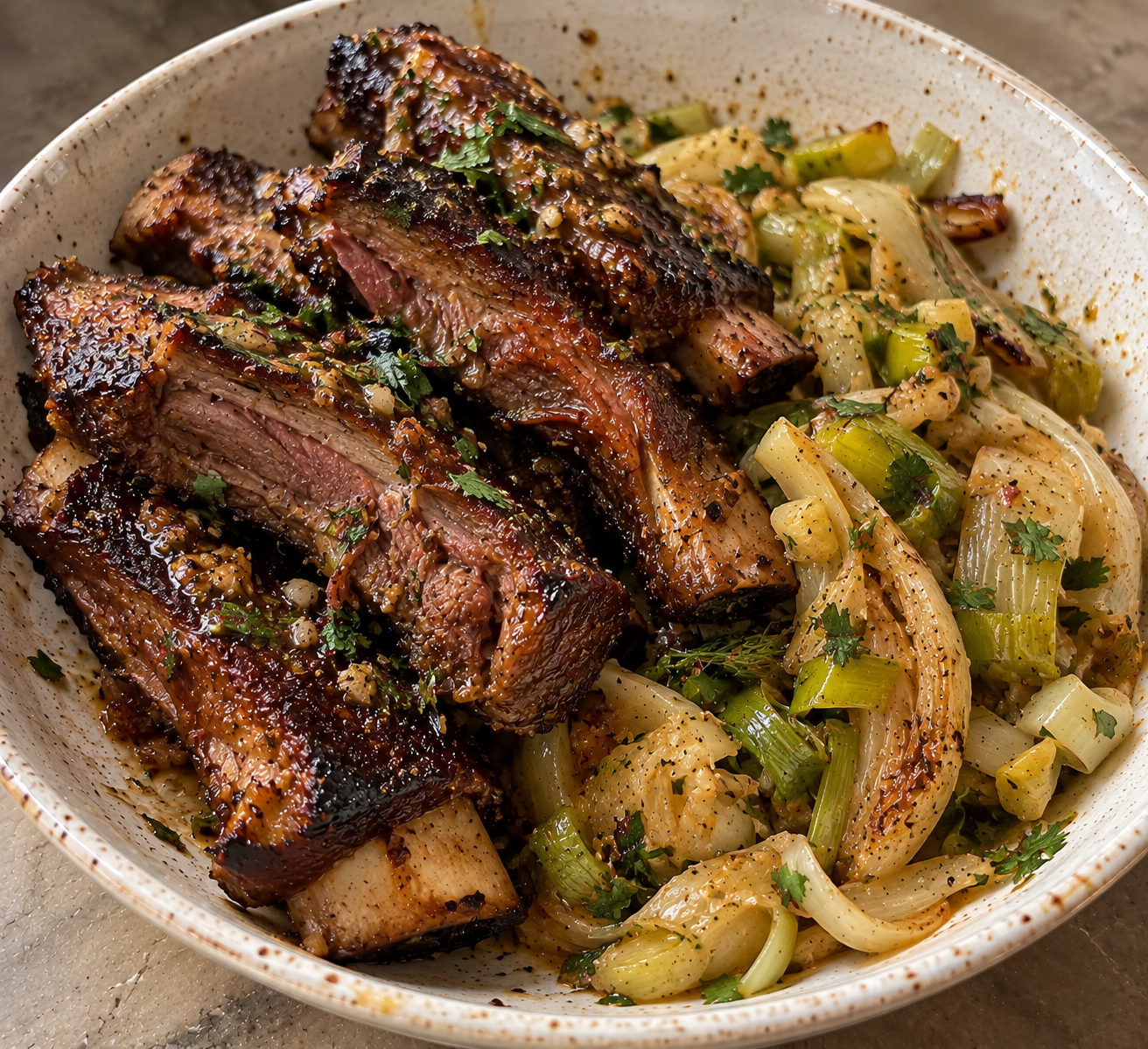
Slow-roasted grass-fed beef back ribs with a smoky spice rub and a glossy, savory glaze of butter, coconut aminos, apple cider vinegar, Dijon, and fresh herbs, served with silky fennel and leeks. All the satisfaction of barbecue ribs, with no sugary sauce.
Yield: Serves 4–6 · Active: 25 min · Total: about 3 hours (mostly hands-off) · Year-round, with fennel and leeks at their sweetest from fall through spring · Cuisine: American, farm-to-table · Best eaten: midday or early evening
Beef ribs are one of the most satisfying meats in the American kitchen, and one of the most often smothered. The usual treatment is a thick coat of bottled barbecue sauce (mostly sugar, corn syrup, and vinegar), grilled until it caramelizes. Almost anything tastes good coated in caramelized sugar, but it hides the meat itself.
These go the other way. The ribs are rubbed with smoked paprika, coriander, and cumin, then slow-roasted with a glaze of grass-fed butter, coconut aminos, apple cider vinegar, Dijon, and fresh herbs. There’s no added sugar, and the result tastes like real beef: deeply savory, herbal, and fall-off-the-bone tender, with a sticky, glossy glaze that’s barbecue-adjacent but far more interesting.
A note on beef back ribs: Back ribs come from the rib section, the same area as ribeye steaks. When the butcher cuts ribeyes, the bones are separated and sold as back ribs, with rich, well-marbled meat between the bones that slow-roasts beautifully. They’re different from short ribs, which come from lower on the animal and need a longer braise.
On the side: thinly sliced fennel and leeks, cooked slowly in butter until silky, with rosemary, thyme, and oregano. Their brightness and gentle anise flavor are just what the rich beef needs.
Ingredients
Ribs
2 racks grass-finished beef back ribs (about 4–5 lbs total)
1 tbsp Baja Gold sea salt
1 tsp smoked paprika (Pimentón de la Vera)
1 tsp ground coriander
1 tsp ground cumin
½ tsp black pepper
Glaze
¼ cup coconut aminos
¼ cup raw apple cider vinegar
¼ cup grass-fed butter, melted
2 tbsp whole-grain Dijon mustard
1 garlic clove, finely grated (optional)
4 sprigs fresh rosemary, leaves chopped
4 sprigs fresh thyme, leaves stripped
4 sprigs fresh oregano, leaves chopped (or 1 tsp dried)
Sautéed fennel and leeks
2 medium fennel bulbs, thinly sliced (save the fronds for garnish)
2 large leeks, white and pale green parts, thinly sliced and rinsed well
3 tbsp grass-fed butter
1 tbsp extra virgin olive oil
1 tsp each fresh rosemary, thyme, and oregano, chopped
½ tsp Baja Gold sea salt and black pepper
To finish
Chopped fennel fronds, flaky salt, fresh herb sprigs, and lemon wedges
Swaps:
Short ribs: braise 3–4 hours.
Lamb ribs: roast about 2 hours.
Dairy-free: Use olive oil or tallow instead of butter in the glaze and the vegetables.
Method
Prep. Heat the oven to 350°F, and line a rimmed baking sheet with parchment.
Remove the membrane. Flip the racks bone-side up. Slide a knife under the thin, shiny membrane at one end to loosen it, grip it with a paper towel, and pull it off. This lets the rub season the meat and keeps the ribs tender.
Season. Pat the ribs dry. Mix the salt, paprika, coriander, cumin, and pepper, and rub it into both sides. Set the racks on the baking sheet, meat-side up.
Make the glaze. Whisk the coconut aminos, vinegar, melted butter, Dijon, and garlic (if using). Set aside the chopped herbs for later. Pour about two-thirds of the glaze over the ribs, and save the rest.
Roast covered. Cover the pan loosely with foil, and roast 90 minutes. The foil keeps the meat moist and stops the glaze from burning.
Glaze and finish. Remove the foil. Stir the chopped herbs into the reserved glaze, and brush it over the ribs. Roast about 1 hour more, basting once or twice with the pan juices, until the glaze is glossy and mahogany and the meat is fall-off-the-bone tender, pulling back from the bone tips (about 195°F at the thickest part).
Cook the fennel and leeks (during the last 30 minutes). Melt the butter with the olive oil in a large skillet over medium-low heat. Add the fennel and leeks, and cook 15–18 minutes, stirring now and then, until silky and golden. Don’t rush it. Stir in the herbs, salt, and pepper for the last 2 minutes.
Rest and serve. Let the ribs rest 5–10 minutes, then cut between the bones. Pile them on a platter, spoon over some of the pan glaze, and surround them with the fennel and leeks. Finish with fennel fronds, herb sprigs, flaky salt, and lemon wedges. These are eaten with your hands, so set out plenty of napkins.
Save the drippings. Strain the pan juices into a jar, and refrigerate. Once chilled, lift off the fat on top; it keeps up to 1 month in the fridge and is wonderful for roasting vegetables. Use the jellied juices underneath within 4 days, stirred into vegetables, soups, or sauces.
Serve It With
A simple green salad, roasted baby potatoes tossed in some of the saved beef fat (see my Roasted Potatoes Four Ways), cauliflower purée (from my Velvet Vegetable Purées), or sourdough, if you eat grains. If you drink, a full-bodied red, like a Rioja or Malbec, is a lovely match; otherwise, sparkling water with lemon.
Storage
Leftover ribs: refrigerated up to 4 days, or frozen up to 2 months. Reheat covered at 300°F for about 15 minutes.
Leftover ideas: Shred the meat into tacos or lettuce wraps, toss it over a salad, or eat it cold, straight from the fridge, with mustard.
Make ahead: Mix the spice rub anytime, and whisk the glaze up to 4 hours ahead.
For a crowd: For 8–12, double the recipe, and use two sheet pans on different racks, swapping them halfway.
Nourishment Notes
Grass-finished beef ribs — heme iron, zinc, B12, and complete protein (about 30–40 grams per serving), plus more omega-3s, CLA, and vitamin E than grain-finished beef.
The slow roast — over 2½ hours, the connective tissue around the bones melts into gelatin, bringing glycine and proline, amino acids that support the skin, joints, and gut lining. They come from collagen-rich cuts like ribs, and they’re often missing from diets built on lean muscle meat.
Coconut aminos — a savory, soy-free, gluten-free seasoning made from coconut sap and sea salt, lower in sodium than soy sauce, with a gentle sweetness.
Apple cider vinegar — acetic acid and bright acidity that balance the rich meat.
Grass-fed butter — vitamins A, D, E, and K2, plus butyrate and CLA.
Whole-grain Dijon — glucosinolates from the mustard seed (a cousin of broccoli and cabbage), plus a sharp bite.
Smoked paprika, coriander, and cumin — carotenoids, plus warming spices traditionally used to support digestion.
Fennel — fiber, vitamin C, potassium, and anethole, the compound behind its licorice-like flavor. Fennel has been used around the Mediterranean for centuries to ease the digestion of rich meals, which is part of why it pairs so well with beef.
Leeks — prebiotic fiber, quercetin, and the sulfur compounds of the onion family, which support heart health.
Fresh herbs — rosemary, thyme, and oregano bring rosmarinic acid, thymol, and carvacrol, aromatic compounds studied for their antioxidant effects.
As a circadian food, this rich, protein-dense meal is best at midday or early dinner. It’s welcome year-round, and especially cozy in fall and winter.
For your cycle: With heme iron, zinc, B12, and gelatin, these ribs are especially restorative during and just after your period, and in the late luteal phase, when your body asks for warm, grounding food.
Sourcing
Beef back ribs — 100% grass-fed and grass-finished, from a local rancher, White Oak Pastures, or US Wellness Meats (frozen is fine)
Coconut aminos — organic and soy-free, like Coconut Secret
Raw apple cider vinegar — organic, with the mother (Bragg)
Grass-fed butter — organic, from 100% grass-fed cows
Whole-grain Dijon — organic, like Delouis Fils or Maison Orphée
Smoked paprika — Spanish Pimentón de la Vera DOP, like La Chinata
Spices — organic and non-irradiated coriander, cumin, and black pepper (toast whole seeds and grind them fresh, if you can)
Fennel, leeks, herbs, garlic, and lemons — organic, from a farmers’ market
Extra virgin olive oil — organic, single-estate, harvest-dated, in dark glass
Salt — Baja Gold sea salt; Maldon for finishing
— Anna aka Food Marshall