Seared Scallops with Creamed Brussels Sprouts and Crispy Pork Belly
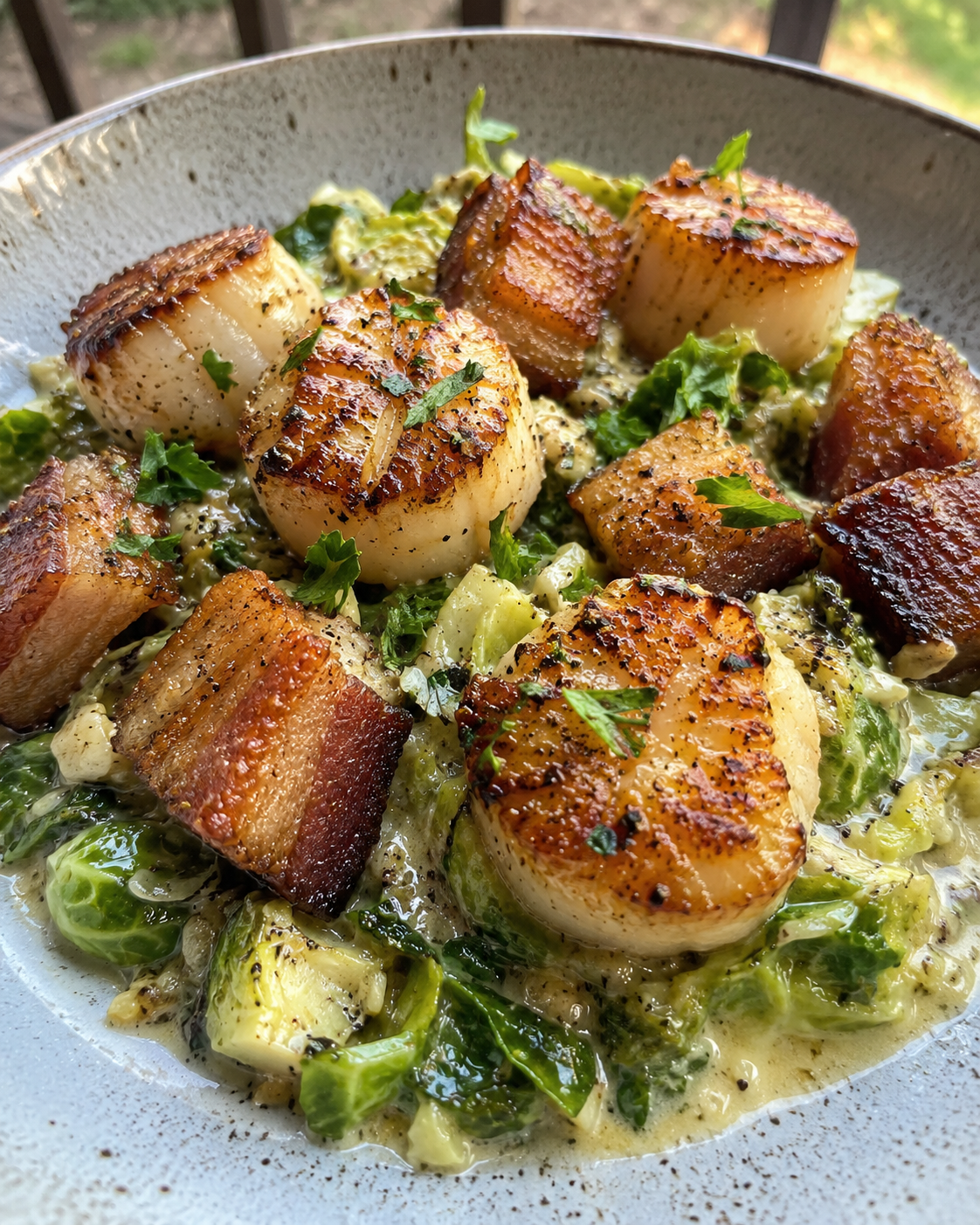
Golden seared sea scallops and chunks of crackling-crisp pork belly over silky Brussels sprouts creamed with hard cider, garlic, and parsley.
Yield: Serves 4 · Active: 45 min · Total: 2½ hours (plus an optional overnight rest for the pork skin) · December through March, when Brussels sprouts are sweetest after a frost and Maine’s hand-harvested scallop season is open · Cuisine: British farmhouse · Best eaten: early evening
Sweet, tender scallops and rich, crunchy pork belly are a classic pairing, surf and turf the farmhouse way. Here they sit on a bed of shredded Brussels sprouts simmered in hard cider and cream, a combination borrowed from the cider country of England’s West Country (Devon and Somerset), where pork, apples, and cream have always gone together. It looks like restaurant cooking, but it comes together simply: the pork roasts mostly on its own, the sprouts take 20 minutes, and the scallops cook in under 3.
Your Game Plan
The night before (optional): Salt the pork skin, and refrigerate it uncovered.
2½ hours before: Take the pork out of the fridge, and pat the skin dry.
2 hours before: Roast the pork.
30 minutes before: Shred and cream the Brussels sprouts.
5 minutes before: Sear the scallops while the pork rests.
Ingredients
Pork belly
2 lbs pasture-raised pork belly, skin on (heritage breed if you can find it)
2 tsp Baja Gold sea salt
Black pepper
Creamed Brussels sprouts
1 lb Brussels sprouts, trimmed and thinly shredded
2 tbsp grass-fed butter
2 garlic cloves, sliced
1 cup dry hard cider (or 1 cup unsweetened apple cider plus 1 tbsp raw apple cider vinegar, for alcohol-free)
¾ cup grass-fed heavy cream (raw or vat-pasteurized)
A handful of fresh flat-leaf parsley, chopped
Baja Gold sea salt and black pepper
Scallops
12 large dry sea scallops, ideally hand-dived
Baja Gold sea salt and black pepper
1 tbsp extra virgin olive oil or avocado oil
1 tbsp grass-fed butter
1 garlic clove, smashed
3–4 sprigs fresh thyme
Optional, to serve
Shaved Parmigiano-Reggiano
Chimichurri (from my Argentine Skirt Steak)
Method
Prep the pork (optional, the night before). Score the skin and fat in a crosshatch with a very sharp knife, without cutting into the meat. Rub the skin with the salt, and refrigerate the pork uncovered overnight, so the skin dries out. This is the secret to crisp crackling.
Bring to room temperature. Take the pork out of the fridge 1–2 hours before roasting, and pat the skin completely dry. (If you skipped step 1, score and salt it now.) Season with pepper.
Roast the pork. Heat the oven to 425°F. Roast the pork, skin-side up, in a roasting pan for 25–30 minutes, until the skin starts to blister. Lower the heat to 350°F, and roast about 1½ hours more, until the skin is crunchy and golden and the meat is tender. Let it rest 10 minutes, then cut it into bite-sized chunks.
Shred the sprouts. While the pork roasts, shred the Brussels sprouts thinly with a sharp knife or mandoline. If you can, do this 30 minutes before cooking them (see the Nourishment Notes).
Cream the sprouts. Melt the butter in a large heavy skillet over medium heat. When it bubbles, add the garlic, and sizzle a few seconds. Add the sprouts, season with salt and pepper, and cook 5–8 minutes, stirring, until they start to soften. Pour in the cider, and let it bubble 3–4 minutes. Add the cream, lower the heat, and simmer gently until the cream thickens and the sprouts are silky, about 5 minutes. Stir in the parsley, taste for seasoning, and keep warm.
Prep the scallops. Pull off the small, tough side muscle from each scallop, if it’s there. Pat the scallops very dry with paper towels (dry scallops brown; wet ones steam), and season with salt and pepper.
Sear the scallops. Heat a cast iron or stainless steel skillet over high heat, then add the oil. When it shimmers, add the scallops, spaced apart, and sear 1½–2 minutes, without moving them, until deep golden. Flip, and cook 30–60 seconds more.
Baste. Add the butter, garlic, and thyme. Tilt the pan, and spoon the foaming butter over the scallops for about 30 seconds. They should be just opaque in the center.
Plate. Spoon the creamed sprouts onto a platter or 4 plates, scatter the pork belly over the top, and tuck the scallops around it. Finish with shaved Parmigiano and a spoonful of chimichurri, if you like. Serve right away.
Serve It With
This is a rich plate, so a bright or earthy vegetable side balances it beautifully:
Honey-thyme roasted carrots, or my Colorful Carrots with Pepita Pesto
Celery root or cauliflower purée, from my Velvet Vegetable Purées
Roasted fennel and leeks with lemon and fennel fronds
Roasted delicata squash rings with sage and brown butter
A crisp apple-fennel slaw with lemon, olive oil, and parsley, to cut the richness
Bitter greens, like arugula, frisée, or radicchio, with apple and a cider vinaigrette
Garlicky spinach or green beans, from my Sunday Sides
Roasted root vegetables, from my Farm-to-Table Roasted Root Vegetables
Crispy roasted potatoes, from my Roasted Potatoes Four Ways
Storage
Best eaten the day it’s made, especially the scallops.
Pork belly: refrigerated up to 4 days. Recrisp the skin in a 425°F oven for 8–10 minutes.
Creamed sprouts: refrigerated up to 2 days. Reheat gently with a splash of cream.
A note on the cider: Simmering cooks off much of the alcohol, but not all of it. Use the alcohol-free swap for children or anyone avoiding alcohol.
Nourishment Notes
Sea scallops — lean protein, B12, selenium, zinc, iodine, and magnesium. Hand-dived scallops are a more sustainable choice than dredged ones: divers pick only mature scallops and leave the young ones and the seabed undisturbed, while dredges drag metal frames along the bottom and scoop up everything in their path. Hand-dived scallops are also sweeter and firmer. Whatever you buy, look for “dry” scallops, which aren’t soaked in sodium tripolyphosphate, so they sear golden instead of releasing water.
Pasture-raised pork belly — thiamine (B1), zinc, and selenium, plus more vitamin D than conventional pork, since the pigs live outdoors in the sun. Crackling pork belly is a winter classic in British cooking, and Italy’s porchetta (a rolled, herb-stuffed pork roast) uses the same idea: a blast of high heat to blister the skin, then a long, slower roast to render the fat and tenderize the meat. Dry skin is everything; even a little moisture keeps it from crackling.
Brussels sprouts — vitamins C and K, folate, fiber, and glucosinolates, which your body turns into sulforaphane, supporting estrogen metabolism. Shredding them and letting them sit 30 minutes before cooking gives the sulforaphane time to form.
Hard cider — fermented apples bring gentle acidity and a hint of sweetness that balance the cream and sprouts. The same idea is behind English pork in cider and the cider-cream sauces of Normandy. Choose a dry, unsweetened cider, not a sugary one.
Grass-fed cream and butter — vitamins A, D, E, and K2, plus butyrate.
Garlic, thyme, and parsley — allicin, thymol, vitamin K, and vitamin C.
As a circadian food, this rich, celebratory dinner is best eaten early in the evening. As a seasonal food, it’s made for the depths of winter, when Brussels sprouts are sweetest after a frost.
For your cycle: With zinc, selenium, and iodine from the scallops and glucosinolates from the sprouts, which support estrogen metabolism, this is a lovely meal in the follicular and luteal phases.
Sourcing
Scallops — dry (untreated) sea scallops, ideally hand-dived, from a trusted fishmonger or Maine seafood source (Maine’s hand-harvest season runs December through April)
Pork belly — pasture-raised, skin on, ideally a heritage breed, from a local farm or butcher
Brussels sprouts, garlic, thyme, and parsley — organic, from a farmers’ market (sprouts on the stalk stay freshest)
Hard cider — dry and unsweetened, from a local cidery, or organic unsweetened apple cider for alcohol-free
Heavy cream and butter — grass-fed and organic; vat-pasteurized cream (avoid ultra-pasteurized)
Parmigiano-Reggiano (optional) — DOP, aged 24 months or more
Extra virgin olive oil or avocado oil — organic, cold-pressed, in dark glass
Salt — Baja Gold sea salt; Maldon for finishing
— Anna aka Food Marshall