Beef Zucchini Lasagna with Swiss Chard and Goat Cheddar
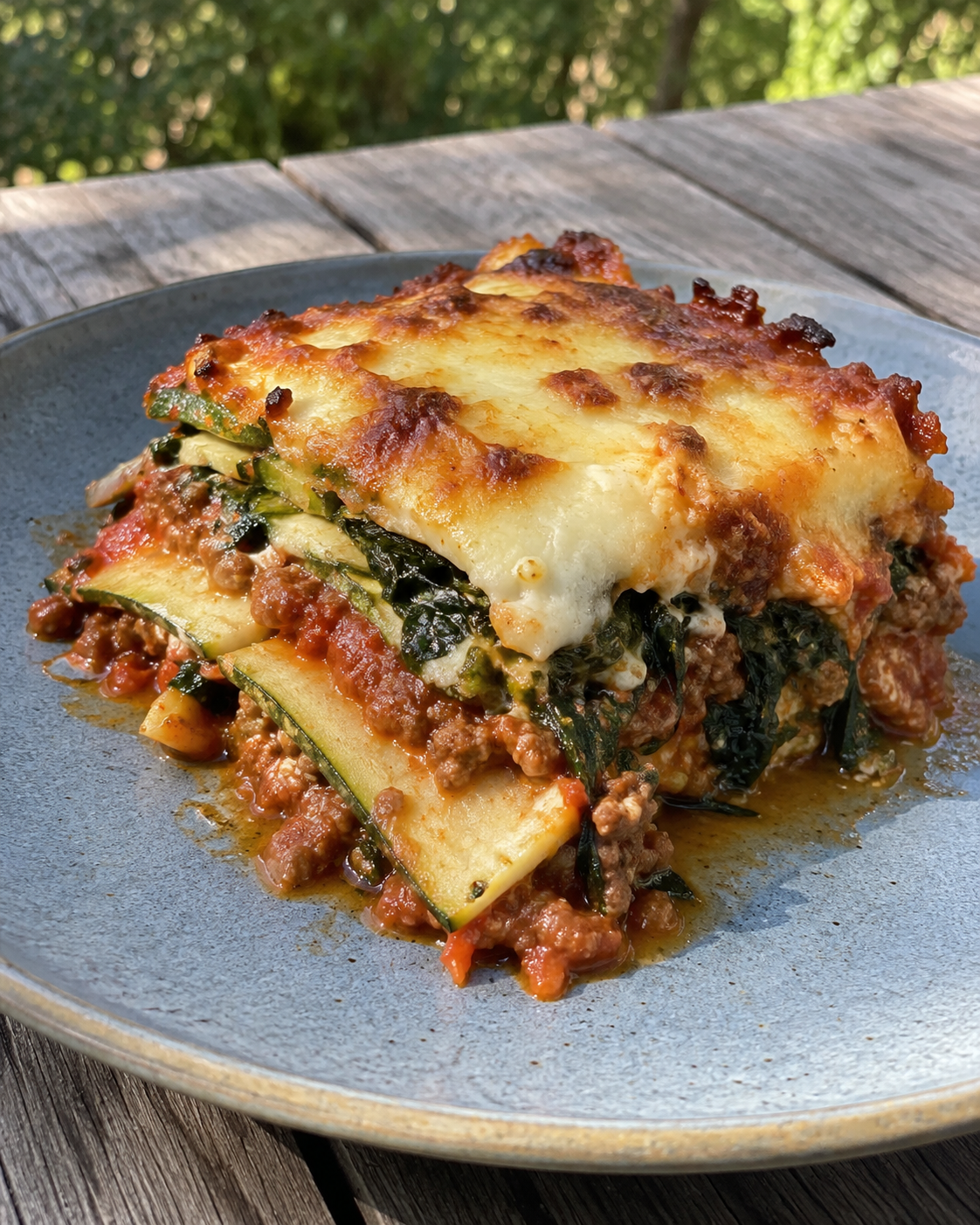
A grain-free baked lasagna with zucchini “noodles,” lightly spiced grass-fed beef in marinara, a layer of garlicky Swiss chard, and melted goat cheddar.
[hero image — slice of lasagna showing layered zucchini, beef, and chard, golden cheese top]
Serves 6 · Active: 1 hour · Total: 1 hour 45 minutes · Year-round, with zucchini and chard at their best from June through September · Best eaten: early evening
This is the family-style, make-ahead version of zucchini lasagna: one big baked dish you can slice, freeze, and reheat all week. Zucchini stands in for pasta, a layer of garlicky Swiss chard adds a big serving of greens, and goat’s milk cheddar melts into a golden top.
More avorites:
Summer Zucchini Lasagna Stacks
Zucchini Ravioli and Involtini.
Ingredients
Zucchini noodles
4–5 medium zucchini
1 tsp Baja Gold sea salt
Chard
2 tbsp avocado oil or extra virgin olive oil
4 garlic cloves, pressed (about 1 tbsp plus 1 tsp)
1 tsp Baja Gold sea salt
2 bunches Swiss or rainbow chard, stems removed, leaves cut into thin strips
1 tbsp lemon juice
Beef filling
1½ tbsp avocado oil or extra virgin olive oil
2 tsp minced seeded jalapeño (optional)
3 garlic cloves, pressed (about 2 tsp)
2 tsp chili powder
1 tsp smoked paprika
1 tsp dried oregano
1 tsp onion powder
1½ lbs grass-fed ground beef (or pasture-raised ground turkey)
1½ cups no-sugar-added marinara sauce
1 cup fresh basil leaves, chopped
1¼ tsp Baja Gold sea salt
1 tsp black pepper
Cheese and garnish
6 oz goat’s milk cheddar, finely grated (about 1½ cups)
¼ cup thinly sliced fresh basil
Method
Prep. Heat the oven to 400°F, and line two baking sheets with parchment.
Slice the zucchini. Trim the ends, and slice the zucchini lengthwise on a mandoline into ¼-inch strips, like lasagna noodles. You’ll want about 22 strips.
Salt and blot. Lay the strips on the sheets in a single layer, sprinkle with the salt, and let them sit 15 minutes. Blot them well with paper towels.
Pre-bake. Bake 15 minutes, rotating the sheets halfway, until tender and slightly dry. (This is the secret to a lasagna that isn’t watery.) Lower the oven to 375°F.
Cook the chard. Heat the oil in a large sauté pan over medium heat until shimmering. Add the garlic and salt, and cook 30 seconds, stirring. Add the chard in batches, stirring until it all wilts, 2–3 minutes. Lower the heat, stir in the lemon juice, and transfer to a colander to drain. Press out any extra liquid.
Bloom the spices. Heat the oil in a sauté pan over medium-low heat. Add the jalapeño (if using), garlic, chili powder, paprika, oregano, and onion powder, and cook 2 minutes.
Cook the beef. Raise the heat to medium, add the beef, and cook about 8 minutes, breaking it up as it cooks, until browned. Stir in the marinara and basil, cook 2 minutes more, and season with salt and pepper.
Layer. In an 8×8 baking dish, layer:
a layer of zucchini, then half the beef
another layer of zucchini, then all the chard, then ½ cup of the cheddar
the remaining zucchini, the remaining beef, and the remaining 1 cup cheddar on top
Bake 25–30 minutes, until bubbly and the cheese is golden.
Rest 15 minutes, so it slices cleanly. Garnish with fresh basil.
Storage
Refrigerator: up to 4 days. Reheat individual portions at 350°F for about 12 minutes.
Freezer: Freeze individual slices up to 3 months. Thaw overnight in the fridge before reheating.
Make ahead: Assemble the lasagna up to 1 day ahead, cover, and refrigerate. Add 10 minutes to the bake time.
Nourishment Notes
Why pre-bake the zucchini? Zucchini is about 95% water. Salting, blotting, and pre-baking it draws out much of that water first, so the lasagna sets up properly, instead of turning soupy as it bakes.
Grass-fed beef — heme iron, zinc, B12, and complete protein, plus more omega-3s and CLA than grain-fed beef.
Swiss chard — vitamins K, A, and C, magnesium, and potassium. It adds a big serving of dark leafy greens, and its gentle bitterness balances the rich meat and cheese. Italy’s lasagne verdi adds spinach for the same reason. Chard sautéed with garlic, lemon, and olive oil is one of the simplest Mediterranean ways to cook greens.
Zucchini — vitamin C, potassium, and lutein, light and hydrating.
Goat’s milk cheddar — calcium, protein, and vitamin K2, with a milder, slightly tangy flavor that lets the zucchini and chard shine. Many people who are sensitive to cow’s milk find goat cheese easier to digest. If you can’t find it, aged Manchego or another aged sheep’s milk cheese works well.
Tomatoes, garlic, and basil — lycopene (better absorbed when cooked with fat), allicin, and aromatic polyphenols.
As a circadian food, this is a comforting early dinner: protein, greens, and vegetables, without the heaviness of pasta.
For your cycle: The heme iron and B12 make this especially restorative during and just after your period, and the chard’s magnesium supports the luteal phase.
Sourcing
Ground beef — 100% grass-fed and finished, from a local farm or White Oak Pastures
Ground turkey (optional) — pasture-raised, from a local farm
Zucchini, chard, basil, garlic, jalapeño, and lemons — organic, from a farmers’ market
Marinara — organic, with no added sugar, in glass, like Rao’s (or homemade)
Goat’s milk cheddar — from a local creamery, or a specialty grocer
Avocado oil or extra virgin olive oil — organic, cold-pressed, in dark glass
Spices — organic and non-irradiated
Salt — Baja Gold sea salt
— Anna aka Food Marshall